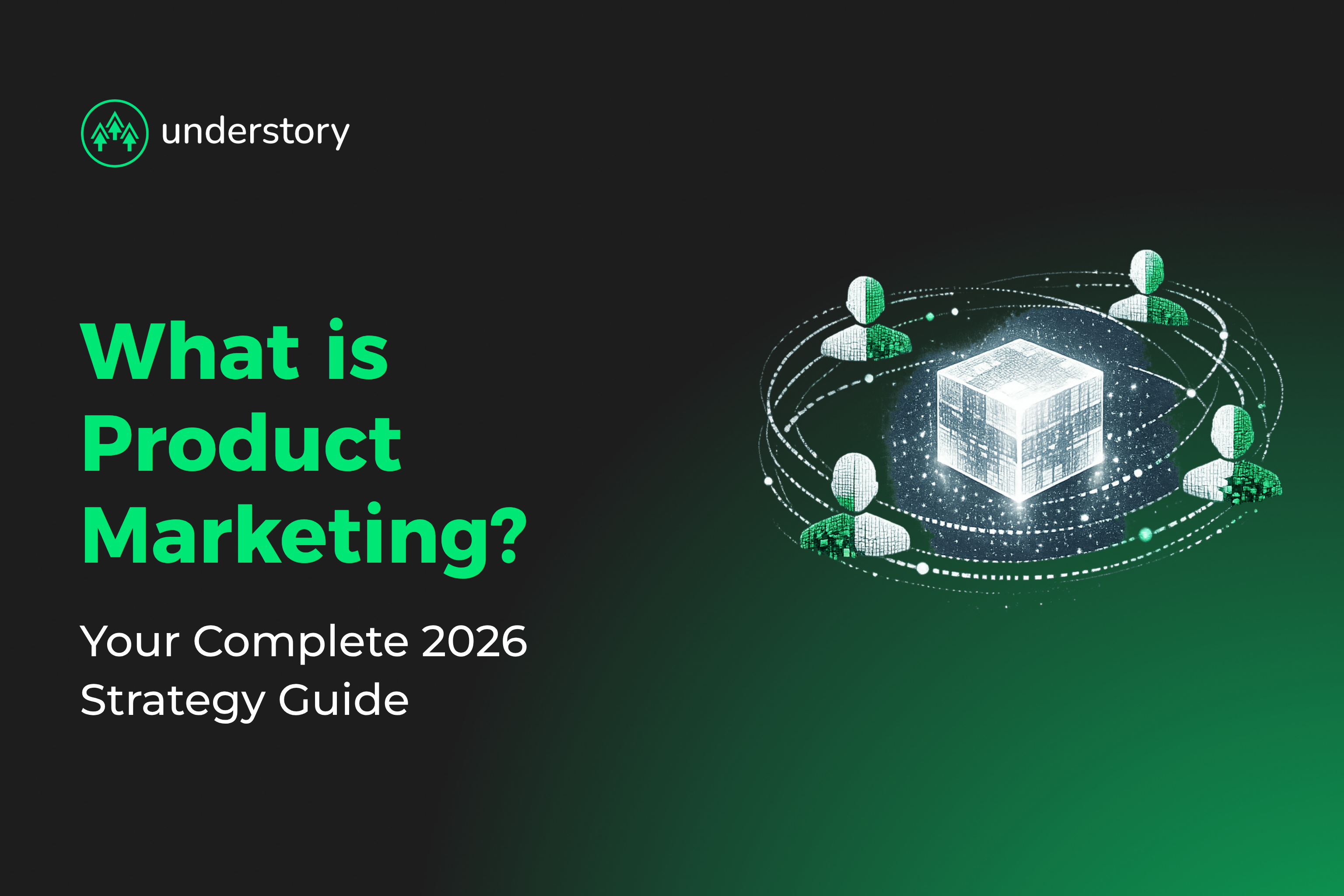
Product marketing is the function that connects what your product does to why buyers should care about it now. It owns positioning, messaging, go-to-market strategy, sales enablement, and competitive intelligence. Every channel your team runs, including paid media, outbound, and sales, executes against the narrative product marketing defines.
For B2B SaaS companies with $20K–$100K+ ACVs, the challenge is rarely a lack of product marketing thinking. It is getting that thinking to carry consistently across every touchpoint. When paid media says one thing, outbound another, and sales a third in the demo, buyers notice the gap. That inconsistency slows the pipeline and complicates forecasting.
This guide covers what product marketing actually does in modern SaaS, what has shifted heading into 2026, and how coordination between the function and GTM execution determines whether it delivers results.
Product marketing defined for B2B SaaS
Product marketing sits at the intersection of product, sales, and marketing. It defines what you say, who you say it to, and why it matters. Demand generation distributes that message. Content builds educational engagement around it. Sales uses it to move deals forward.
The function spans five core areas: market discovery, GTM planning, persona and journey definition, sales enablement, and retention and expansion support. In high-ACV SaaS, each area requires coordination across teams that typically work in silos.
When product marketing works, positioning is sharp, messaging is consistent across channels, and sellers know exactly how to frame the product for each stakeholder. When it is absent or fragmented, the buyer experience reflects that.
Why product marketing matters more in 2026
Three shifts explain the growing pressure on product marketing in high-ACV SaaS.
Coordinated execution raises pipeline quality
Aligned messaging and timing produce cleaner handoffs, stronger sales conversations, and better conversion at each stage. When channels operate independently, prospects get a fragmented story and qualification suffers.
Buyers do more independent research before engaging sales
B2B buyers now complete a significant portion of their evaluation before speaking to a sales rep. That means positioning has to work across content, paid media, and outbound long before a sales conversation begins.
Multi-stakeholder deals require persona-specific messaging without a fragmented core story
Technical evaluators, business sponsors, and economic buyers all need different proof points. Product marketing coordinates that work while keeping the narrative consistent across every channel.
Core responsibilities in high-ACV SaaS
Here’s what's most important responsibilities in high-ACV SaaS.
Positioning and messaging
Positioning sets the direction for everything that follows. A practical framework answers a few key questions:
- What alternatives buyers actually compare you against
- Which attributes truly differentiate your product
- How those attributes translate into outcomes buyers care about
- Which personas care most about those outcomes
- What category context makes your strengths obvious
For $20K–$75K+ ACV products with multi-stakeholder buying committees, this work must support persona-specific messaging while keeping the core story consistent. Technical evaluators and economic buyers need different proof points, but the underlying narrative cannot shift between channels.
Go-to-market strategy
Strong GTM strategy turns positioning into coordinated execution. In complex SaaS, that typically means building around four foundations: clear personas with distinct pains and buying triggers, buyer journey maps showing what each stakeholder needs at each stage, messaging tailored by audience and funnel position, and cross-functional timelines aligning marketing, sales, product, and customer success.
One frequently overlooked element: GTM strategy should follow buyer timing, not just internal launch timing. Regulatory changes, budget cycles, renewal windows, and system migrations often create stronger entry points than product release calendars.
Sales enablement
Without formal enablement, sales teams learn about new capabilities too late. In some cases, customers tell reps about new features before the company does.
Effective enablement in high-ACV SaaS maps to the actual sales process:
- Discovery: ICP qualification frameworks, problem framing, and initial value proposition decks
- Technical evaluation: Demo scripts, implementation narratives, and proof-of-concept success criteria
- Business case: ROI calculators, executive summaries, and internal champion materials
- Commercial negotiation: Battle cards, objection handling, and pricing and packaging guidance
The key shift is workflow integration. Enablement should surface where sellers already work, not sit in a static repository no one opens during a live deal. That is one reason AI-assisted playbooks are gaining traction: they surface the right message, proof point, or objection response in context, during the conversation that matters.
Competitive intelligence
Competitive intelligence goes beyond a battle card. It should help sellers and buyer champions navigate three specific moments: initial evaluation, technical validation, and commercial negotiation.
For enterprise SaaS with long sales cycles, competitive positioning needs regular updates. New features, pricing changes, analyst narratives, and category shifts all affect how your product should be framed. Product marketing should also create champion-ready materials, such as ROI tools, briefing documents, and internal decks, so buyers can sell internally when you are not in the room.
Key trends reshaping product marketing in 2026
Here’s what will reshape product marketing in 2026.
AI is transforming workflows, not replacing the function
AI is changing how buyers research vendors and how sellers prepare for conversations. For product marketers, the shift means less time producing one-off assets and more time building reusable messaging systems.
A few practical implications:
- Buyers increasingly use AI tools to compare vendors before engaging sales, which raises the bar for clarity in all top-of-funnel content
- Content needs to work for both human readers and AI-assisted research workflows
- Teams with organized, well-structured messaging can deploy it more effectively across tools and channels
Product marketing still owns the core work. AI changes the workflow, not the need for clear positioning or the enablement work that supports those who sell.
The hybrid buyer engagement model
Buyers want self-service research, but they still need guided expertise in complex purchases. A realistic product marketing strategy for 2026 supports both: educational content for independent research, clear handoffs into sales, and touchpoints where human interaction helps buyers evaluate risk, build consensus, and move toward a decision.
When those moments align, the buying experience feels coherent. When they do not, buyers disengage or slow down at exactly the wrong stage.
Product-led growth requires category-specific execution
PLG is not one playbook. What works for an analytics tool often fails for a security platform with implementation, compliance, or procurement complexity.
Product marketing acts as the bridge between product experience and GTM strategy in PLG models. It shapes in-product messaging, trial-to-paid conversion paths, expansion triggers, and the handoff between product signals and sales action. Without it, PLG motions generate volume without the qualification or education buyers need to convert.
Product marketing vs. demand gen vs. content marketing
These functions work best when the division of responsibility is clear:
- Product marketing defines what to say, to whom, and why it matters
- Demand generation distributes that message through campaigns, channels, and lead generation programs
- Content marketing creates educational assets that build trust and help buyers learn over time
None operate effectively in isolation. Product marketing gives the GTM team a shared narrative. Demand gen and content extend it into market-facing execution.
The line between product management and product marketing is also closer than many teams expect. In modern SaaS, roadmaps, launches, and market narratives need to stay aligned, or buyers receive a confusing story across every touchpoint where they encounter the product.
Scale product marketing execution with Understory Agency
Product marketing only delivers results when the messaging it defines reaches buyers consistently across paid, outbound, and sales. That coordination gap is what most SaaS growth teams actually struggle with: the strategy exists, but execution across channels is fragmented.
Understory's allbound model is built for exactly that. We help B2B SaaS companies with $20K+ ACVs carry positioning and messaging consistently across strategic paid media, Clay-powered outbound, and professional creative so every touchpoint reinforces the same narrative. One partner, one coordinated motion, less overhead.
Schedule a demo to see how Understory closes the gap between product marketing strategy and coordinated GTM execution.
Related Articles

Have this running in your pipeline this quarter
We build it, we run it, and every result lands in your CRM.