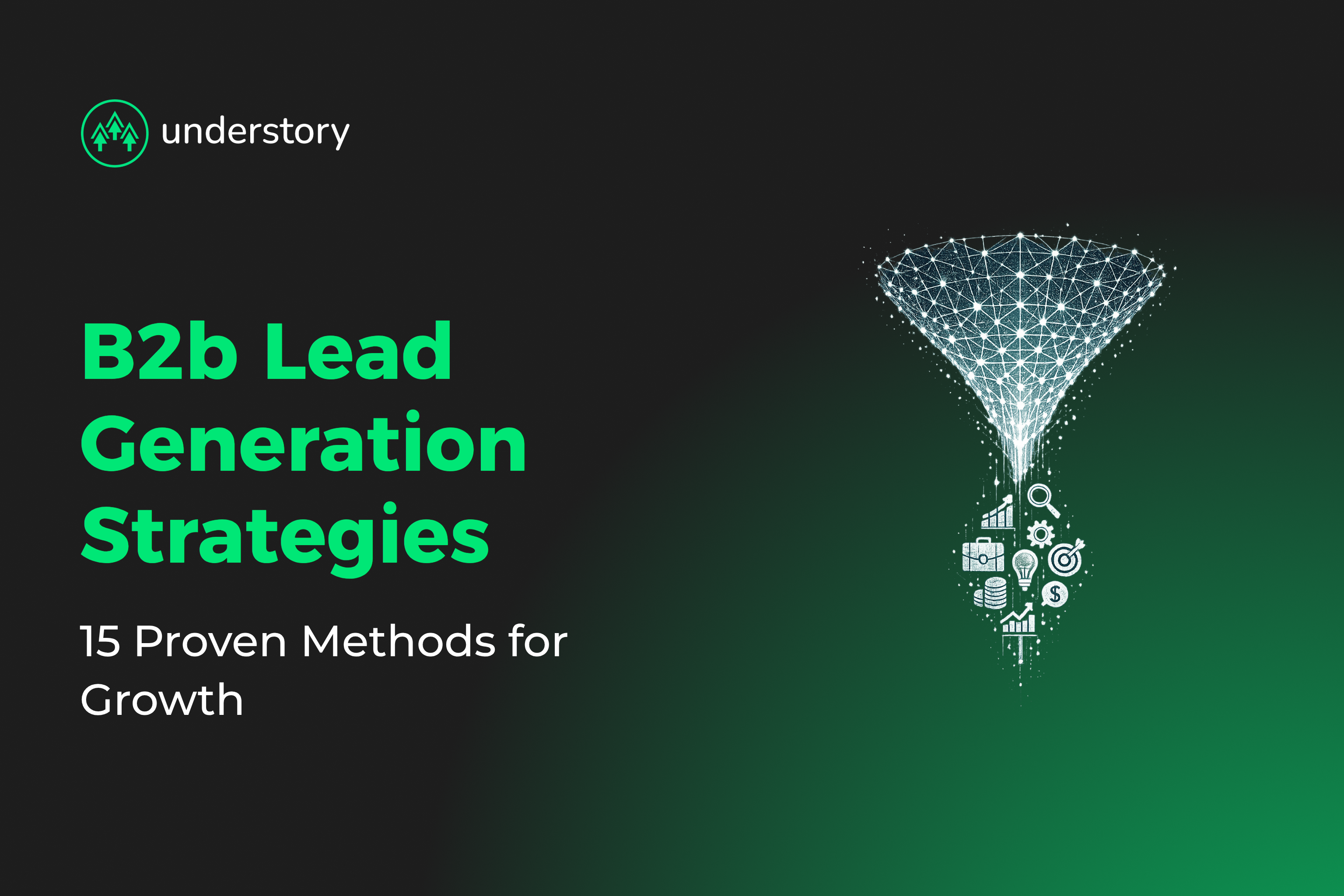
B2B lead generation is the process of identifying, attracting, and converting high-fit buyers into qualified pipeline opportunities. For SaaS companies selling $20K+ contracts to buying committees, that process is more complex than most guides acknowledge.
The real challenge is not finding strategies. It is generating qualified opportunities across paid media, outbound, content, and sales, consistently, without spending more time managing vendors than optimizing campaigns.
Here is what B2B lead generation looks like for scaling SaaS: 15 strategies that drive pipeline and not just MQLs.
The B2B lead generation process for high-ACV SaaS
The standard framework is the Demand Waterfall: Inquiry → MQL → SAL → SQL → Opportunity → Revenue.
MQL-to-SQL conversion rates vary widely by company, methodology, and how tightly teams define qualification stages. For SaaS growth leaders, the takeaway is simple: lead volume without strong qualification and routing is expensive waste.
In practice, the process usually breaks in a few predictable places:
- Marketing drives form fills that sales would never prioritize.
- Sales follows up too slowly, or without context from paid and content touchpoints.
- Buying committee members see different messages across ads, outbound, and landing pages.
- Intent signals appear in one system but never reach the team that should act on them.
Every strategy below is filtered through one lens: qualified pipeline over lead volume.
Account-based precision
Here are some account-based strategies that your team can follow.
1. ABM with buying committee personalization
Enterprise technology purchases often involve large buying groups with multiple stakeholders. ABM can improve account engagement and conversion, but only when messaging stays aligned across the touchpoints buyers actually see: ads, emails, sales outreach, and landing pages. When those channels run through separate vendors, the alignment breaks down.
2. Multi-stakeholder engagement mapping
Stop engaging one champion and hoping they sell internally. Map each buying committee member, including technical evaluators, financial decision-makers, and executive sponsors, then build role-specific engagement sequences for each. This is standard practice in larger B2B deals, where internal consensus often determines outcomes more than any single stakeholder.
For this to work, the paid media team, outbound team, and sales team need the same account intelligence and campaign timing.
3. Precision ICP definition with firmographic and technographic filters
Many SaaS teams target too broadly because their ICP is too generic. Better targeting starts with stronger account selection: firmographics, technographics, role fit, and buying signals that reflect how best customers actually buy. When that data is shared across paid, outbound, and sales, teams can focus budget on accounts with a real chance of becoming pipeline.
AI-powered pipeline acceleration
Here’s how you can leverage AI to accelerate your pipeline.
4. AI agents for prospecting and qualification
Many SaaS growth teams are already using AI to expand prospecting capacity and speed up early qualification. The practical use case is straightforward:
- AI handles high-volume prospecting.
- AI supports initial qualification.
- Human sellers focus on the complex, relationship-driven work that $20K+ deals require.
Used well, AI expands seller capacity without replacing judgment.
5. Generative AI for sales productivity
AI can speed up research, personalization, and follow-up. But adoption alone is not the advantage. The real lift comes from feeding AI the context generic tools do not have: customer data, intent signals, account history, competitive positioning, and approved messaging. Without that context, AI produces faster output, not better output.
6. AI governance as deal protection
Ungoverned AI creates real downside risk. For SaaS companies selling to sophisticated buyers, one inaccurate claim or sloppy AI-generated email can damage trust fast. Governance should cover approved use cases, message review, claim validation, and clear ownership across marketing and sales.
Demand generation architecture
Focus on optimizing your demand generation architecture with these strategies.
7. Demand creation vs. demand capture rebalancing
This is one of the highest-leverage adjustments many SaaS teams have not made. When teams over-invest in demand capture, a few things consistently happen:
- CAC rises as teams compete on the same keywords and channels.
- Paid efficiency gets harder to sustain.
- Pipeline becomes too dependent on buyers already in the market.
Demand creation through thought leadership, brand, and education builds compounding inbound momentum that demand capture alone cannot replicate.
8. Thought leadership pre-nurture
Running thought leadership and engagement campaigns before conversion-focused campaigns can improve buyer education and sharpen downstream targeting. This matters most for products with $30K+ ACVs, where unqualified ad spend is costly and buyers need context before they are ready to speak with sales.
9. Sustained buying-group coverage
For complex B2B deals, consistency matters more than bursts of campaign activity. Sustained, role-relevant messaging across the full decision cycle keeps your brand visible as internal consensus forms, especially for enterprise deals that span multiple quarters.
Multi-channel execution
Leverage multiple channels with allbound execution to grow your pipeline.
10. Coordinated outbound across email, LinkedIn, and phone
Coordinated campaigns across email, LinkedIn, and phone outperform single-channel outreach because they meet buyers where they already are. Running those channels through separate vendors on separate timelines creates a fragmented experience. A stronger motion looks like this:
- A prospect sees a relevant LinkedIn ad.
- They receive a personalized email tied to a role-specific pain point.
- They receive a follow-up call that builds on both, within a deliberate cadence.
Most SaaS growth teams understand the model. Fewer execute it consistently because the coordination overhead falls through the cracks between vendors.
11. LinkedIn ads with long-cycle commitment
LinkedIn ads can work for high-ACV SaaS, but only with a commitment to the full timeline and a connection to a broader account-based motion. Enterprise buying cycles are long, and paid social rarely converts in isolation. Treating LinkedIn as one layer in a broader motion, rather than a standalone demand engine, is what separates teams that see ROI from those that write it off.
12. Intent signals and rapid response routing
When a target account shows buying signals, response speed affects conversion. Common signals include pricing page visits, demo requests, repeat visits from multiple stakeholders, and engagement with late-stage content. To act on those signals, marketing and sales need shared MQL and SQL definitions, automated routing, and response-time SLAs. Otherwise, high-value intent stays in reports instead of turning into pipelines.
Content and positioning
Optimize your content and messaging to generate more leads.
13. Executive thought leadership for pre-sales education
B2B buyers increasingly prefer self-directed research before speaking with sales. For technical SaaS products, content does much of the selling before sales gets involved. Strong pre-sales content helps buyers do four things:
- Understand the problem in concrete terms.
- Compare tradeoffs between approaches.
- See what implementation requires.
- Evaluate whether the outcome justifies the change.
For technical SaaS products, that means deep expert content, not surface-level blog posts. Better pre-sales education produces better sales conversations and stronger pipeline quality.
14. AI-optimized brand presence for zero-click search
AI-generated summaries are changing how buyers discover vendors. B2B SaaS brands should optimize for inclusion through structured content, strong topic authority, and consistent positioning, not just traditional search rankings.
15. Value-based selling with co-created outcomes
High-ACV SaaS deals often stall when value is discussed too loosely. Stronger programs give buyers concrete ways to evaluate impact: ROI models, implementation roadmaps, and outcome benchmarks that hold up under committee scrutiny. Without that structure, many teams fall back to discounting when buyers push for harder justification.
Why coordination is the real strategy
Each strategy above can move the needle. The issue is execution across channels and teams. The most common breakdowns look like this:
- ABM without coordinated creative creates inconsistent buyer experiences.
- Multi-channel outbound without aligned paid media weakens message recall and wastes ad spend.
- AI-powered prospecting without governance introduces risk.
- Thought leadership without conversion infrastructure creates awareness that never becomes a pipeline.
- Intent-based routing without fast follow-up leaves high-value signals untouched.
Most SaaS growth leaders already know the tactics. The harder part is replacing fragmented vendor management with expert allbound execution that coordinates paid media, outbound, and creative under one growth strategy. For scaling SaaS, the problem is not a lack of strategies. It is inconsistent execution across the ones that already work.
Build your B2B lead generation engine with Understory Agency
Generating a qualified B2B pipeline requires more than running the right tactics. It requires paid media, outbound, and creative execution from the same playbook, on the same timeline, with consistent messaging at every touchpoint.
Understory coordinates strategic paid media management across LinkedIn, Meta, Google, and Reddit, Clay-powered outbound built for high-ACV SaaS, and professional creative that supports the full buying journey, all under one growth partnership. Clients like Rivial Security scaled from $20K to $70K monthly ad spend while maintaining performance. RemoFirst replaced their entire internal SDR team. Yofi generated so many qualified leads they had to pause outbound to catch up with sales capacity.
Schedule a consultation to see how coordinated allbound execution drives a qualified pipeline for your SaaS.
Related Articles

Pipeline that compounds
Paid, outbound, content, creative and RevOps as one system. Same team, same ICP, same messaging.