ICP scoring comes down to three things: does this account fit, are they paying attention, and is something forcing their hand right now? A SaaS selling to mid-market assigns points for employee count, tech stack overlap, and recent funding. Behavioral scores track content engagement and outbound responses. The rubric should disqualify fast, not just prioritize well.
SaaS teams often score leads using different criteria across sales, marketing, and RevOps. Marketing automation may apply one definition of "qualified," CRM uses another, and outbound operates from a third. The result is pipeline friction, wasted SDR cycles, and qualified prospects slipping through the cracks.
This guide shows you how to build, automate, and refine an ICP scoring rubric that flags the deals most likely to close. It uses seven predictive dimensions: firmographic fit, technographic overlap, intent signals, engagement behavior, buying triggers, economic outcome, and negative signals that disqualify fast.
Core scoring dimensions explained
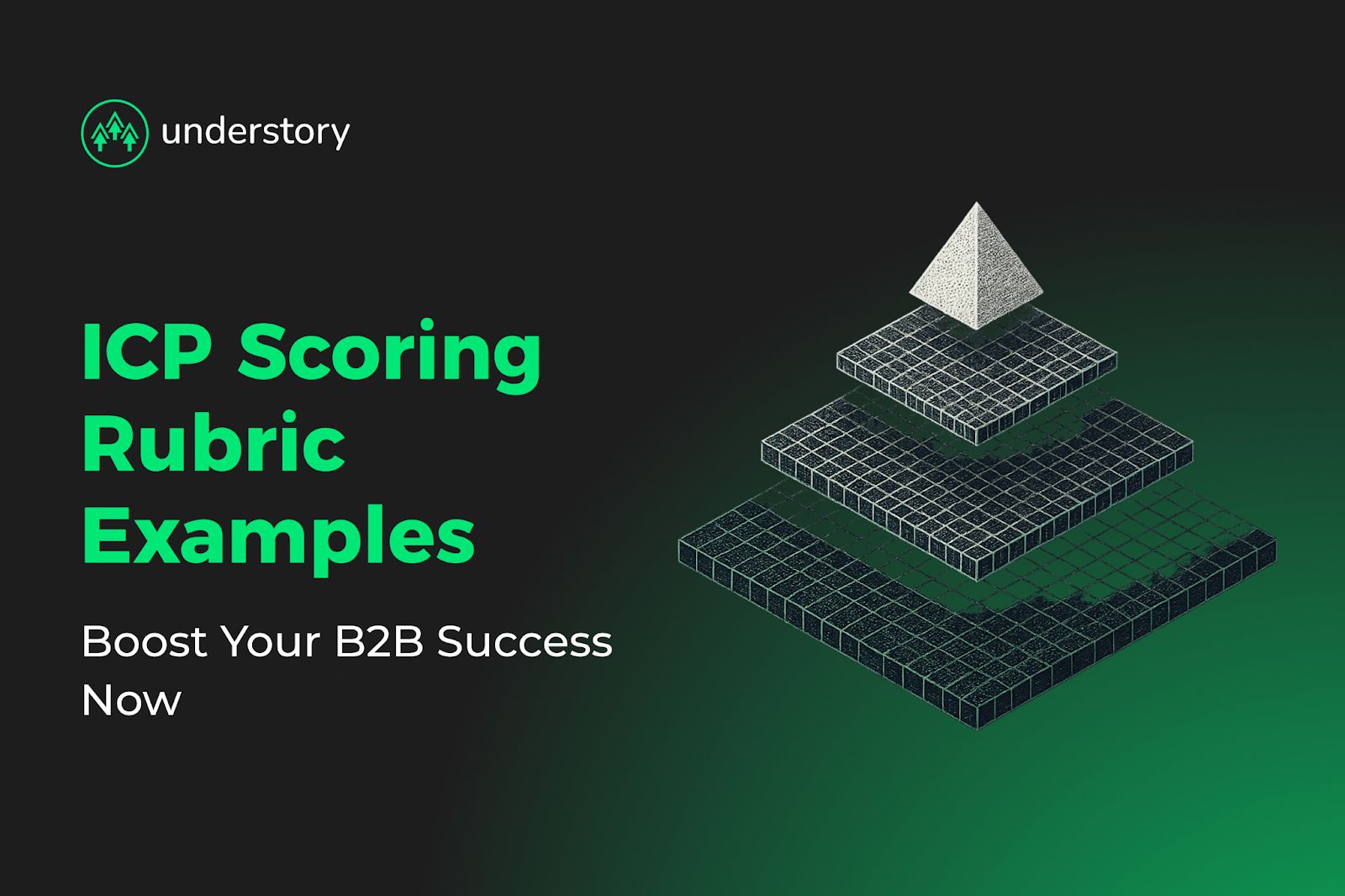
Seven dimensions predict close probability. Separate fit, intent, and engagement so CRM data turns into a 0–100 score.
- Firmographic fit forms your foundation: industry, employee count, and funding stage. Companies that mirror your strongest customer cohort should carry the most weight. If your close-won analysis shows 70% of ARR comes from fintech firms between 200–1,000 employees, weigh that segment highest.
- Technographic fit examines the stack your product plugs into. Shared infrastructure or complementary platforms can reduce implementation friction and support faster time-to-value.
- Intent signals answer a simple question: is this account already researching a solution like mine? Track third-party surges on review sites, keyword clusters, or partner marketplaces. Layering third-party intent data on top of firmographics can improve MQL-to-SQL rates by flagging buyers before competitors do.
- Engagement activity reveals momentum you can nurture into pipeline. Web sessions, demo requests, pricing-page views, and email replies show prospects ready to move.
- Buying triggers create immediate urgency. Funding rounds, leadership changes, or new compliance mandates often force fresh budgets. They align your outreach with an internal mandate to act.
- Economic outcome covers projected ACV and lifetime value. Prioritizing high-LTV accounts can lift gross margin even if topline logo count stays flat.
- Negative signals tell you who to remove from pipeline before they waste cycles. Score deductions for disqualifying traits like wrong industry, no budget authority, or an active competitor contract keep your pipeline honest.
Stack all seven into a 100-point rubric. High scorers close faster and expand more.
Designing and weighting the rubric table
Your raw ICP attributes should become a 0–100 score that drives immediate GTM strategy.
Fair warning: getting your first rubric right usually takes iteration. Most teams overthink the weights and underthink the disqualifiers.
Build a three-row structure: Ideal, Acceptable, and Low Fit. Each row assigns point values an account earns within every dimension. Add a negative column for disqualifiers that subtract points regardless of fit.
| Dimension | Weight (%) | Ideal (pts) | Acceptable (pts) | Low Fit (pts) |
| Firmographic Fit | 25 | 10 | 6 | 2 |
| Technographic Fit | 20 | 10 | 5 | 1 |
| Intent Signals | 15 | 10 | 5 | 0 |
| Engagement Activity | 15 | 10 | 4 | 0 |
| Buying Triggers | 10 | 10 | 3 | 0 |
| Economic Outcome (ACV) | 10 | 10 | 5 | 1 |
| Negative Signals | 5 | 0 | 0 | −15 |
Total Score = Σ(weight × value).
The negative signals row is where most teams underinvest. Without role-weighting, an intern opening 10 emails could outscore a VP requesting one demo. Negative scoring prevents that distortion.
Keep the rest of the weighting process simple:
- Pull twelve months of closed-won and closed-lost deals.
- Calculate average win rates for accounts with strong firmographic fit, high intent scores, and the other dimensions.
- Give heavier weight to dimensions with stronger historical correlation to wins.
- Test draft weights with marketing, sales, and RevOps before turning the model loose.
That gives you a starting model grounded in both CRM data and frontline reality.
Quantitative vs. qualitative scoring criteria
Keep these two categories separate in your scoring model.
- Quantitative criteria are attributes you can pull directly from enrichment tools: industry codes, employee count, revenue range, tech stack, and geography. Binary or categorical. The account either matches your ICP firmographics or it doesn't.
- Qualitative criteria require interpretation: website engagement patterns, email reply sentiment, social media interactions, and NPS scores from existing customers. Harder to automate, but often more predictive of deal progression than firmographic checkboxes alone.
- Use them differently: quantitative criteria populate your fit score. Qualitative criteria feed your engagement score.
When you keep them distinct, you can quickly spot high-fit accounts that need a nudge versus low-fit visitors burning bandwidth.
Adapt weights to your growth motion
Different motions need different weights. Expansion-focused SaaS companies often prioritize economic outcomes over engagement signals. Early-stage product-led teams emphasize real-time usage signals. Re-run win-rate analysis quarterly.
Layering behavioral and intent signals
After fit, this is the part that tells you whether they will buy.
Most scoring projects stall here. Behavioral data is messy, decays fast, and looks different in every CRM.
Use three rules:
- Fit stays stable.
- Engagement decays fast.
- Behavioral signals should lose 10–20% of their value every 30 days of inactivity.
If you're not on HubSpot, build the same logic with workflow automation.
Start with a simple baseline scale:
- Pricing page visit: +10
- Case study download or webinar attendance: +8
- G2/Gartner research activity: +7
- Demo request: +30
- Unsubscribed from emails: −15
- Bounced from homepage (no further engagement): −5
The exact numbers matter less than their relativity. Calibrate these values against your closed-won data. Weight by role too: a C-level executive downloading a case study should score higher than a junior employee opening a newsletter.
First-party behavior is only half the story. Layer in intent data to surface accounts researching your category off-site. Because these feeds get noisy, count the spike only if at least one first-party touch occurred inside the same 14-day window.
Quarterly back-tests reveal which events actually predict revenue. Pull a scatter plot of engagement score versus opportunity value. Any cluster driving deals but sitting below your threshold gets an immediate weight bump.
Thresholds, routing, and SLAs
Without score bands, every lead gets the same lazy treatment.
- 80–100 (Tier A, Hot): Route immediately. SDR call within five minutes.
- 60–79 (Tier B, Warm): Automated sequence followed by SDR call within 24 hours. ABM campaigns and retargeting run in parallel.
- Below 60 (Tier C, Nurture): Marketing nurture until engagement increases. No active outbound. Monitor for intent spikes that would trigger a tier upgrade.
Agree on handoff rules before you turn the model on. These thresholds also steer retargeting efforts and outbound prioritization. High scorers enter premium retargeting audiences. Others nurture in more cost-effective channels.
Set your initial MQL threshold to capture the top 20% of leads by score. If the average lead scores 35 points, set the MQL cutoff at 70. Then monitor every 30 days, tracking SQL benchmarks and SQL-to-closed conversion rate. If you're passing too much junk to sales, your threshold is too low.
ICP scoring rubric SaaS examples
Here's what happens when teams deploy this.
Mid-market RevOps platform
A company saw plenty of top-funnel activity but anemic qualification. Historic win analysis revealed engagement was the missing predictor.
The team made two changes:
- Bumped the Engagement weight from 25% to 35%
- Re-published the model in their CRM
Reps reported carrying a significantly higher share of qualified pipeline.
The original rubric over-indexed on firmographic fit while under-weighting behavioral signals that actually predicted conversion. Once the team rebalanced toward engagement, reps stopped chasing accounts that looked good on paper but showed no buying intent.
Enterprise FinTech compliance SaaS
Long sales cycles and surprise stall-outs can cluster around legal review. Historical analysis showed deals accelerated when companies had a new regulatory deadline.
The team adjusted the model in a focused way:
- Added a regulatory trigger column worth 15 points
- Synced it with third-party intent signals
- Prioritized deadline-driven opportunities without rebuilding the rest of the model
The regulatory trigger created a forcing function that competitors couldn't match. Because the trigger sat in its own column, sales could filter for deadline deals and sprint, keeping the rest of the rubric intact.
Coordinating ICP scoring across channels
ICP scoring gets more valuable when it runs across your allbound model. Plenty of agencies do solid ICP work, Directive and Refine Labs included. Where most implementations stall is at the spreadsheet. The rubric only works when it's wired into your automation stack.
At Understory, we use Clay to enrich prospect records in real-time and score accounts as they enter the funnel.
- Prospect records are enriched as they enter the funnel.
- Accounts are routed to the right sequences based on composite scores.
- Clay's workflow can combine enrichment, scoring, and signal-based research across multiple data sources.
- Scored outputs route directly to CRM with alert logic and programmatic suppression for accounts that don't pass threshold.
A shared scoring model keeps channels aligned:
- Paid media targets accounts that match firmographic and technographic fit criteria.
- Outbound sequences prioritize accounts showing intent signals.
- Retargeting reinforces messaging to engaged prospects.
When a high-scoring account clicks a LinkedIn ad, that engagement data feeds directly into their composite score, which can trigger an outbound sequence. When these channels share a single scoring model, growth teams stop reconciling conflicting data and start accelerating qualified pipeline.
Build your ICP scoring system with Understory Agency
Treating ICP scoring like a static spreadsheet is where most teams get stuck. The rubric only delivers when it's wired into your tech stack, calibrated against real conversion data, and shared across every team touching the prospect journey.
Understory builds coordinated paid media and GTM engineering systems powered by Clay that integrate ICP scoring into every campaign touchpoint.
Book a call to explore how expert allbound execution can turn your scoring model into a predictable pipeline engine.
FAQ
What is an ICP scoring rubric?
An ICP scoring rubric is a weighted model that assigns points to account attributes and behaviors so teams can prioritize the prospects most likely to convert.
What should be included in an ICP scoring rubric?
This article uses seven dimensions: firmographic fit, technographic fit, intent signals, engagement activity, buying triggers, economic outcome, and negative signals.
How often should you update an ICP scoring model?
Quarterly recalibration is a practical starting point, especially after reviewing closed-won and closed-lost patterns.
What's a good threshold for routing sales-ready accounts?
In this framework, Tier A starts at 80 points.
Why do negative signals matter in account scoring?
Negative signals help teams disqualify poor-fit accounts early, reduce wasted sales effort, and keep the pipeline focused on deals with a better chance of closing.
Related Articles

Qualified pipeline, handled
Signal-based outbound that fills the funnel while your team closes.