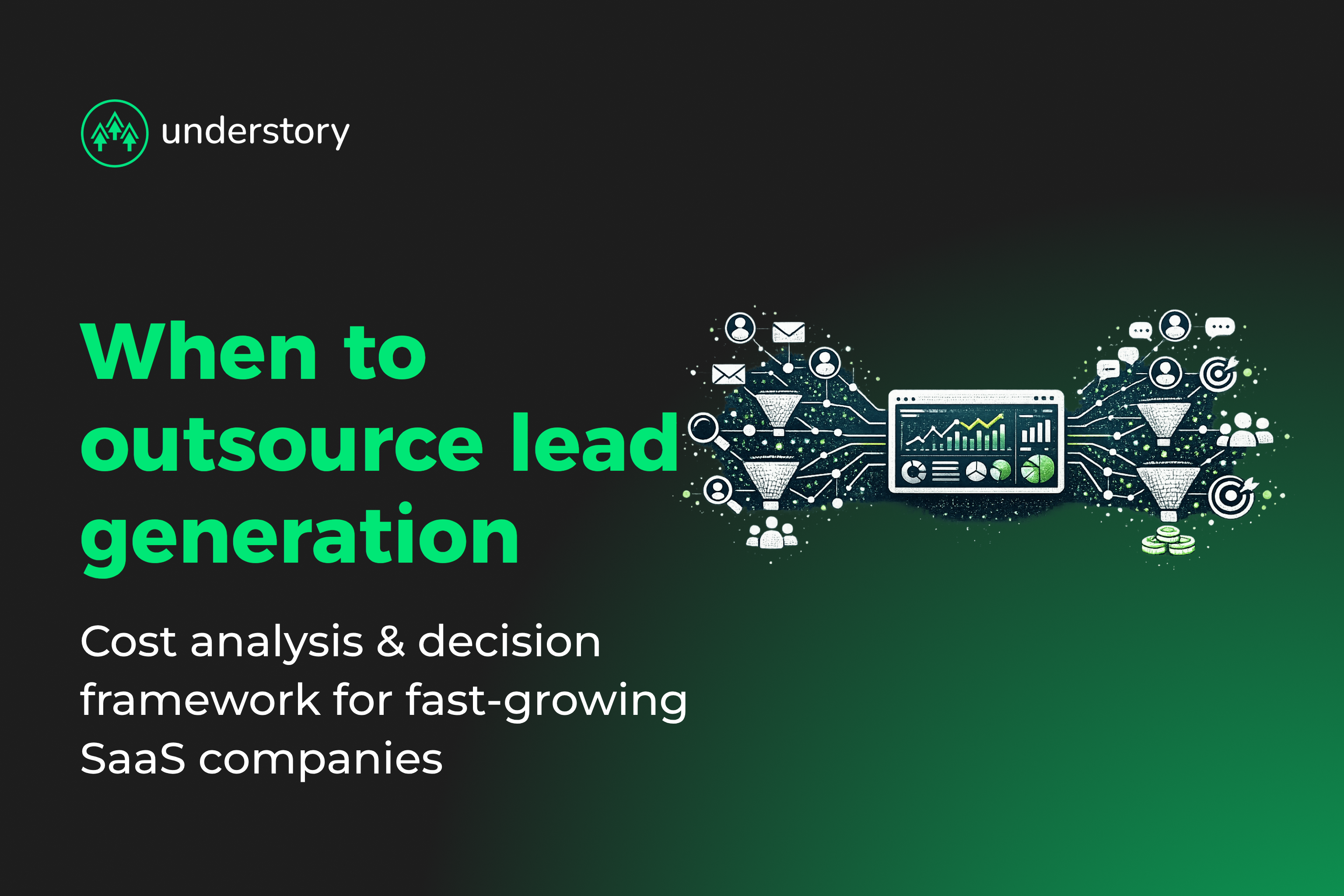
Building an in-house lead generation team requires significant annual investment in personnel, tools, and management overhead. Outsourcing typically costs considerably less. But cost alone won't answer the question: the real decision hinges on whether your SaaS company can absorb months of ramp time and high SDR turnover while hitting pipeline targets.
This framework provides cost considerations, stage-based decision criteria, and clear signals for when each approach makes sense for SaaS companies with $20K–$100K ACVs.
The real cost comparison
Let’s understand the breakdown of cost between hiring inhouse and outsourcing.
In-house team economics
A minimum viable in-house lead generation team (2 SDRs plus a manager) runs significant annual costs that most SaaS companies underestimate.
Personnel costs:
- 2 SDRs (fully loaded): Base salaries typically range from $50K–$60K with on-target earnings around $75K–$85K per rep
- 1 Sales/Demand Gen Manager: Compensation varies by market and experience level
Tool stack for a 2-SDR team:
- Engagement platforms, data providers, LinkedIn Sales Navigator, and CRM licenses add substantial costs
- Companies now spend between $6,000 and $7,000 per SDR yearly on tech tools alone
Hidden costs hit harder than the line items. Usually, SDR ramp time averages 3.2 months to full productivity. Factor in recruiting and onboarding, and you're looking at several months before your team operates at capacity.
Then there's turnover. The median SDR annual turnover sits at 30%, split between involuntary and voluntary departures. Each departure restarts the ramp cycle.
Beyond turnover, several hidden challenges drain leadership bandwidth:
- Coordination overhead: Managing SDR activities, reviewing calls, and adjusting messaging requires significant weekly time from sales leadership.
- Brand consistency: Ensuring SDRs represent company values and articulate nuanced product positioning accurately demands ongoing attention.
- Technical integration complexity: Connecting SDR tools with your existing marketing stack, CRM workflows, and reporting infrastructure adds friction.
- Training investment: Ongoing coaching, skill development, and competitive intelligence updates require dedicated resources.
Combined, these factors significantly increase the true cost of in-house teams beyond headline personnel and tool expenses.
Outsourced agency economics
Comprehensive outsourced programs for companies with $20K–$100K ACVs typically run $10,000–$12,500 monthly. That represents meaningful cost reduction compared to fully-loaded in-house teams when you factor in tools, management overhead, and turnover costs.
The speed advantage matters more than the cost savings. Outsourced teams can launch initial outreach in weeks from contract signing versus months for in-house teams to reach full productivity. For SaaS companies with immediate pipeline pressure, that time-to-value difference represents the real strategic value.
However, the initial launch timeline refers to outreach activity, not optimized performance. Realistic onboarding requires 30–60 days before outsourced teams reach full ramped capacity. During this period, external teams absorb your ICP definitions, internalize messaging frameworks, and develop sufficient product knowledge to represent your company effectively.
The trade-off: you're primarily paying for speed and flexibility with outsourced teams rather than conversion optimization. In-house teams offer greater strategic control and deeper product knowledge integration, but require significantly higher upfront investment and longer timelines.
The decision framework
The most effective approaches increasingly favor allbound coordination, integrating in-house expertise with external capacity rather than choosing one or the other.
Stage-based guidance
Your company stage determines the baseline recommendation more than any other factor.
- Seed stage (<$1M ARR): Neither build nor buy. Founders must conduct 20–50 sales conversations personally before any outsourcing or hiring.
- Pre-Series A ($1–3M ARR): Outsource for testing only. Use 3-month pilots to validate outbound channels before committing.
- Series A ($3–10M ARR): Hybrid models become optimal. 1–2 in-house SDRs build the core playbook while outsourced teams handle overflow.
- Series B+ ($10–50M ARR): Build dedicated in-house SDR teams (3–8 reps) with a dedicated manager while maintaining outsourced capacity for market expansion.
ACV-based thresholds
Your average contract value creates hard economic constraints on which approach makes sense.
The right sourcing model depends on deal size. Below $5K ACV, the unit economics rarely support dedicated SDRs, so outsourcing or automating outbound is the practical move. In the $5K to $25K range, a hybrid approach works: you can justify SDRs, but watch the math closely. For $25K to $100K deals, building in-house at scale makes sense, though outsourcing still earns its place when testing new segments.
Once you cross $100K, relationship complexity demands deep product knowledge that's hard to replicate externally. And at $500K+, there's no substitute for a fully in-house team; no vendor can match the relationship depth those deals require.
The $25K ACV threshold marks the inflection point where in-house SDR economics begin to favor dedicated internal teams.
The LTV:CAC override
Regardless of stage or ACV, your unit economics create a hard override on the decision.
- LTV:CAC between 3:1 and 4:1 with payback under 18 months: This represents the healthy growth zone where hybrid models optimally balance efficiency and control. The 3:1 ratio is a commonly accepted benchmark across the SaaS industry.
- LTV:CAC below 3:1 or extended payback periods: Outsource while you fix efficiency problems. Building in-house with broken unit economics just burns cash faster.
When to outsource: clear signals
Here are some clear signals that you should outsource your lead generation.
- Pipeline urgency under 90 days: If you need qualified meetings within the quarter, building in-house isn't viable. The months-long ramp timeline makes outsourcing the only path for urgent pipeline creation.
- Testing new markets or verticals: Outsourcing provides rapid market validation with minimal infrastructure investment.
- Pipeline stalls for 2+ consecutive quarters: External expertise can diagnose problems that internal teams may be too close to see.
- Rising CPL and CAC without quality improvements: This pattern signals efficiency problems that fresh external perspectives often solve faster.
When to build in-house: clear signals
Here are clear signals to watch out for when it’s time to build in-house.
- Lead volume exceeds what outsourced teams can handle effectively: At scale, the conversion rate advantage of in-house teams outweighs the cost premium.
- Your sales cycle requires deep product knowledge: For enterprise deals above $500K ACV with complex buying committees, no external team can replicate the relationship depth required.
- You need a repeatable, documented sales process: Building that process requires close team alignment challenging with external partners.
- You've validated messaging and ICP through founder selling: External teams execute playbooks; they don't create them.
- Leadership capacity exists: Build in-house only when you have experienced sales leadership. Missing this signals an allbound model with external support may be better.
The hybrid model reality
For most growth-stage SaaS companies, the binary choice is a false frame: allbound models that coordinate multiple channels outperform siloed approaches.
Strategy-driven division model
The in-house team owns strategy, ICP definition, and messaging framework development. The outsourced team executes volume outbound within those parameters, handling prospect research, cold outreach, and initial qualification while internal stakeholders maintain brand control.
Outsourced engine model
The external team runs the full outbound program end-to-end. In-house SDRs focus exclusively on inbound qualification and high-intent leads from marketing campaigns, ensuring the highest-value opportunities receive dedicated internal attention.
Practical hybrid structure:
- In-house SDRs handle high-value accounts and complex deals
- Outsourced teams manage volume prospecting for mid-market segments
- Strategic control, ICP definition, and messaging stay internal
- External capacity flexes based on market conditions
Successful coordination requires regular alignment meetings, shared dashboards for real-time visibility, and documented handoff protocols for lead escalation. Without these mechanisms, hybrid models fragment rather than amplify your pipeline efforts.
Metrics that actually matter
Whether you build, buy, or blend with allbound coordination, track these metrics.
- Sales Accepted Lead (SAL) rate
A healthy SAL rate indicates strong targeting and qualification. Rates significantly below expectations indicate fundamental targeting or qualification problems.
- Lead Velocity Rate (LVR)
This measures month-over-month qualified lead growth and serves as a more predictive indicator of future revenue than current pipeline snapshots. Declining LVR for consecutive months signals serious program problems requiring immediate attention.
- Cost per opportunity (CPO)
Total program costs (personnel, tools, agency fees) divided by sales-qualified opportunities created provides the true cost of pipeline generation. If CPO is substantially higher than CPL, quality problems exist in your targeting or qualification process.
- CAC payback period
The median CAC payback period for SaaS companies is about 18 months. CAC payback of 12 months or less is typically considered healthy for SaaS businesses, while payback beyond 18–24 months often signals efficiency problems.
- Performance benchmarks by stage
SDRs generate meaningful pipelines when properly ramped and supported. Use consistent internal benchmarks to evaluate both in-house and outsourced team performance against your specific sales cycle and ACV.
Coordinate lead generation with Understory Agency
The build vs. buy decision for lead generation is really a question about where you want to spend your coordination bandwidth.
Building in-house means coordinating hiring, training, tools, and management. Traditional outsourcing means coordinating with another specialist vendor who operates independently from your paid media, content, and creative teams. Either path fragments your prospect experience.
At Understory, we coordinate LinkedIn ads, personalized outbound, and professional creative as a unified allbound system. Your prospects receive consistent experiences across all touchpoints, and you reduce management complexity between specialists.
Book an intro call to see how coordinated lead generation works for SaaS companies.
Related Articles

Pipeline that compounds
Paid, outbound, content, creative and RevOps as one system. Same team, same ICP, same messaging.