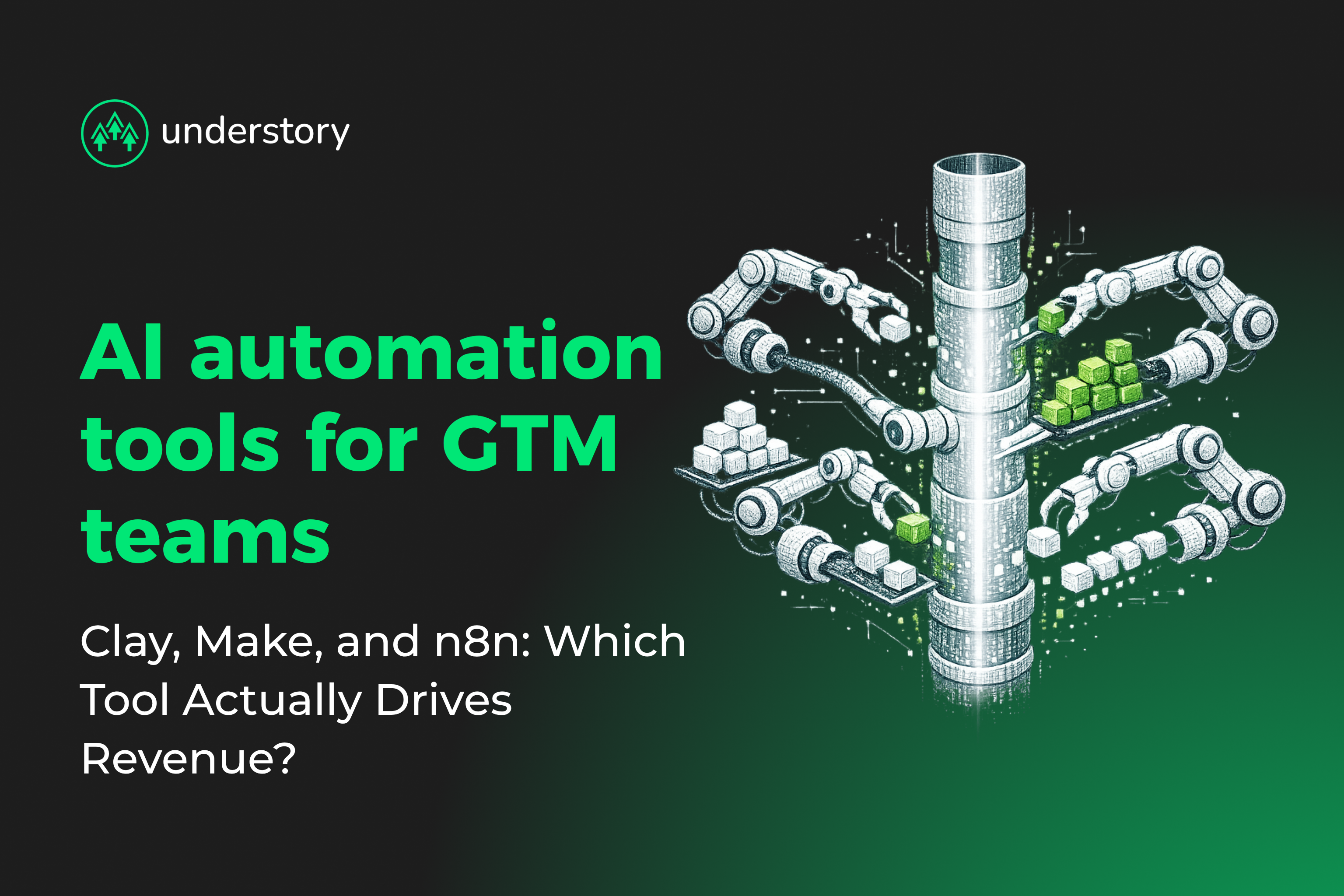
Clay, Make, and n8n solve different GTM automation problems. Most SaaS teams combine them: Clay for enrichment, Make or n8n for workflow orchestration. Coordinating multiple tools across specialists creates overhead that consumes strategic growth time.
Organizations often achieve a pipeline increase with Clay. Yet RevOps communities reveal a different story: most implementations struggle with over-engineered workflows, poor data foundations, and lack of cross-team alignment.
Pipeline growth comes from systematically scaling prospecting and enrichment, not just streamlining existing processes. Most teams miss the real challenge: establishing clean data, defined processes, and proper foundations before implementing any tool.
This guide covers what each platform does, where the real ROI comes from, and how to avoid common pitfalls that derail GTM automation projects.
Why SaaS growth leaders struggle with tool coordination
SaaS growth teams waste time coordinating Clay enrichment, Make workflows, and n8n integrations across disconnected specialists. The coordination overhead compounds with each additional tool: SDRs wait for enrichment, RevOps troubleshoots integration breaks, and growth leaders spend more time managing vendors than optimizing campaigns.
Three patterns consistently derail GTM automation implementations:
- Over-engineering workflows that teams cannot maintain creates fragile systems abandoned within months. Teams jumping straight to comprehensive automation skip the learning phases that build sustainable capability.
- Poor data foundations amplify existing problems at scale. Automating chaos creates faster chaos. Without clean CRM data, defined ICP criteria, and proper enrichment strategy, automation multiplies bad data across your entire GTM stack.
- Organizational misalignment on automation priorities across sales, marketing, and customer success leads to competing workflows and unclear ownership. Before selecting tools, get agreement on who maintains workflows, who troubleshoots breaks, and which processes are automation candidates versus which need fixing first.
The underlying mistake is focusing on mastering tool features rather than solving specific business problems with minimal complexity.
What each platform does
Understanding these differences prevents the most common selection mistake: treating them as direct competitors when mature GTM teams combine them.
Clay: data enrichment and AI-powered personalization
Clay consolidates 100+ data providers into a single interface using "waterfall enrichment," which sequentially attempts multiple providers until successful enrichment is achieved. Claygent AI research agent for company analysis, personalized outreach content generation, and intent signal monitoring.
Clay does not handle complex multi-step workflow orchestration beyond data enrichment operations. It requires pairing with Make or n8n for sophisticated workflows. Credit-based model starting at $149/month. Plan for 15–25 credits per lead depending on enrichment depth.
Make: visual workflow orchestration for business users
Make serves RevOps teams needing complex automations without engineering resources. Its drag-and-drop interface connects 2,500+ native app integrations.
Make excels at multi-app orchestration (CRM, marketing automation, analytics), data transformation between systems, lead routing with complex scoring criteria, and rapid deployment without developer involvement. It is less customizable than n8n, and operations-based pricing escalates with high-volume automation.
n8n: developer-first platform for maximum flexibility
n8n offers open-source deployment with full control over code, data, and hosting. It's the choice for engineering-led organizations requiring customization and cost-effective scaling.
n8n excels at custom API integrations for proprietary systems, complex conditional logic across departments, self-hosted deployment for compliance requirements, and unlimited executions without per-operation costs. It requires developer resources. With ~400 native integrations versus Make's ~2,500, teams often build custom connectors.
Where the real ROI comes from
The credible evidence base is narrower than vendor marketing suggests. Fewer than 10 named enterprise customers provide defensible metrics across all three platforms. But the documented results are substantial when teams focus on revenue-generating workflows.
Pipeline generation, not just time savings
The strongest ROI comes from prospecting and enrichment workflows, lead qualification and routing (SQL improvements with Make), dormant account revival (improved response rates), and operational efficiency through automated coordination.
These workflows outperform pure time-saving automation because they enable GTM teams to scale outbound to thousands of personalized touches monthly, which is impossible with manual research.
The pattern that matters
Companies achieving triple-digit pipeline growth use these tools to generate more pipeline, not merely save time. They coordinate outbound prospecting with inbound qualification to systematically generate more pipeline than siloed channel efforts.
Real workflow examples
Understanding how these tools combine in practice clarifies their distinct roles.
Inbound lead enrichment workflow
When a new lead enters your CRM via form submission, the workflow unfolds as follows: a HubSpot webhook fires on new contact creation, Clay waterfall enrichment pulls company size, tech stack, funding stage, and decision-maker contact data, Clay formulas calculate ICP fit score based on firmographic and technographic signals, and n8n or Make routes high-score leads to priority SDR queues with Slack notifications while lower scores enter nurture sequences.
This pattern enables 80%+ enrichment coverage with complete automation of manual research tasks.
Outbound prospecting at scale
For systematic outbound pipeline generation: Clay monitors job postings, funding announcements, and tech adoption signals for ICP identification. Sequential providers ensure 90%+ email deliverability through waterfall enrichment. Claygent researches each company and generates contextual opening lines. n8n or Make pushes enriched contacts to Salesloft or Outreach with personalization variables.
This workflow enables teams to maintain personalization quality while scaling to 500+ daily touches.
When to use each platform
Choose Clay if data enrichment and AI personalization are your primary bottlenecks, SDRs spend 40–60% of their time on manual research, you need to replace 5–10 separate data vendor subscriptions, or your budget supports credit-based pricing for heavy enrichment.
Choose Make if your RevOps team needs sophisticated automation without engineering resources, pre-built integrations (2,500+ native apps) cover your tech stack, visual workflow design is preferred over code, or rapid deployment without developer involvement is important.
Choose n8n if technical resources are available (developers, DevOps), custom integrations or complex logic are required, high-volume automation needs cost-effective scaling, or compliance requires self-hosted deployment.
The combination pattern
Mature GTM teams combine Clay with Make or n8n rather than choosing exclusively. Clay handles specialized data enrichment from 100+ sources, while Make or n8n serves as the workflow orchestration layer for broader automation and multi-system coordination. This approach uses each tool's strengths rather than forcing single-platform compromises.
Implementation requirements often underestimated
Each platform requires different expertise and resource commitment.
Clay implementations need understanding of data enrichment strategies and waterfall logic, API concepts and CRM workflow design knowledge, and formula construction skills for scoring and routing. Budget 20–30 hours for formal training plus 0.5–1.0 FTE for ongoing management.
Make implementations require visual workflow design skills and data transformation logic, integration pattern understanding across multiple systems, and RevOps teams can manage without dedicated engineering resources. Expect 15–25 hours initial setup, 0.25–0.5 FTE ongoing.
n8n implementations require JavaScript knowledge for complex conditional logic, DevOps skills for self-hosting and infrastructure management, and dedicated developer resources for setup, custom connectors, and maintenance. Plan for 30–50 hours initial setup plus ongoing developer time.
Most teams underestimate ongoing maintenance requirements. Data sources change, integrations break, and workflows need optimization as your GTM motion evolves.
The maturity progression that works
Successful GTM automation follows a deliberate progression that builds capability over time.
Months 1–2: single high-impact workflow. Focus on one measurable use case (inbound lead enrichment is the common starting point). High value, repetitive process with clear success metrics. Build team familiarity with platform capabilities and limitations.
Months 3–6: adjacent use case expansion. Add outbound prospecting and lead routing workflows. The team develops automation muscle and troubleshooting skills. Establish maintenance processes and ownership.
Months 6–12: full GTM stack integration. Sophisticated multi-tool orchestration across departments. Coordinate enrichment, routing, personalization, and reporting. Optimize cost efficiency and workflow performance.
Year 2+: optimization and scaling. Focus on workflow efficiency and cost management. Scale automation capabilities with company growth. Refine processes based on performance data.
Teams that skip phases and jump straight to comprehensive automation create fragile systems and abandoned implementations.
Coordinate GTM automation with Understory Agency
The complexity above explains why SaaS growth teams waste months managing Clay enrichment, Make workflows, and n8n integrations across disconnected specialists. Pipeline opportunities slip through coordination gaps.
At Understory, we coordinate Clay enrichment, workflow orchestration, and multi-channel prospecting into unified pipeline generation as a Clay Enterprise Partner. We eliminate the specialist coordination overhead consuming your strategic growth time.
What coordinated automation delivers:
- Expert implementation of Clay, Make, or n8n based on your specific GTM requirements without trial-and-error learning overhead
- Ongoing maintenance and optimization that prevents workflow breaks and keeps automation running as data sources evolve
- Unified prospect experiences across paid media, outbound, and creative coordinated by one expert partner
- Predictable pipeline generation from revenue-focused automation, not just time-saving workflow improvements
Book an intro call to discuss how coordinated GTM automation can replace fragmented processes with reliable, scalable revenue generation.
Related Articles

Qualified pipeline, handled
Signal-based outbound that fills the funnel while your team closes.