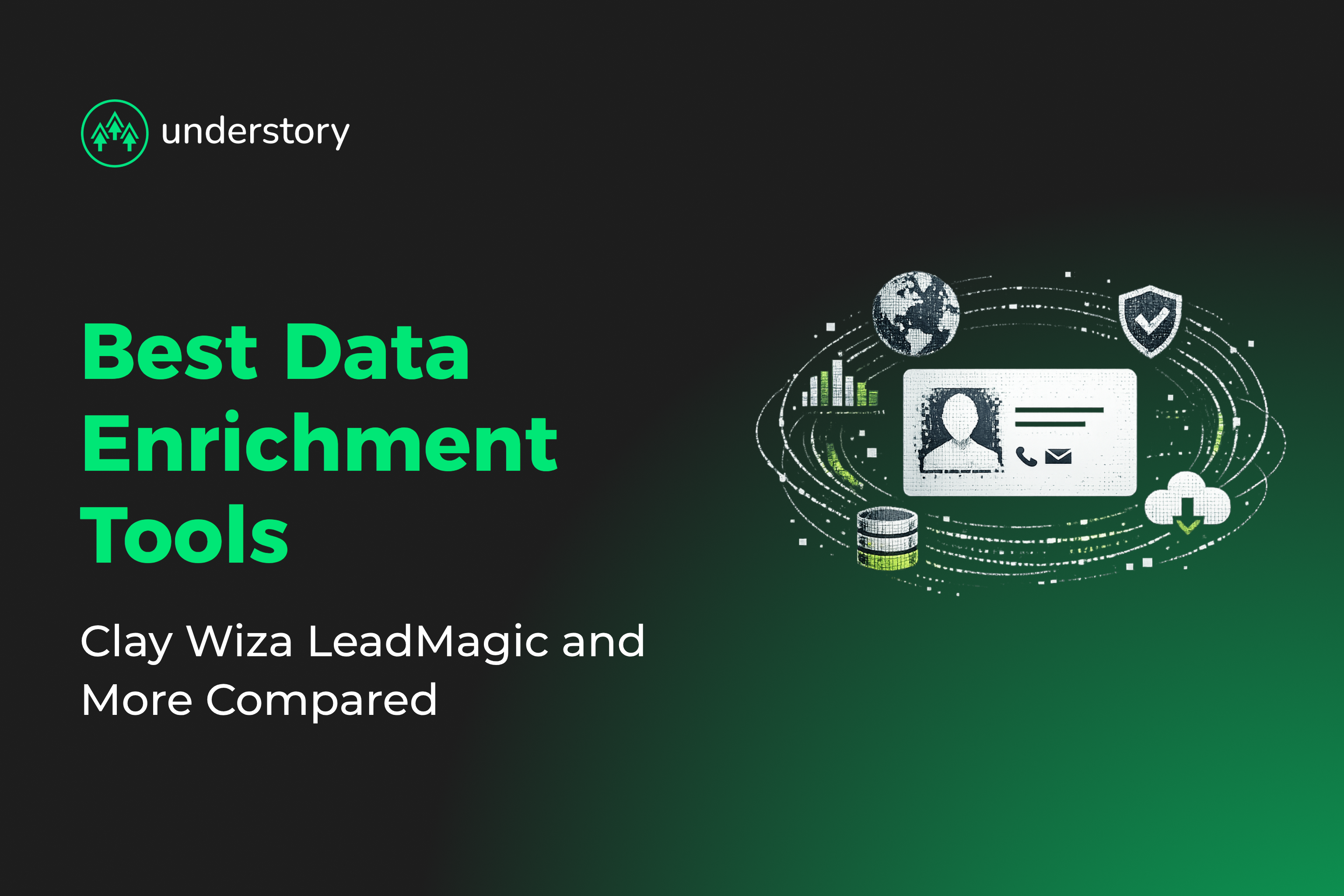
Data enrichment transforms basic contact information into complete prospect profiles. For SaaS teams with $20K+ ACVs, enriched data powers the personalization that sophisticated buyers expect.
This guide matches leading enrichment tools to specific use cases so you can align capabilities with your GTM motion.
Why data enrichment matters for SaaS outbound
Data enrichment appends firmographic, technographic, and contact data to minimal inputs like email addresses or LinkedIn URLs. This powers personalization at scale, accurate lead scoring, and faster qualification.
The challenge: these tools create workflow complexity that compounds coordination overhead.
- Integration architectures differ: Clay integrates with 150+ data providers, while Wiza operates exclusively through LinkedIn Sales Navigator.
- Credit consumption varies: Clay charges 1-5 credits for basic contact information but 10-20+ credits for detailed company intelligence.
- Data coverage gaps remain critical: Cognism excels in European markets while ZoomInfo dominates North America.
Choosing poorly means paying for capabilities that don't match your GTM motion or geographic focus.
Best data enrichment tools
Here’s a list of the best data enrichment tools available in the market.
1. Clay: the workflow automation powerhouse
Clay integrates with 150+ data providers using a waterfall methodology that queries multiple sources until finding a match.
It’s best for RevOps teams requiring multi-source enrichment without engineering resources
Core capability: It comes with waterfall enrichment. You define the provider sequence based on data quality and cost priorities. Clay starts with your minimal input data, queries your first-choice provider, then automatically moves to alternatives when sources lack information. This continues until finding a match or exhausting your sequence.
Pricing structure: Clay uses credit-based annual billing. Basic contact information runs 1-5 credits per record, while detailed company intelligence costs 10-20+ credits. Calculate your actual volume before committing.
Where Clay excels: The spreadsheet-style interface makes it accessible for non-technical users while supporting sophisticated automation. AI-powered Claygents can search databases, navigate gated forms, and draft personalized emails based on enriched context. Native integrations to HubSpot and Salesforce eliminate manual data syncing.
Limitations: API rate limits and provider-specific pricing structures aren't consistently documented; request detailed breakdowns during evaluation.
2. Wiza: LinkedIn Sales Navigator extraction
Wiza operates exclusively through a Chrome extension designed for LinkedIn Sales Navigator. It's a point-in-time export tool rather than continuous automation: you conduct prospecting searches in Sales Navigator, then trigger exports when you've refined your target criteria.
Best for: SDR teams with existing Sales Navigator investments needing contact enrichment
Core capability: Export up to 2,500 contacts simultaneously from Sales Navigator searches, enriched with verified emails and phone numbers. Real-time verification happens at export, reducing bounce rates that damage sender reputation.
Pricing: Plans range from $49-$199/month with 17% discounts for annual commitments. Native connections with Salesforce, HubSpot, and Outreach. CSV export supports additional systems.
Where Wiza fits: Teams of 2-10 SDRs conducting regular LinkedIn prospecting who need verified contact data without building complex workflows.
Limitations: Point-in-time exports only; no continuous automation. LinkedIn-dependent, offering limited value for prospecting outside that platform's database.
3. LeadMagic: simple LinkedIn-to-CRM workflows
LeadMagic focuses on simplicity over feature breadth. The platform provides six primary capabilities: Email Finder, Mobile Finder, Profile Finder, Email Validation, Company Finder, and Jobs Finder.
Best for: Small businesses wanting straightforward contact enrichment with excellent support
Core capability: Credits only consumed for valid results. Failed lookups don't deduct from your balance, improving cost predictability.
Pricing: Plans range from $60-$800/month. Email Finder uses 1 credit per lookup; Mobile Finder costs 5 credits. For teams prioritizing phone outreach, mobile number costs add up: 1,000 mobile lookups consume 5,000 credits.
Where LeadMagic wins: Native Clay integration positions it as a focused data provider within larger enrichment workflows. LeadMagic also integrates natively with SmartLead and Instantly for automated outbound campaigns. Peer reviews note strong ease of use and support quality, which matters for lean teams without dedicated RevOps resources.
Limitations: Limited enterprise validation given small business concentration. LinkedIn-dependent for primary data inputs. Mobile number enrichment at 5 credits per lookup becomes expensive at scale.
The real challenge: coordinating enriched data across your stack
Data enrichment tools solve the data quality problem. They don't solve the coordination problem.
You still need enriched data flowing into personalized sequences, coordinated with paid campaigns, aligned with creative messaging, and synced across channels.
Each tool you add creates another integration to maintain, another vendor to manage, another potential disconnection point in your prospect experience. For SaaS growth leaders already spending more time coordinating specialists than optimizing campaigns, adding sophisticated enrichment workflows compounds complexity rather than reducing it.
How Understory Agency coordinates enrichment with allbound execution
Most SaaS growth teams face this reality: they choose between building internal enrichment workflows (coordinating Clay, Wiza, LeadMagic, sales engagement platforms, and creative separately) or settling for disconnected point solutions that leave prospects with inconsistent experiences.
At Understory, we eliminate that false choice through expert allbound execution that coordinates enriched data with multichannel campaigns from the start.
Outbound prospecting with technographic targeting
We enrich ICP accounts from intent data or LinkedIn Sales Navigator with technographic data showing current tech stack and recent technology changes. Then we prioritize accounts displaying tech switching signals and coordinate personalized outreach across LinkedIn ads, email sequences, and professional creative.
Account-based marketing with multi-stakeholder targeting
We enrich each target account with organizational structure and decision-maker mapping, then build contact lists spanning champions, economic buyers, and technical evaluators. Coordinated messaging by role across paid campaigns, outbound sequences, and creative ensures consistent positioning reaches all stakeholders.
Real-time inbound qualification with coordinated follow-up
When website visitors submit minimal form data, real-time enrichment appends firmographics. Lead scores calculate instantly based on ICP fit. High-value leads route to coordinated nurture sequences combining personalized email, LinkedIn retargeting, and contextual creative.
Intent signal activation with multichannel coordination
We monitor content consumption and search behavior, enrich intent-signaling accounts with firmographic and technographic data, then score combined intent and fit to identify in-market ICP accounts. Coordinated activation across paid media, personalized sequences, and professional creative generates qualified opportunities efficiently.
At Understory, we combine enrichment expertise with allbound execution. You work with a single expert team that understands sophisticated SaaS buyer journeys, coordinates enriched data across channels, and optimizes based on actual pipeline results rather than disconnected metrics from individual specialists.
Evaluation framework: questions before you commit
If you're evaluating standalone enrichment tools, ask these questions:
Integration depth: Does the platform sync bidirectionally with your CRM? Native HubSpot and Salesforce integrations are table stakes, but verify field mapping flexibility and error handling.
Credit consumption transparency: Request specific credit costs for each data type. Calculate projected monthly costs using actual query volumes from your current prospecting motion.
Geographic coverage: Cognism specializes in European market coverage with strong data quality for EU/UK markets. ZoomInfo and Apollo.io focus on North American presence. Request sample data for your specific target markets.
Processing modes: Do you need real-time enrichment for inbound leads, batch processing for database cleansing, or both? Confirm the platform supports your workflow requirements.
Coordination requirements: Who will coordinate enriched data with outbound sequences, paid campaigns, and creative messaging? If the answer involves multiple vendors or internal coordination, factor that overhead into your decision.
Pilot with real data: Test vendors with representative samples from your actual CRM. Measure match rates and data accuracy against existing clean records, not vendor demo data.
Scale enrichment with Understory Agency
Data enrichment delivers maximum impact when integrated directly with execution channels. The best enrichment data won't move the pipeline if it creates disconnected prospect experiences.
At Understory, we coordinate enriched data with expert allbound execution: outbound campaigns, personalized prospecting sequences, and professional creative working together to reach sophisticated SaaS buyers consistently.
Book a call to see how Understory turns enriched data into qualified pipeline without the coordination overhead.
Related Articles

One agency. Every channel. One strategy.
Paid, outbound, content, creative and RevOps run as one system, not five vendors.