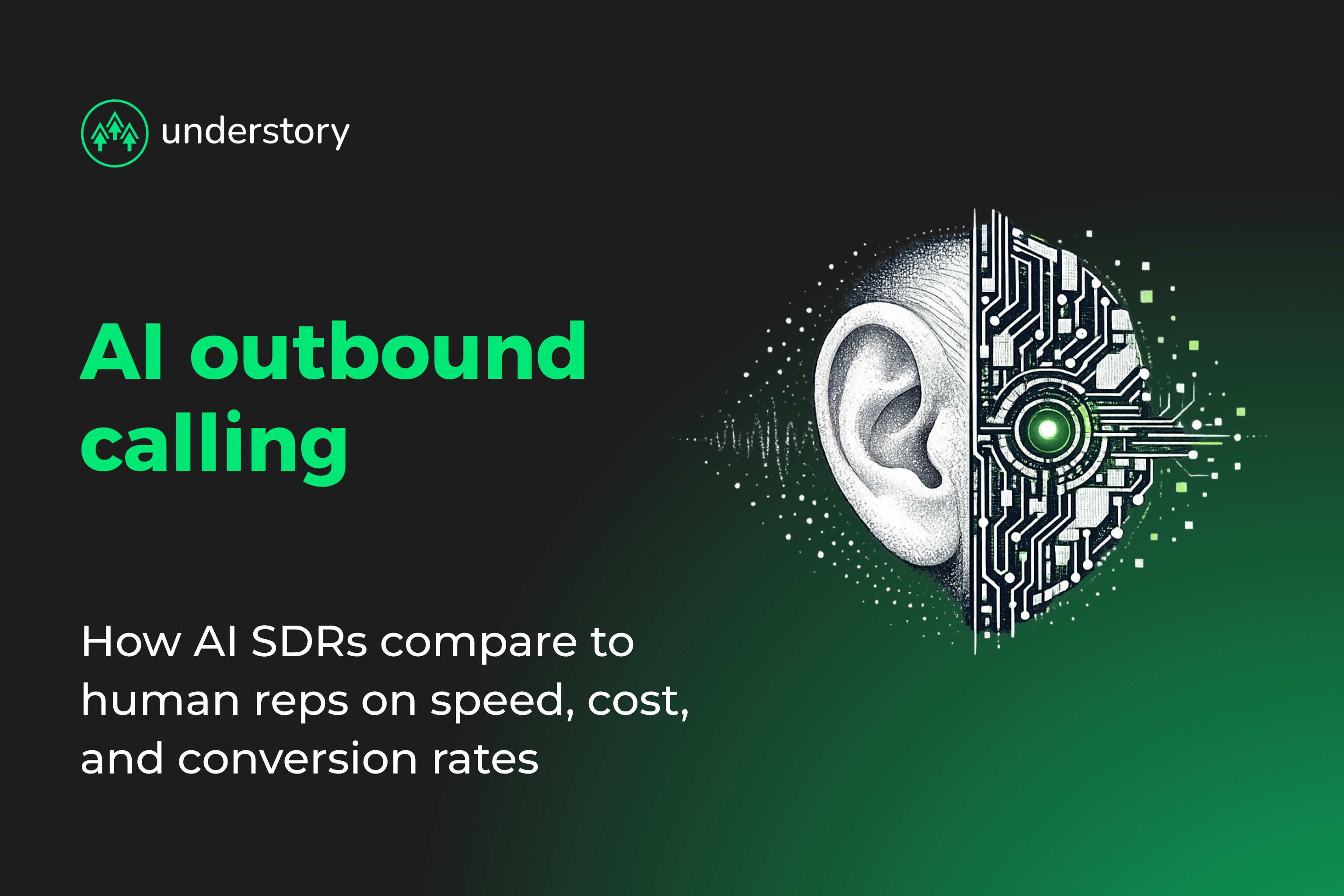
AI outbound calling platforms promise efficiency gains, but standalone deployment creates another coordination challenge. Your paid media specialist runs LinkedIn ads, your outbound team manages email sequences, and now an AI calling platform sits partially integrated. Prospects receive disconnected messages about the same product.
This guide covers AI outbound calling platforms, performance benchmarks against human SDRs, effective use cases for high-ACV B2B SaaS, deployment limitations, and coordination frameworks that turn point solutions into pipelines.
The performance gap: AI vs human SDRs
Before evaluating platforms, understand what the data shows about AI outbound calling performance.
AI calling offers specific advantages: faster response times under 1 minute versus 2-4 hours for human SDRs, increased connection rates through parallel dialing, and reduced administrative burden for qualification tasks.
Quality metrics tell a different story. Expert allbound execution outperforms either pure automation or purely manual execution. Coordinated approaches achieve 18.7 meetings per month compared to 10.4 meetings from human-only approaches. Coordinated approaches also demonstrate higher win rates.
When paid media, AI calling, and outbound sequences work together with unified messaging, prospects convert at higher rates than disconnected specialist execution.
Leading AI outbound calling platforms for high-ACV SaaS
The AI outbound calling market has evolved into distinct categories. Your choice depends on whether you're enhancing live rep effectiveness, adding AI to existing communications infrastructure, extending your current sales engagement platform, or deploying autonomous voice agents.
Most SaaS growth teams add these platforms as another point solution requiring coordination. The challenge isn't selecting the right platform; it's orchestrating AI calling with paid media, outbound sequences, and creative messaging so prospects receive coordinated experiences.
Specialized AI calling platforms
Three leading dedicated platforms serve different deployment needs:
- Orum offers parallel dialing with intelligent routing, AI coaching with objection detection, and deep integrations with major sales platforms for enterprise teams
- Nooks provides an integrated suite including AI Prospector, AI Dialer, AI Coach, and Virtual Salesfloor with conversation intelligence for SDR automation
Platform capabilities matter less than how you orchestrate them with your broader sales stack. Coordinate AI calling platforms with paid media, outbound sequences, and creative execution so prospects receive consistent experiences across every touchpoint.
Effective use cases for sophisticated B2B buyers
AI SDRs don't replace human SDRs for high-ACV, complex sales environments. Success requires ongoing coordination discipline, not set-and-forget automation.
Call intelligence and connection optimization
AI excels at enhancing human SDR effectiveness through specific functions that reduce administrative burden while preserving relationship quality:
- Call automation and parallel dialing
- Real-time transcription and pattern recognition
- Optimal call timing algorithms
- Coaching insights from conversation analysis
Humans handle conversation strategy, relationship building, and nuanced objection handling, particularly for sophisticated buyers in enterprise deals.
Here’s how allbound coordination works in practice. AI handles initial dials, voicemail drops, and scheduling coordination while human SDRs take over once a live connection is made. During live calls, AI provides real-time coaching prompts, surfaces relevant prospect data, suggests objection responses, and flags key moments for follow-up.
This coordination reduces human SDR administrative burden, allowing reps to focus exclusively on high-value conversations rather than manual dialing and note-taking. The result is higher connection rates without sacrificing the human touch that sophisticated buyers expect.
Lead qualification with structured handoffs
AI qualifies based on predefined BANT criteria with automated routing to human SDRs when thresholds are met. The critical success factor: ongoing optimization of handoff quality through regular review of qualification logic and continuous refinement based on closed-won deal analysis.
The coordination challenge emerges when qualification criteria from AI calling don't align with qualification signals from paid media or email sequences. Prospects qualified through one channel may receive redundant or conflicting outreach through another.
You can solve this by unifying qualification logic across paid media, AI calling, and outbound sequences. When prospects show buying signals through any channel, our coordinated approach ensures appropriate follow-up without redundant outreach.
Multi-touch follow-up for long sales cycles
For B2B SaaS companies with lengthy sales cycles typical of $20K-$100K+ ACV deals, AI enables dynamic sequencing based on prospect behavior. Systems adjust follow-up cadences across email, phone, and LinkedIn based on real-time interactions and automate prioritization of high-value leads showing buying signals.
Multi-touch coordination requires more than platform capabilities. When your paid media specialist runs LinkedIn ads, your outbound team runs cold sequences, and your AI calling platform automates follow-up, prospects often receive the same message three times through different channels, or contradictory positioning that undermines sophisticated SaaS messaging.
Limitations for high-ACV sales
AI outbound calling faces four critical constraints for sophisticated B2B SaaS sales: trust-building failures with sophisticated buyers, complex objection handling limitations, buyer perception risks, and data quality dependencies.
Complex objection handling
AI platforms demonstrate specific technical constraints in natural language processing, emotional intelligence, and real-time problem-solving that prevent adaptive objection handling. This limitation becomes particularly pronounced in enterprise SaaS sales where decision committees involve 6 to 10+ stakeholders with competing priorities.
Human SDRs outperform AI in consultative conversations about product fit, integration requirements and technical architecture discussions, customization capabilities for complex environments, and multi-stakeholder navigation and political dynamics.
These areas separate deal quality from deal volume. AI can generate connection volume, but humans drive the consultative conversations that sophisticated buyers expect for strategic purchases.
Buyer perception risks
Sophisticated buyers quickly identify AI-generated outreach. Enterprise buyers view AI calling as inappropriate for strategic account development.
The brand damage compounds over time as your SaaS product becomes associated with automated, low-touch sales approaches, which is precisely the opposite positioning needed for high-ACV deals requiring consultative selling.
You should use AI for high-volume qualification while reserving human SDRs for enterprise accounts and trust-critical conversations. This preserves your professional positioning with sophisticated buyers while maintaining connection efficiency.
Data quality dependencies
Poor data quality limits AI's predictive accuracy significantly. AI calling becomes less suitable for markets with high executive turnover or newly created buyer personas where data quality is inherently difficult to maintain.
Your AI calling platform is only as effective as your CRM data quality. When contact information is outdated, job titles are wrong, or account hierarchies are incorrect, AI automation amplifies these errors at scale rather than correcting them.
Strategic deployment recommendations
Deploy AI for high-volume functions while maintaining disciplined handoff protocols.
AI excels at:
- High-volume lead qualification
- Initial contact attempts and connection optimization
- Data enrichment and scheduling coordination
- Pattern recognition and coaching insights
Reserve human SDRs for:
- Enterprise and strategic accounts
- Complex objection handling in multi-stakeholder buying environments
- Trust-critical conversations with senior decision-makers
- Consultative discussions about product fit and integration requirements
Base deployment decisions on buyer sophistication and deal complexity, not blanket automation strategies.
Implementation sequencing
Start with a pilot program targeting one segment. Mid-market accounts typically offer the best balance of volume and deal complexity for initial testing.
Follow this sequence for deployment:
- Establish baseline metrics before deployment: meeting conversion rates, cost-per-meeting, win rates
- Allow 3-6 month optimization period before scaling to additional segments
- Refine AI qualification criteria and handoff triggers during optimization phase
- Document handoff protocols explicitly to define specific signals that trigger human engagement
- Train both systems and people on seamless transitions between AI and human touchpoints
Before platform evaluation, complete these foundational steps: audit your CRM data quality (prerequisite for AI effectiveness), assess existing sales platform AI capabilities, and define buyer sophistication segments to determine where coordinated execution versus human SDRs make sense.
The most common failure mode: deploying AI calling without coordinating it with paid media, outbound sequences, and creative messaging. Prospects receive disconnected experiences. Attribution becomes unclear. Your growth team spends more time managing specialists than optimizing results.
Coordinate AI calling with Understory Agency’s allbound execution
AI outbound calling delivers performance gains through coordinated execution across your entire sales stack, not as another disconnected point solution.
Adding an AI calling platform means another vendor relationship requiring coordination, another specialist to manage, another attribution challenge to solve. At Understory, we orchestrate AI calling, paid media, sales engagement platforms, and human SDR workflows through expert allbound execution that turns disconnected point solutions into coordinated pipeline generation.
Book a consultation to evaluate how expert allbound execution within your existing sales stack can accelerate pipeline generation.
Related Articles

Qualified pipeline, handled
Signal-based outbound that fills the funnel while your team closes.