AI SDRs automate top-of-funnel sales activities, like prospecting, outreach, and lead qualification, at scale. For SaaS growth teams, they handle volume while humans focus on complex deal navigation and relationship building.
This guide covers what AI SDRs actually do, where they fall short, and how they fit into a coordinated allbound growth execution plan.
What is an AI SDR?
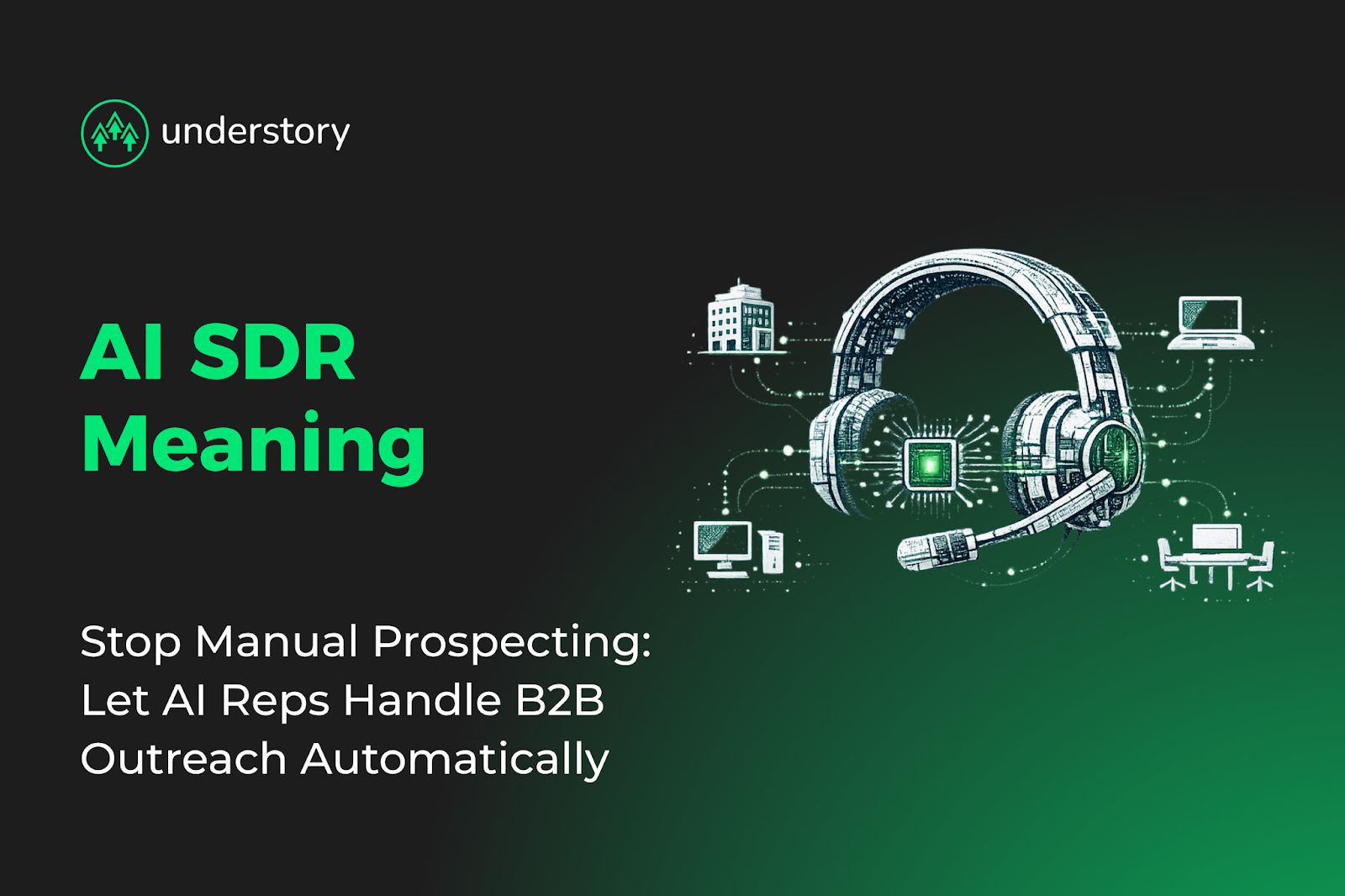
An AI SDR is a generative AI-powered tool designed to automate top-of-funnel sales activities traditionally handled by human sales development representatives. These systems handle prospecting, outreach, and lead qualification at scale.
AI SDRs are enterprise-grade systems built for complex B2B sales cycles, not generic chatbots. They function as Sales AI Assistants, streamlining workflows by automating tasks including follow-ups, scheduling, and data entry.
Key operational differences from human SDRs:
- Volume capacity: AI SDRs handle 1,000+ contacts daily compared to 30-50 for human reps
- Response speed: Under one minute versus 2-4 hours for human follow-up
- Cost structure: $500-$1,000 monthly subscription versus $3,000-$10,000 for human SDRs including overhead
For SaaS companies with $20K+ ACVs, this capacity differential creates strategic options, but implementation requires nuance.
Six tasks AI SDRs automate in B2B sales
AI SDRs handle specific, high-volume activities across six functional categories.
1. Prospecting and list building
AI SDRs build dynamic lead lists by analyzing public data sources against your ideal customer profile. These systems identify prospects through LinkedIn, company databases, and business records, continuously refreshing lists based on changing market conditions and buyer signals.
2. Lead qualification and scoring
AI SDRs evaluate lead quality through engagement patterns and buying readiness indicators. They assess company fit, engagement level, and behavioral signals simultaneously to prioritize leads for human follow-up.
3. Multi-channel outreach
AI SDRs orchestrate outreach across email, LinkedIn, SMS, calls, and WhatsApp in conditional sequences. The platforms use AI-powered decision logic to select optimal channels and timing based on prospect engagement patterns.
4. Personalized email at scale
AI SDRs generate personalized messages using real-time buyer signals. Advanced platforms use 150+ signals to automatically generate hyper-personalized sales emails at scale. These signals include:
- Recent company news and funding announcements
- Job changes and role transitions
- Technology stack changes
- Competitive intelligence
This moves beyond basic field substitution to contextual relevance, though coordinating AI-generated messaging with your broader campaign positioning requires oversight most growth leaders underestimate.
5. Meeting scheduling
When prospects express interest, AI SDRs handle calendar coordination automatically. Modern AI appointment setters respond to leads within 10 seconds, handling objections, scheduling preferences, and timezone coordination through natural dialogue.
6. Follow-up sequences
AI SDRs personalize follow-up messages using prospect data, behavioral signals, and previous interaction context, adjusting messaging tone and value proposition emphasis based on what resonated in earlier touchpoints.
ROI metrics for high-ACV SaaS companies
The financial case for AI SDRs focuses on cost per qualified opportunity, not activity volume.
Pipeline generation efficiency
The numbers across implementations show consistent patterns:
- Exponential increase in meetings scheduled for B2B SaaS startups
- Around 7% response rates with AI-personalized outreach versus 3-4% industry average
- 70% lower customer acquisition costs through improved targeting
Cost per qualified opportunity
AI SDRs achieve approximately a $25-50 cost per qualified opportunity compared to $150-500 for human SDRs. This is a 66-85% reduction that compounds across high-volume prospecting programs.
AI improves win rates when combined with process redesign. Technology deployment alone doesn't deliver results.
Where AI SDRs fall short
AI SDRs excel at initial prospecting and lead qualification but face limitations in high-value scenarios typical of sophisticated B2B buyers. The optimal model for $20K+ solution sales combines AI-powered initial outreach and qualification with human SDR involvement for complex, relationship-dependent activities.
Complex discovery and multi-stakeholder engagement
Human SDRs excel at handling unscripted conversations and adapting to unexpected objections through improvisation. AI systems struggle fundamentally with:
- Diagnosing nuanced business problems across buying committees
- Navigating internal organizational dynamics and political considerations
- Mapping competing stakeholder interests in enterprise deals
- Adapting messaging as priorities shift across technical buyers, procurement teams, and finance stakeholders
While AI systems can identify stakeholders and draft targeted messages, they lack the strategic understanding to recognize internal political dynamics or adjust approaches in real-time.
Authenticity and trust building
AI SDRs lack the nuanced emotional intelligence and empathy that human SDRs bring to conversations. This makes it difficult to build genuine trust with technical buyers evaluating complex, high-stakes purchases.
Sophisticated buyers readily identify AI-generated outreach. For brands targeting technical personas who value authenticity, poorly executed AI outreach damages reputation: a critical consideration when your prospects evaluate dozens of tools professionally.
Integration challenges
Many AI SDR tools struggle to integrate seamlessly with existing CRM systems. SaaS growth leaders underestimate the coordination overhead required to manage:
- CRM synchronization failures requiring manual intervention
- Data fragmentation and duplicate record creation
- Field mapping discrepancies needing ongoing reconciliation
- Handoff workflows between AI qualification and human follow-up
These issues undermine the efficiency gains AI implementation provides if not managed through proper workflow redesign and ongoing oversight.
The hybrid model that works
Across implementations, a clear pattern emerges: AI SDRs function most effectively as augmentation tools and not replacements for human sales teams. The most effective implementations take an allbound approach, coordinating AI automation with human expertise across the entire buyer journey.
Most organizations achieve around a 7% response rate, which is more than double the 2-3% industry average, by implementing human review of AI-generated messages before sending to strategic accounts. Fully automated outreach without human oversight produced significantly lower-quality responses.
The division of labor is clear. AI handles scale and consistency while humans handle empathy, strategic selling, and complex deal management.
| Appropriate AI SDR use cases | Scenarios requiring human SDRs |
|---|---|
| High-volume initial outreach to target account lists | Complex enterprise sales cycles with extended timelines |
| Inbound lead qualification and response | Technical buyer engagement requiring deep product expertise |
| Meeting scheduling and calendar coordination | Multi-stakeholder navigation and internal champion development |
| Follow-up sequences for unresponsive prospects | Objection handling demanding creative problem-solving |
| Lead data enrichment and CRM hygiene | Relationship-building in strategic accounts |
How AI SDRs fit into your sales stack
AI SDRs function as an intelligent automation layer between marketing automation and human sales teams. They sync data between CRM systems, consuming enrichment data and intent signals while pushing qualification scores and engagement metrics back to the CRM for sales team visibility.
Most enterprise-grade AI SDR platforms integrate with:
- Marketing automation tools: Marketo, Pardot, HubSpot, and Eloqua for lead scoring data and campaign coordination
- Sales engagement platforms: Outreach and SalesLoft for sequence orchestration
- CRM systems: Salesforce, HubSpot CRM, and Microsoft Dynamics for contact management
This enables data flow that pulls enrichment data while pushing qualification scores and engagement metrics back to sales systems.
Scale AI SDR results with Understory Agency
AI SDRs deliver documented ROI with almost 10X returns and 66-85% lower cost per qualified opportunity. But maximum returns require process redesign, not just technology deployment.
The real implementation challenge is coordinating AI SDRs across paid media, creative, and human sales activities. At Understory, we integrate AI-powered prospecting with coordinated outbound and paid media to eliminate the specialist overhead that fragments prospect experiences.
Book a strategy call to discuss how Understory’s coordinated allbound execution drives better pipeline results than point solutions.
Related Articles

Qualified pipeline, handled
Signal-based outbound that fills the funnel while your team closes.