Your paid media team targets accounts based on basic firmographics. Your outbound team works from disconnected lists. Your creative team builds generic messaging. The result: prospects receive fragmented experiences across every touchpoint, and your best opportunities slip through undetected.
The root problem is imprecise targeting based on stale, incomplete account data. B2B data decays annually. Without continuous enrichment, your ICP targeting drifts from actual market conditions and buyer intent signals.
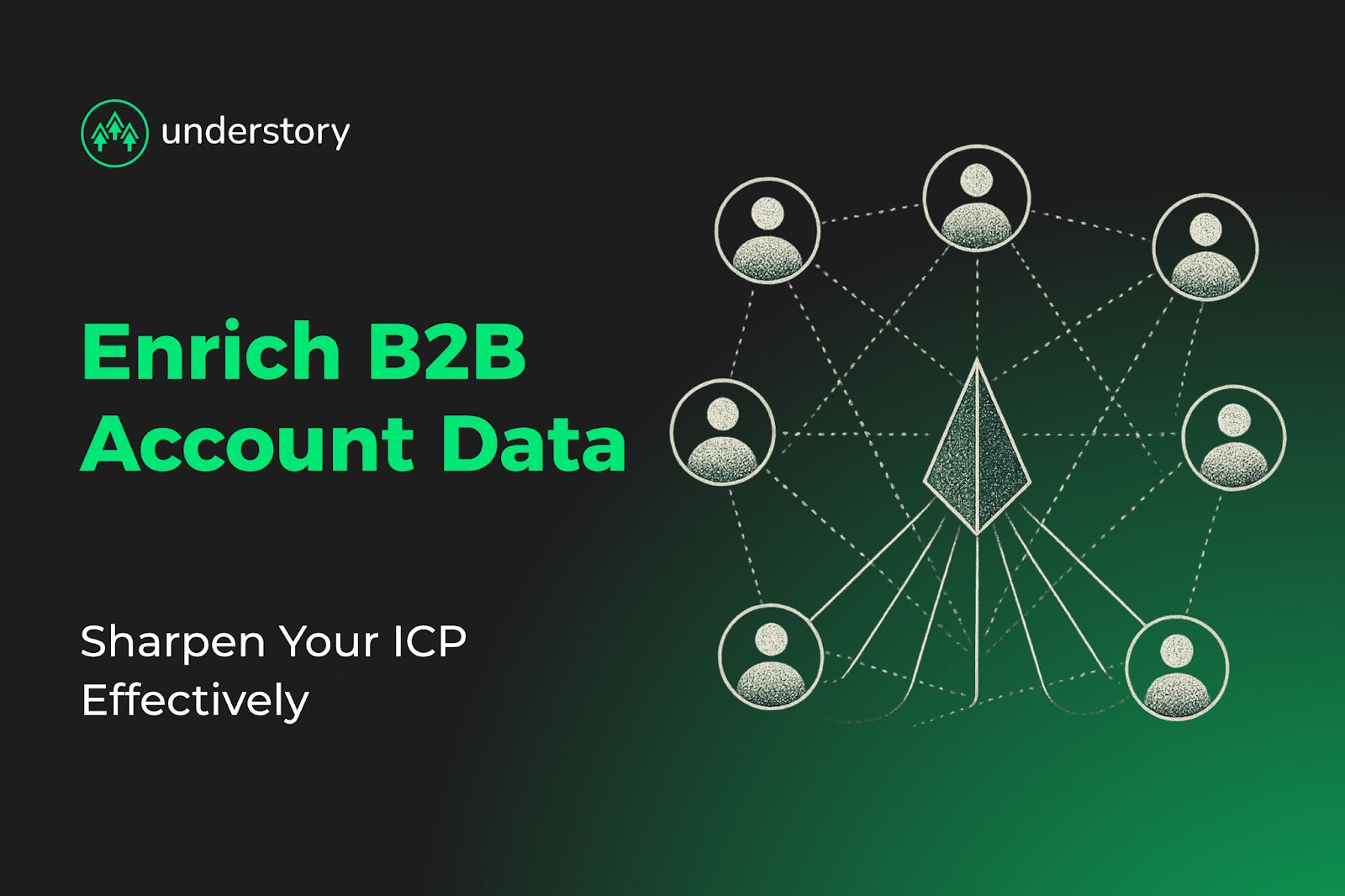
Account data enrichment fixes this. By adding verified firmographic, technographic, behavioral, and intent signals to your CRM, you shift from managing coordination overhead to executing allbound campaigns that prospects want to engage with. Better data enables coordinated execution across paid media, outbound, and creative touchpoints.
The hidden cost of poor account intelligence
SaaS growth teams lack visibility into which accounts are most likely to convert. You're targeting without understanding who's ready to buy, which technologies they use, or how their buying committee operates. Companies with early decision-maker engagement see higher win rates, yet most teams target based on firmographics alone and miss these critical signals.
Poor data quality costs companies significant revenue through wasted sales time, missed opportunities, and inefficient resource allocation. The coordination trap emerges predictably. Your paid media specialist targets accounts without intent signals, your outbound team works from lists lacking technographic enrichment, and your creative team builds generic messaging. All while prospects research competitors using buying signals your teams can't see.
This fragmentation happens because teams lack shared, enriched account data combining firmographic fit, technographic compatibility, behavioral engagement, and intent signals. Your best prospects slip through because research signals remain invisible, account lists stay misaligned, and messaging fails to reflect each prospect's evaluation stage and technical requirements.
What B2B account data enrichment actually means
Most SaaS teams enrich every account in their CRM without filtering for ICP fit first. This wastes enrichment credits on accounts that will never convert.
Account enrichment adds verified information from multiple sources to create profiles that enable better ICP definition, targeting accuracy, and revenue operations decisions. Four data categories transform ICP precision.
1. Firmographic foundation
Employee count with RevOps maturity indicators reveals operational sophistication. The critical ratio is 12:1 Sales Rep (AE + SDR) to RevOps, with most 200+ employee companies having dedicated RevOps teams. This establishes the 200-employee threshold as minimum for "ops-mature" account targeting.
Annual revenue with growth trajectory predicts budget availability and organizational maturity. Companies with strong Net Revenue Retention demonstrate active investment in their stack. Those below 100% NRR show signs of customer churn constraining growth investment.
2. Technographic intelligence
Technographic data reveals which technologies and software a company uses. This intelligence identifies accounts with compatible integration requirements and proven technology adoption patterns.
Technographic enrichment captures signals that predict buying readiness:
- Current technology stack mapping front-end and back-end technologies
- Software category deployment across CRM, marketing automation, analytics platforms, and sales enablement tools
- Specific vendor identification revealing exact products and platforms in use
- Usage intensity indicators classifying accounts as light, moderate, or power users
- Integration architecture including API usage, native integrations, and third-party middleware
- Technology adoption lifecycle positioning identifying early adopters, mainstream users, and technology laggards
Technology investment patterns reveal critical buying windows. Accounts demonstrating recent tool adoption or stack changes indicate willingness to invest in new solutions. Contract renewal dates for competitive tools (particularly 90-day windows) signal displacement opportunities.
3. Behavioral engagement patterns
Website engagement metrics including page views, content consumption, and return visit frequency reveal research intensity and behavioral patterns. Product usage telemetry from freemium or trial users provides signals of feature adoption and usage depth predicting conversion likelihood.
Accounts demonstrating 3+ high-value interactions within a 7-day window combined with cross-device activity within 48 hours show higher purchase readiness and conversion velocity. These signals enable coordinated allbound execution: triggering personalized outbound sequences, adjusting LinkedIn ad targeting, and adapting creative messaging based on demonstrated buying behavior.
4. Intent signal detection
Topic-based research activity on specific solution categories, competitor investigations, and purchase stage signals like pricing page visits reveal buying readiness. Most research happens anonymously before traditional lead scoring captures known activity.
The 8 core attributes that sharpen ICP targeting
To refine your ideal customer profile and improve account targeting, B2B SaaS companies should enrich data across 8 core attributes spanning firmographic foundation, technographic intelligence, organizational structure, and intent signals. For companies targeting $20K-$100K+ ACV deals, enriching these attributes delivers measurable improvements in conversion rates and deal velocity.
Tier 1 critical foundation:
- Employee count (200+ threshold) with RevOps maturity indicators including 12:1 Sales Rep to RevOps ratio
- Annual revenue ($50M-$100M+) with NRR benchmarks indicating strong GTM performance
- Technology stack sophistication using enterprise CRM plus marketing automation platforms
- Multi-attribute intent scoring combining impressions, ad clicks, and total engagements
Tier 2 high-impact differentiators:
- Organizational structure ratios validating operational maturity
- Buying committee composition with 8+ stakeholders and economic buyer clearly mapped
- Customer success maturity with dedicated CS teams and strong gross revenue retention
- Active hiring velocity in GTM departments (5+ sales roles within 30-day windows)
Multi-attribute scoring combining firmographic fit, technographic sophistication, and behavioral intent enables sales teams to identify high-value accounts and accelerate deal velocity. This enriched data creates the foundation for coordinated allbound execution across all growth channels.
Proven methodology for ICP refinement
Account data enrichment follows a systematic process that enables coordinated execution.
Step 1: Build unified data foundation
Implement a unified data model to standardize data collection across your customer lifecycle. This model captures three core components: pre-sales data (lead source, engagement scoring, qualification criteria), post-sales data (product usage, health scores, expansion signals), and the central connection point (win/loss attributes, deal velocity, competitive displacement data).
By consolidating data architecture around this framework, sales, marketing, and customer success teams access the same ICP-aligned information. This eliminates data silos and enables coordinated allbound execution where enriched account intelligence flows seamlessly across LinkedIn ads, outbound sequences, and creative messaging.
Step 2: Segment and analyze win/loss patterns
Implement structured scoring methodology rating each characteristic on win rate correlation, sales cycle impact, and LTV potential. Tier 1 ICP accounts should demonstrate measurably better performance across metrics to validate accuracy.
Step 3: Identify predictive attributes
Move beyond surface-level firmographics to behavioral and outcome attributes. The most successful ICP refinements combine quantitative enriched data analysis with qualitative customer interviews to discover non-obvious predictive patterns.
Step 4: Operationalize across GTM systems
ICP refinement requires company-wide operationalization. Enrich all accounts in CRM with ICP scoring attributes via automated APIs. Implement real-time ICP fit scoring combining firmographic match (40%), intent signals (40%), and engagement data (20%). Configure lead routing rules that assign Tier 1 ICP accounts (scores 85+) to senior AEs within 2 hours, route Tier 2 accounts (70-84) to standard AE flow, and direct Tier 3 accounts (<70) to nurture tracks.
Cross-functional alignment ensures coordinated execution: marketing campaign targeting weighted toward Tier 1 segments, sales territory design that concentrates accounts in Tier 1 clusters, and customer success onboarding playbooks tailored by ICP segment.
Step 5: Establish validation frameworks
Measure ICP effectiveness across lead-to-opportunity rates, win rates by tier, deal velocity, and customer lifetime value. Quarterly refinement cycles ensure ICP criteria remain accurate as market conditions evolve.
Step 6: Implement continuous enrichment
Quarterly refinement cycles analyze previous quarter's win/loss data, assess engagement quality and account progression patterns, evaluate pipeline impact by ICP segment, and update ICP scoring weights based on performance metrics. Validate whether Tier 1 ICP accounts demonstrate better performance across conversion, velocity, and LTV metrics as product-market fit evolves.
From coordination overhead to expert execution
The most successful SaaS growth teams combine enriched account intelligence with specialized expertise across functions. They use coordinated vendors and tools that integrate around shared data. Instead of spending strategic time managing disconnected specialists around confused targeting, they implement unified data models that enable each function to execute with consistent, personalized messaging informed by account intelligence.
The transformation looks like this: your LinkedIn ads target accounts based on specific intent signals and engagement behaviors; your outbound sequences reference their documented technology stack and recent hiring patterns. Your creative messaging addresses the pain points revealed in your enriched account data. All coordinated because your teams work from the same unified, enriched account profiles.
Coordinate your enriched data strategy with Understory Agency
At Understory, we coordinate LinkedIn ads, Clay-powered outbound, and professional creative for technical SaaS companies. We combine precise audience profiles based on your ICP with dual-axis lead scoring that integrates both firmographic fit and high-intent behavioral signals.
Rather than managing isolated LinkedIn, email, and outbound campaigns, we implement coordinated workflows that synchronize messaging across every touchpoint. Want to see what this coordinated workflow looks like for your organization?
Book a strategy call to explore how expert allbound execution can turn your enriched account data into coordinated campaigns that convert.
Related Articles

Qualified pipeline, handled
Signal-based outbound that fills the funnel while your team closes.