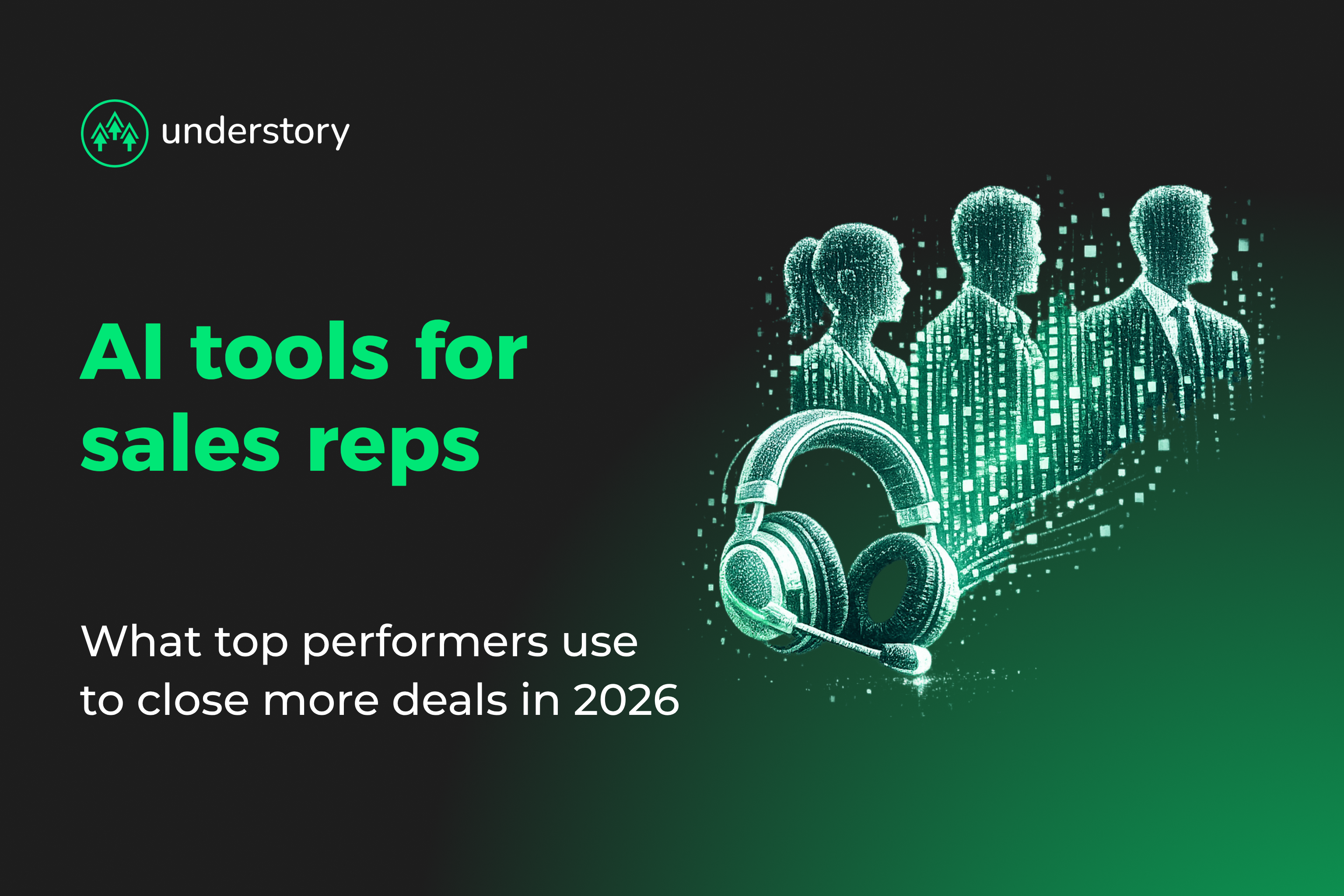
Sales reps using AI tools are more likely to meet quota. This is why the question isn't whether to adopt AI. It's which tools move the needle and how to coordinate them without creating new overhead.
Here's what top-performing B2B SaaS sales reps use in 2026 and how coordinated implementation eliminates the fragmentation that slows most teams down.
How top performers spend their time
The most effective AI tools fall into three categories that must work together:
- Research and enrichment (Clay and Claygent): Automating prospect research to gather contextual intelligence traditional enrichment providers miss
- On-demand intelligence (ChatGPT and GPT-4): Providing analysis, outreach generation, and tactical support for research, competitive intelligence, and objection handling
- Conversation intelligence (Gong, Jiminny): Analyzing sales conversations to identify winning talk tracks, detect deal risks, and provide data-driven coaching
Most SaaS teams implement these tools separately. Different specialists run each platform, creating disconnected data flows and inconsistent prospect experiences.
Top performers build allbound coordination where data flows automatically between systems, eliminating the manual research and data entry that consumed half their day.
Top AI tools for sales reps
Here’s our list of the top AI tools for sales reps.
1. Claygent: Autonomous research coordinated with outreach
Clay's AI research agent automates qualitative prospect research top reps traditionally do manually. Unlike basic enrichment tools that append firmographic fields, Claygent gathers specific intelligence: recent product launches, hiring patterns, technology stack details.
Coordinate Clay enrichment with outbound sequences and paid media targeting to eliminate the gap where most SaaS teams struggle. You should configure workflows, maintain data quality, and ensure enrichment connects directly to execution.
Performance impact:
SaaS clients report increasing enrichment coverage using Clay's multi-source enrichment. For enterprise SaaS with long cycles, that coverage improvement means reaching decision-makers early rather than entering late when competitors are already engaged.
Time savings:
Clay plus ChatGPT integration reduces research time from 30 minutes to 3 minutes per prospect. For reps researching 20 prospects daily, that's 9 hours reclaimed for selling.
Implementation reality:
Plan for a 2-4 week learning curve. At $720/month for the Pro plan, the 3-5 hours saved per rep weekly delivers 1.7x to 2.9x ROI.
2. ChatGPT: Coordinated prompts across sales workflows
Top B2B SaaS reps use ChatGPT across four core areas: prospecting, email writing, competitive intelligence, and objection handling. The challenge: different reps develop different prompts and workflows, creating inconsistent prospect experiences.
Pre-call research
Top performers compress pre-call research from 15-20 minutes to 2-3 minutes using strategic account brief prompts:
"Analyze [Company]'s website and recent news from the last quarter. Create a strategic account brief including business priorities, likely pain points for [specific role], trigger events, and key language they use."
Email writing with the 4T framework
The 4T cold email framework (Trigger, Think, Third-Party Credibility, Talk) with constraints enables personalization at scale:
- Subject under 3 words
- Body under 75 words
- Enables SDR teams sending 50-100 emails daily to maintain quality
Competitive intelligence and battle cards
Top performers analyze competitor positioning directly from their websites:
"Analyze [Competitor]'s website and recent marketing content. Identify their primary positioning, target audience messaging, feature emphasis, and pricing strategy. Generate a one-page battle card highlighting where [Your Product] has advantages and how to handle common competitor comparisons."
This competitive research integrates back into prospecting workflows. Reps reference competitor weaknesses when reaching prospects using competitive solutions.
Objection handling preparation
Generate multiple response options before calls:
"Generate 3 responses to the objection [specific objection] that are data-backed, under 25 words each, using empathy-insight-evidence structure."
Post-call documentation
Summarize the call and draft follow-up in one prompt. Include key points discussed, agreed next steps, and specific timing. This eliminates the 10-15 minutes reps spend crafting follow-ups.
Implementation principle: Keep AI in existing workflow. Reps won't consistently use ChatGPT if it requires leaving their CRM. Embedding GPT-4 assistants within your CRM platform maintains prompt consistency across your team.
3. Gong: Conversation intelligence that closes the feedback loop
Gong creates a reality layer over CRM systems, capturing what happens in deals versus what sales reps manually log. The platform analyzes every customer interaction to surface patterns that drive closed-won outcomes.
The platform captures granular conversation metrics driving coaching insights:
- Talk-to-listen ratios
- Question frequency patterns
- Competitor mentions
- Pricing discussion timing
- Next-step commitment rates
Top performers integrate Gong with Clay to create automated workflows triggered by call insights. When a competitor is mentioned, a battle card auto-generates. When a buying signal is detected, the deal stage auto-updates. Conversation data flows back into Clay and Claygent, enabling smarter prospecting based on what's working in live sales conversations.
Implementation reality:
Gong requires 30-60 days for meaningful pattern recognition across your team's calls. ROI accelerates after the platform has analyzed 50+ calls per rep, establishing baseline metrics for coaching comparisons.
4. HubSpot: CRM automation that eliminates manual data entry
HubSpot's AI capabilities transform CRM from a logging burden into an execution platform. Sales reps spend less time documenting activities and more time acting on AI-surfaced insights.
Core AI features for sales reps:
- Predictive lead scoring: Automatically prioritizes prospects based on engagement signals and fit criteria, eliminating manual list sorting
- Email sequence optimization: AI analyzes open rates, reply patterns, and conversion data to recommend send times and template adjustments
- Meeting scheduling intelligence: Suggests optimal times based on prospect engagement history and historical booking patterns
- Deal stage automation: Moves opportunities through pipeline stages based on activity triggers rather than manual updates
HubSpot syncs with Clay enrichment data and outbound platforms like Instantly to create unified prospect records. When Clay enriches a contact with new firmographic data, HubSpot workflows automatically update lead scores and trigger appropriate sequences.
Reps using HubSpot's AI features report saving hours weekly on administrative tasks like logging calls, updating deal stages, and prioritizing follow-ups. That time shifts directly to prospect conversations.
Implementation reality:
HubSpot's AI capabilities require clean data foundations. Plan for 2-3 weeks of data hygiene work before AI features deliver reliable insights. Integration with Clay and outbound tools adds another week of workflow configuration.
The allbound coordination that saves 10+ hours weekly
The most effective approach builds coordinated allbound sequences creating seamless data flow across your entire sales motion.
- Morning research phase (8-9 AM): Clay handles bulk enrichment across all day's prospects. ChatGPT analyzes companies to identify pain points and trigger events. This compresses pre-call work from 15-20 minutes per prospect to 2-3 minutes.
- Outreach creation (9-11 AM): Generate personalized cold email and call scripts using ChatGPT with company research plus prospect LinkedIn data fed into proven prompt templates.
- Pre-call preparation: AI summarizes prospect data and suggests tailored questions, compressing preparation to 2-3 minutes per account.
- Post-call documentation: AI transcribes calls and generates CRM-ready notes. Follow-up emails drafted based on conversation history.
This allbound coordination system saves hours per week per rep. Building this coordination infrastructure requires expertise most SaaS teams don't have in-house.
The governance reality
Despite productivity gains, proper governance frameworks remain necessary. SaaS growth leaders avoid governance issues by implementing coordinated AI frameworks that maintain quality standards while scaling output.
Minimum governance requirements:
- Content review: Establish approval workflows for externally-facing AI-generated content
- Data privacy: Ensure AI tools comply with applicable regulations
- Quality standards: Define and monitor output standards continuously
- Human oversight: Maintain review checkpoints for communications
- Training: Document acceptable use policies and train reps on responsible usage
Start with stricter governance (manual review of all AI-generated outreach) and gradually relax requirements as quality standards are established.
The governance challenge adds another coordination layer: who reviews AI-generated content, who maintains prompt libraries, who ensures compliance across teams?
Implementation priorities for revenue leaders
Start with the fastest ROI applications: email writing prompts, pre-call research, and post-call follow-ups. All deliver immediate time savings with minimal training required.
Establish a phased foundation before scaling:
- Weeks 1-2: Tool setup and workflow configuration with your sales ops team
- Weeks 3-4: Pilot Clay with 2-3 top-performing reps on a single high-impact use case
- Month 2: After validating the pilot (target: 75%+ enrichment coverage and 3-5+ hours saved weekly), expand to your full SDR team
- Month 3+: Integrate conversation intelligence platforms like Gong to create feedback loops completing your allbound coordination infrastructure
Monitor what matters:
- Lead enrichment coverage (target 80%+)
- Hours saved per rep weekly (target 3-5+)
- Response rates on personalized outreach compared to baseline
- Meeting conversion rates from outreach to booked discovery calls
Coordinate your AI-powered sales infrastructure with Understory Agency
Most SaaS growth teams implement Clay for enrichment, ChatGPT for outreach, and Gong for intelligence separately. Coordinating these tools creates the overhead they were meant to eliminate.
Understory provides expert allbound coordination, unifying AI-powered prospecting with paid media and creative execution. As a Clay Enterprise Partner, we handle workflow configuration, prompt optimization, and cross-platform integration so your team focuses on closing deals.
Book a call with Understory to discuss your AI-enabled sales infrastructure.
Related Articles

Qualified pipeline, handled
Signal-based outbound that fills the funnel while your team closes.