People keep asking how companies like Ramp, Linear, and Anthropic ship so much software with agents. There is no new SDLC or secret set of tools. The tools are increasingly available to everyone. You can build your own, use Linear, Claude, or whatever works.
The bigger difference is ambition. These companies encourage their teams to build more, experiment more, and let agents do more of the work. That's the main different between "AI native" or not. You try to use the technology to the max.
But don't get there by adopting a tool, you change your beliefs.
So in the very simplest way:
- let agents build
- automate what you can
- make it easier and faster to contribute
- increase the ambition of what your teams attempt.
In practice, that means things like:
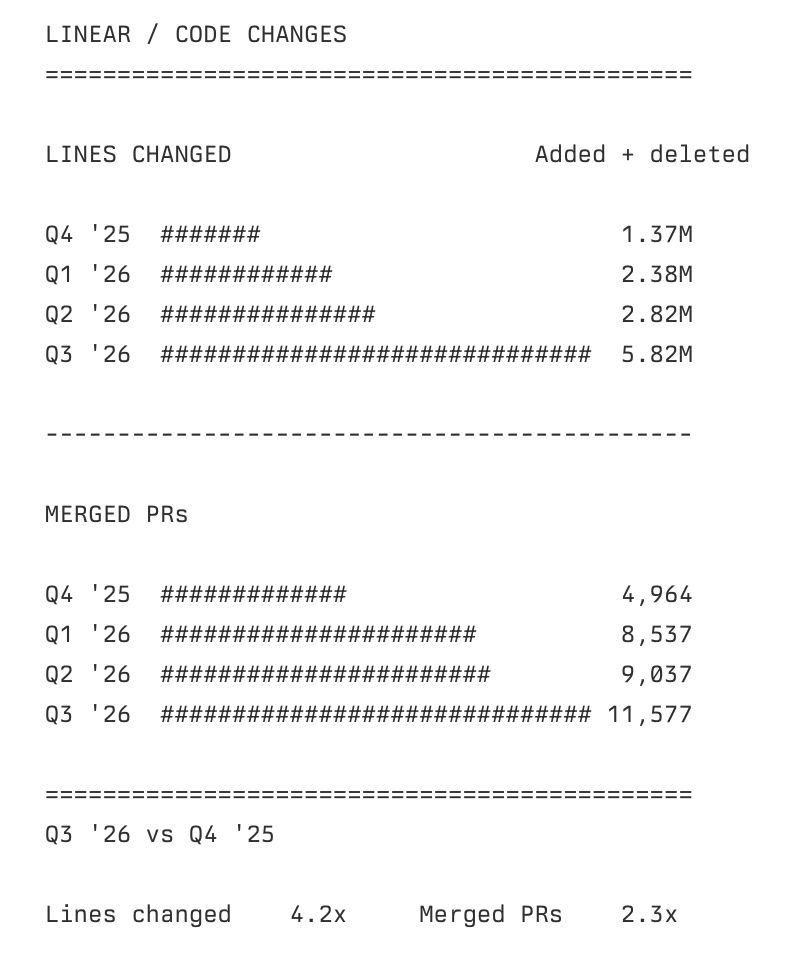
- Standardize around cloud agents. Most of our code (5M lines last quater) is now written in Linear with our Linear cloud coding agent. Cloud sandboxes make standardizing the system and environment easier for everyone and enables faster contributions
- Linear agent (with code access and cloud agent) operates in Slack too. If there is a discussion or someone notices a problem just say "@linear fix this" (decrease the time from something noticed to fixed)
- As bugs, errors etc arrive in Linear, send them to Triage, and have Loop to auto-investigate (connect to tools like Sentry, Datadog), and write a fix
- Let designers, PMs, non-technical people contribute code where useful. If they notice a problem, tell them they can submit a fix. If they want to try something, ask them to build a prototype.
- Set up code review agent and systems to make sure PRs are safe to merge.
- Run security as an automation, have agents constantly try to find security issues in your codebase, as they find, send it to a coding agent
- Instead of working on issue level, increase ambition, make a whole project, ask the agent to ask questions, investigate code base, create issues and have the agent work on the whole project at once.
- Bring customer feedback to the system like Linear, and make it available. At Linear every project now starts with 10-500 customer notes that influence the direction of the work, and which customers we should ask to test the solution first.
- Set up Loops/automations to constantly update reference documents for agents, like product area/code owners so work can be routed to right humans
Then what is left is how do you set direction for your teams (initiatives, projects they should work on) and how do you review results (better code review, Linear does it with Guided Reviews), how you maintain quality/cohesion which is not a new problem either.
At @linear we can help with automation, cloud agents, and code review, customer feedback and planning bits. But we can't change your mindset or how your company operates.
If your company is still spending energy debating jira workflow steps, you're probably solving the wrong problems.
give a man a tool, and he'll get to work.
give a man a way to build his own tools, and building tools becomes his work.
I’ve never quite understood the appeal of software that gives you a blank canvas and building blocks to make your own tools. I’d rather use a purpose-built product from a team whose judgment I trust, or build something custom for my exact needs with AI.
The middle ground makes you do the design work, but limits you to someone else’s building blocks. In companies, everyone can end up building their own systems, leaving the organization to deal with the complexity.
This is why I like the house analogy more than LEGOs for software that’s supposed to help people do work.
A house has a structure. A kitchen is designed for cooking. A bathroom has plumbing. Within that structure, you can choose the furniture, decorate, rearrange things, and make the space your own.
Now imagine sharing that house with 1,000 people. Would it help if everyone could decide for themselves what each room was for? Before doing anything together, you’d have to figure out what everyone meant by a kitchen.
At Linear, we’ve deliberately designed shared concepts like issues, projects, and teams. People have freedom in how they organize and do their work, but they don’t need to invent their own definition of a project.
One of the values of that structure is that it gives the work a canonical place. It’s rare to see someone casually duplicate an entire project in Linear. People do this all the time with documents and spreadsheets. Eventually, someone has to figure out which copy reflects what’s actually happening.
There’s a different feeling when the system helps to represent the work. Changing something has consequences for how other people understand it and what happens next. You’re working in a shared reality rather than making another copy of it.
Ideally in organization I like to see freedom within structure. Not freedom to make the structure meaningless
I think making those structural decisions is part of our job as product builders. Leaving them open doesn’t remove the work. It asks every organization to do it themselves.
With AI making custom software easier to build, that middle ground feels increasingly hard to justify.
A purpose-built product should bring judgment about how the work fits together.
Otherwise, I’d rather have the freedom to build exactly what I need.

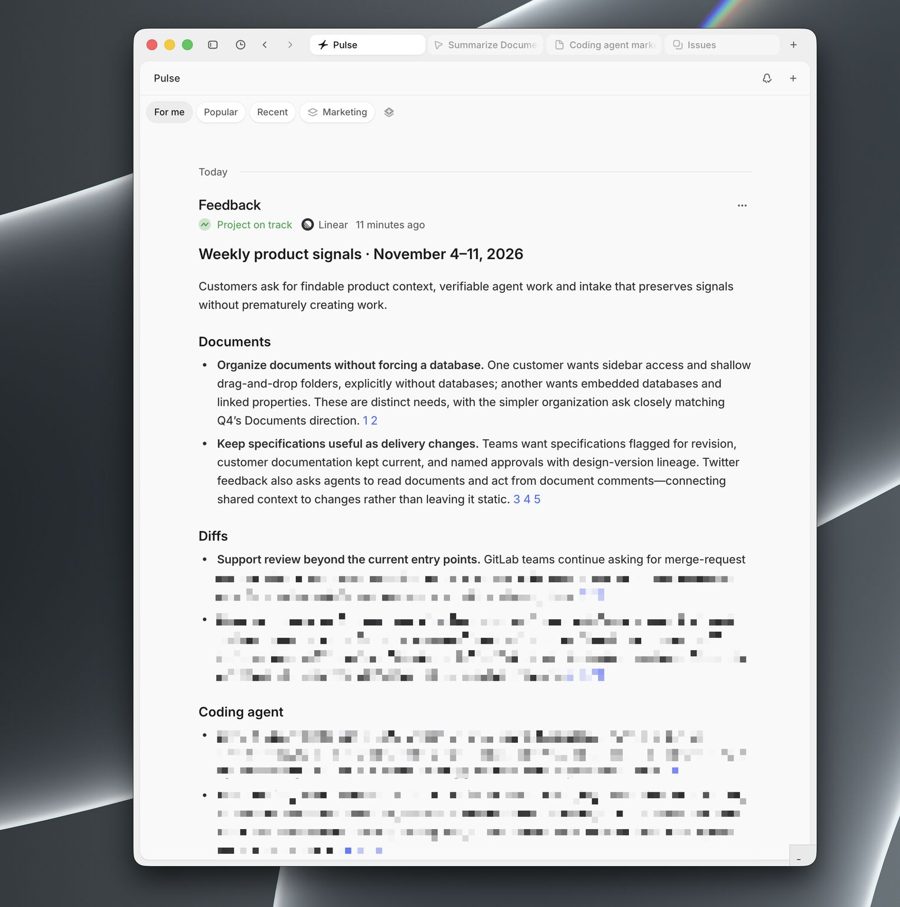
I set up this Weekly product signals Loop in Linear couple weeks ago.
Now it's one my favorite things to read each Wednesday.
- The Loop scans Linear, Slack, Intercom, Gong and X
- Then groups customer feedback by product areas (Documents, Diffs, Core, Intake) and reflecting to our plans or work that is already in prgoress.
- Each bullet has link to the sources, so I can go check back which customer actually talked about this.
- Everyone in the company can also see this and comment on it.
Linear can be your company's knowledge base but also the customer reality, and way to share it, use it and learn from it.
Just a few big names that have moved to Linear: Salesforce, Yahoo, Cars24, Figma, Klaviyo, Oscar Health. Overly complicated setups feel increasingly unnecessary.
It's all about the ambition and velocity you want to give to your teams.
I created the Linear Product Ops bot.
It helps with things like:
– writing clear issues
– short, useful PRDs
– turning feedback into project plans
– triaging feedback from X
– coordinating coding agents
To test it, I built my own Elgato Key Light app and a solar monitoring app. Grok helped me figure out the project, ask questions, write the spec, and turn it into issues. Then I could keep track of progress as the Linear agent worked through them, and review the code as it came in.
What surprised me was how little I had to explain. Linear already has the structure, teams, issues, projects, triage and the MCP tools to work with it. The bot could build on that instead of inventing a system from scratch.
Once you install the skill, you also get $25 in AI credits to build your apps with Linear. Let me know if you have feedback!