Anthropic building its own source control is a sign of what’s coming: agent-scale development will force us to rethink parts of the software lifecycle we’ve treated as settled.
My view is that the unit of autonomy has to become larger than a coding task. An agent that writes a change and hands it off has automated one step. A software factory has to carry that change through integration, testing and release, and use failures to improve the next attempt.
The difficult part is the interaction between changes. Two changes can each pass their tests and still fail together. A passing test result is evidence about a particular version, not every version that comes after it. As more agents work in parallel, keeping that evidence connected to what actually ships becomes a much bigger engineering problem.
That’s why I wouldn’t measure a software factory by how many agents it runs or how much code they generate. I’d measure how much work reaches production correctly, how often engineers have to step in to fix or unblock the work, and how quickly the system recovers when it gets something wrong.
Faster coding is valuable. The bigger leap is making the entire system capable of absorbing it.
Wishing a very happy Diwali to all celebrating today.

Coding agents can write a fix in 30 seconds.
Then they wait 20 minutes for CI to say it failed. And get back a red X and 4,000 lines of logs.
The bottleneck isn’t the code anymore. It’s the loop.
Agents need three things from CI:
- Fast validation. Run only the tests the change affects. Don’t rebuild what hasn’t changed.
- Failure context they can act on. The failed step, the relevant logs, the commit under test.
- A closed loop. Validate the next attempt without an engineer brokering every handoff.
An API that only triggers builds isn’t agent-friendly CI. It’s a doorbell.
That’s what we’ve been building at Harness with Test Intelligence, build caching, and our MCP and IDE integrations.
Build duration still matters. The metric that matters more: time from a failed attempt to a verified fix, and how many manual handoffs it took.
Otherwise you get very fast agents waiting on very slow pipelines.
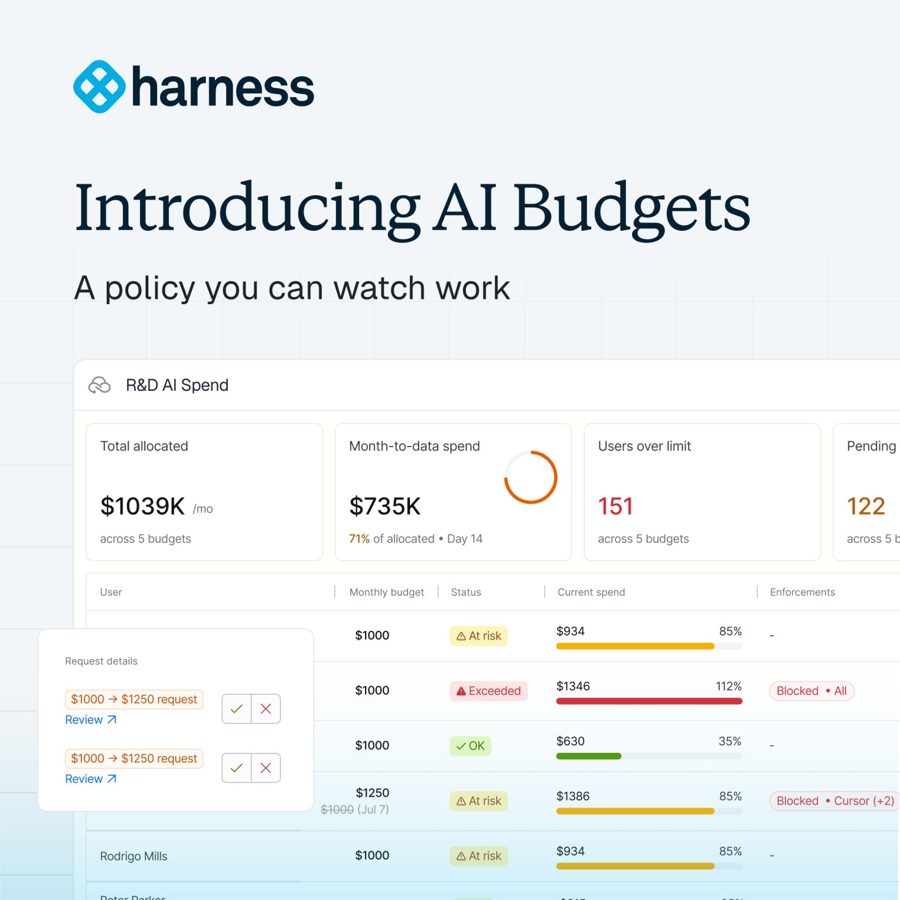
Today we’re launching AI Budgets in the Harness Cost Management Agent.
The agent already attributes cloud, AI and engineering spend to an owner, down to the session or the model. AI Budgets adds a limit on top of that attribution and runs on the same budget and policy engine we use for cloud spend. Every warning, block and approved increase is written to the unified Harness audit trail.
How it works:
- Budgets are set per team, developer, or provider, and reset weekly or monthly.
- At 90% of budget, the person is notified and nothing is restricted.
- Past 100%, access pauses until the next reset or until a request for more is approved.
- Requests for more are made in the product and routed by amount to the right approver, with no ticket.
We use it ourselves. In a few months, we went from a few engineers experimenting with AI tools to our entire team building with AI. Our spend was spread across Cursor, OpenAI, Claude, Bedrock, Copilot, and more, but there was no reliable way to see an aggregated view of cost by developer. So, we signed up to be the first to use AI Budgets. Here’s what we learned.
1) Show people their own spend before you limit anything. Once developers could see their usage by model, behavior changed before we set a single limit. The same task can cost ten times more on one model than another, and nobody had been able to see that.
2) Reset budgets weekly. With a monthly budget, someone can use the whole month’s allowance in the first week. This allows people to change behavior before it’s too late.
3) Make it easy to ask for more. Our developers request more budget directly in the product, without filing a ticket, and the request goes to the right approver. People accepted the limit once raising it took a couple of clicks.
Once we rolled out AI Budgets to the engineering team at Harness, we saw cost per million tokens drop about 55%, and usage held steady. Developers started using cheaper models for work that didn’t need the expensive ones.
AI Budgets is available now. Learn more: https://lnkd.in/gBaPx545
We’re opening early access to the new Harness platform experience.
Agents are already starting to run more of the delivery process, and before long they’ll run it end to end. But delivery was designed around people doing the work. When a person hits an inconsistency in a pipeline, they know the workaround: which stage type goes with which capability, which tools are installed on which host, how deeply to nest the YAML. An agent has none of that knowledge, so every one of those inconsistencies is a place where the pipeline can fail.
To let agents run delivery end to end, we rebuilt Harness. We took what we learned from hundreds of millions of deployments at enterprise scale and applied it to a new platform experience built for agents. Every change we’ve made reduces what an agent has to deal with: less nesting, less setup, less host-level tooling.
Here’s what’s new:
1. One pipeline model. We’ve removed capability-specific stages so an agent only has to learn one model. Build, deploy, security, infrastructure, and agentic work all run on one flexible stage and execution model.
2. One Delegate. It’s rewritten in Go and runs on Linux, Windows, and macOS. Every step starts in its own container with everything it needs in the image, so there’s no host-level tooling for an agent to work around. Step definition updates ship as images, with no Delegate upgrade required.
3. Versioned steps and templates. Harness publishes each step to a shared library, so we can keep improving them while each pipeline pins to an approved version, recorded in the YAML and enforceable with OPA, including for agents that update pipelines.
4. Agents as the primary interface. The agent knows which page you’re on, so it works from that context instead of a pasted log, and it proposes each action for you to approve. Coding agents like Claude Code, Cursor, and Codex can reach the same platform through the Harness MCP Server or CLI.
5. Governed agents. Worker Agents are pipeline steps, so the approvals, policies, and audit trail on your pipelines apply to the work the agent does. An approval step keeps a human in the loop before an agent’s changes move forward, OPA governs its actions at runtime, and every action is logged.
6. Dashboards agents can build. Ask for the view you need in AI Chat or build it in the Dashboard builder. Charts run on the Harness Data Platform and Knowledge Graph, so one can follow a change from commit to deployment to service.
Huge thank you to the product, engineering, and design teams who have been hard at work building this new experience. You can read more about what’s new: https://lnkd.in/gfZJdrnb
Fireworks AI has now been breached twice since early October, which raises a question for anyone who has given an AI vendor an API key: what happens to that key if the vendor is breached? Fireworks says customer account and billing information was accessed, and for a limited number of accounts, secrets, datasets and incomplete models.
Deleting a stored secret doesn’t revoke the credential behind it, so if a vendor holds your keys, their breach becomes yours. A lot of what is happening with AI today repeats a mistake delivery teams have made before: long-lived secrets kept in places we don’t control, like a vendor’s environment variables. Teams are moving fast, and governance habits haven’t kept up with how much we now trust agents and AI vendors to do.
Companies should expect that one of their vendors could be breached and limit what those vendors hold to something that expires quickly. If you aren’t doing these three things yet, a breach at one of your vendors would reach further into your systems than it needs to.
1) Resolve secrets at runtime from a vault you control, so the job never stores them.
2) Use credentials that are short-lived and scoped to the task, so a key found in a log or an environment variable weeks later is no longer useful.
3) Run execution in infrastructure you control, with limits on outbound traffic, so a compromised workload has fewer places to send what it finds.
At Harness, we apply the same approach. Secrets resolve at runtime from your own secret manager, so the values stay in your infrastructure and Harness stores only a reference. Worker Agents build on that and run as pipeline steps, under the same policies, approvals and audit as everything else. Secrets sit with a broker, so the agent never holds a real key. A compromised agent has nothing real to take.
A question to ask this week: for each AI vendor you use, which of your credentials do they hold, and how long would each one stay valid if their environment were compromised today?