Last week, I promised to start sharing examples of AI innovation here at Zendesk, so here’s a great one to kick off with.
Over time, we were starting to see customer storytelling get more and more fragmented. Every region had its own spreadsheet, its own process, and teams spent a significant amount of time just staying aligned with each other. At the same time, demand for customer stories was growing, particularly around customers seeing real results from AI.
Diana Machado on our EMEA Campaigns team had been managing this problem for a while. During our AI upskilling sprint, she saw an opportunity to do something about it.
She built the Customer Story Factory, which takes a customer transcript and generates a tailored interview guide, a full customer story written to our editorial guidelines, a social post, and an internal slide with key metrics. It is now widely used across the team and regional marketers that used to spend the bulk of their time coordinating across spreadsheets are now able to focus on finding and telling great customer stories.
I want to stress that Diana is a campaigns manager. She had never written a line of code before this, but she built this in less than a day. That tells me that with the right tools, we can empower anyone to be an equal partner in building better ways of working.
Earlier this summer, I made a commitment to share what we learned from our company-wide AI upskilling sprint.
Here's where we landed:
- 73% of our global workforce participated in a workshop, with more than 2,800 people attending sessions covering prompt engineering, agent building, and data analysis. 600 hours of focused learning across the organization. Of everyone who participated, 92% came out with greater confidence in their ability to use these tools at work.
The sprint also built three things that did not exist before:
- Infrastructure - a Prompt Library, Agent Marketplace, and AI Hub that anyone in the organization can access and build on.
- Good habits - Weekly Sandbox Hours and community gathering spaces to keep the learning going after the program ends.
- Buy in across the org - Nearly 3 in 4 employees showed up, which tells me the impact of this program went far beyond our technical teams. The best evidence of that came from our Zennovate hackathon shortly after, where non-technical participation tripled.
- What these raw numbers don’t capture are the stories behind the actual innovation that took place. Over the next few weeks, I’ll be spotlighting three such stories from across the company that show what’s possible when the people who understand the problems best are empowered with the tools to solve them.
Stay tuned.
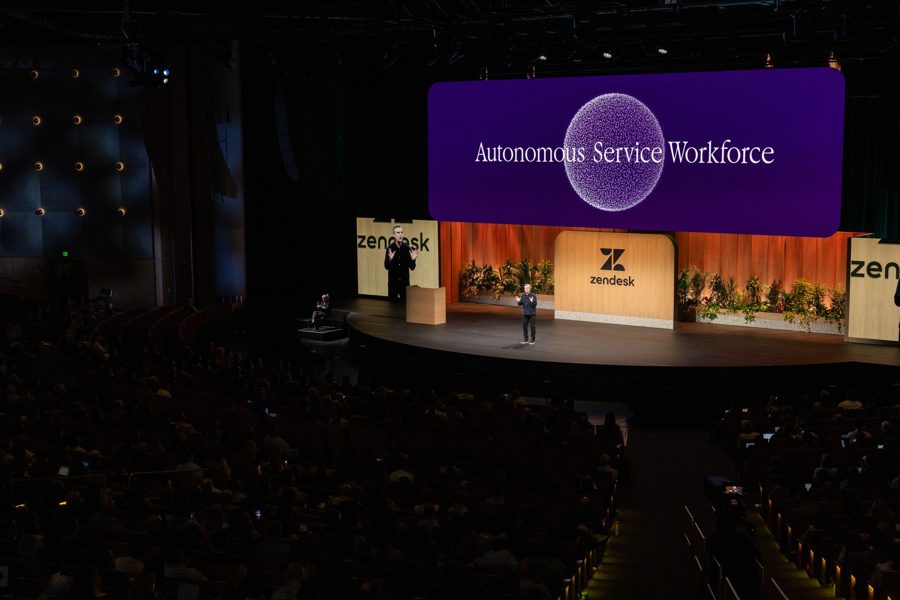
Great week at Zendesk Relate in Denver.
Connecting with customers, catching up with colleagues, and speaking with journalists about the future of customer service made me step back and realize just how far we’ve actually come.
Not that long ago, the ticket inbox was our center of gravity: questions came in and agents resolved them. Self-service was something we always tried to push for, but the bulk of the work sat in the queue.
Today, that center has completely shifted. Thanks to AI agents, most of the work now happens before a conversation ever reaches a human agent. The platform learns and improves with every interaction, and humans can focus on the work that truly needs them.
We finally put a name to where this has been heading all along: the Autonomous Service Workforce.
Thomas Verschoren did a great job capturing this evolution (and our big Relate product announcements), so I highly recommend you give his recap a read.
Proud of this team, energized after the long weekend, and ready to dive back in.
https://lnkd.in/gyX-nFDH
Every enterprise deal comes with questions. Sometimes dozens, sometimes hundreds from a single prospective customer before they commit. Multiply that across nearly 500 companies and you end up with over 60,000 data points showing what customers are asking about, what they care about, and how priorities are shifting.
For years, that signal just sat there. We never had the analyst capacity to turn that insight into meaningful customer value.
Jorge Gutierrez Luthe had been sitting with this challenge for a while, and our AI upskilling sprint gave him the opportunity to try something different. Using Claude Code, he classified every question by product area, analyzed the patterns, and built a dashboard from scratch over the course of a few weeks. Thanks to him, every PM at Zendesk now has on-demand access to customer demand signals by product area, region, and customer type, refreshed every month.
What Jorge's work tells me is that some of the biggest opportunities in front of us are sitting in data we already have. What we have now are the tools and capacity to unlock them.