A couple weeks ago, I wrote that the rituals of customer service were invented in call centers in the 1960s. Hold music is one of those rituals, and it turns 60 this year. The inventor of hold music was Alfred Levy, whose patent for a telephone hold program system was granted in 1966. Levy discovered the solution by accident when a loose wire at his factory touched a metal girder and started picking up a local radio station, piping music to callers on hold. What makes his patent interesting is that he wrote down the better answer on page one, which was not hold music, and then explained why nobody would use it.
Courteous practice, he said, requires that a held caller be assured at reasonable intervals that the person they want is still busy, but the pressure of the operator's duties may prevent them from doing this. Levy wrote that the correct answer was a human periodically reassuring the caller, identified the reason it does not happen as the operator being too busy, and then offered music as the substitute.
The problem Levy was solving is that a caller on hold hears nothing, decides the line is dead or the call has been forgotten, and the call gets abandoned altogether or remade, which he called a waste of time and money. Music was proof the line was live and the thing you could automate in 1962 when the capacity for periodic reassurance was not.
A study from 20 years ago tested what actually keeps people on hold. Researchers at Technion placed 123 real telephone calls and compared three different hold experiences: music alone, apologies delivered at intervals, and announcements telling callers their position in the queue. Queue position announcements led to the lowest abandonment rates, while music and apologies both fell short. What kept people on the line was not sympathy, not reassurance that someone cared, and not hold music, but being able to tell they were making progress toward resolution.
AI changes what is possible. An AI agent picking up the call knows who is calling, what they bought, what broke last week and where the case stands. It can explain specifically where the caller is in the queue and what progress is being made, or it can resolve the issue immediately so the wait does not happen at all. Levy knew in 1962 that periodic human contact was better than silence. The research proved it was specifically progress information that mattered. AI is what makes it possible to finally deliver what the research showed actually works, at a scale that human operators never could.
Meeting customers where they are no longer always means adding another support channel.
At Zendesk, we recorded roughly 2 billion requests to Help Center URLs from AI bots and crawlers in the last 30 days, up 2.5× from the same period a year ago. Most of that traffic came from AI lab crawlers seeking pretraining data for their models, underscoring the value they see in the support instructions and procedures published across 50,000 Zendesk Help Centers.
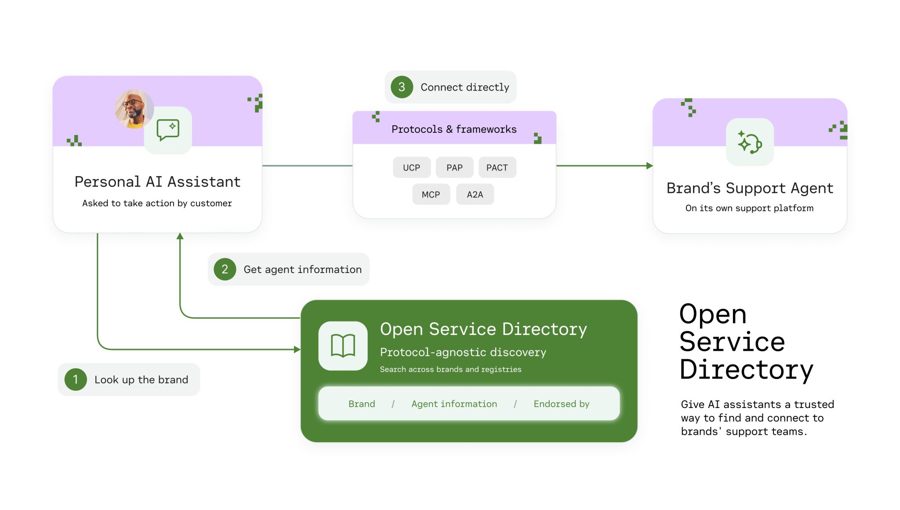
When a customer's request needs action, their personal assistant needs a reliable way to reach the business's official support. Getting the work done requires accurate and complete knowledge, access to the right systems and permission to act.
An assistant might explain how to reschedule a repair appointment. It should also be able to arrange that change through the business's official support, with the customer's approval and within the business's policies. The customer should not have to find the right website and start again because they began with their assistant.
That is the role of Zendesk's Open Service Directory, helping personal assistants find a brand's verified support and connect to it with the customer's permission. Customers should have more flexibility in how they get help, including through the AI assistant they already use.
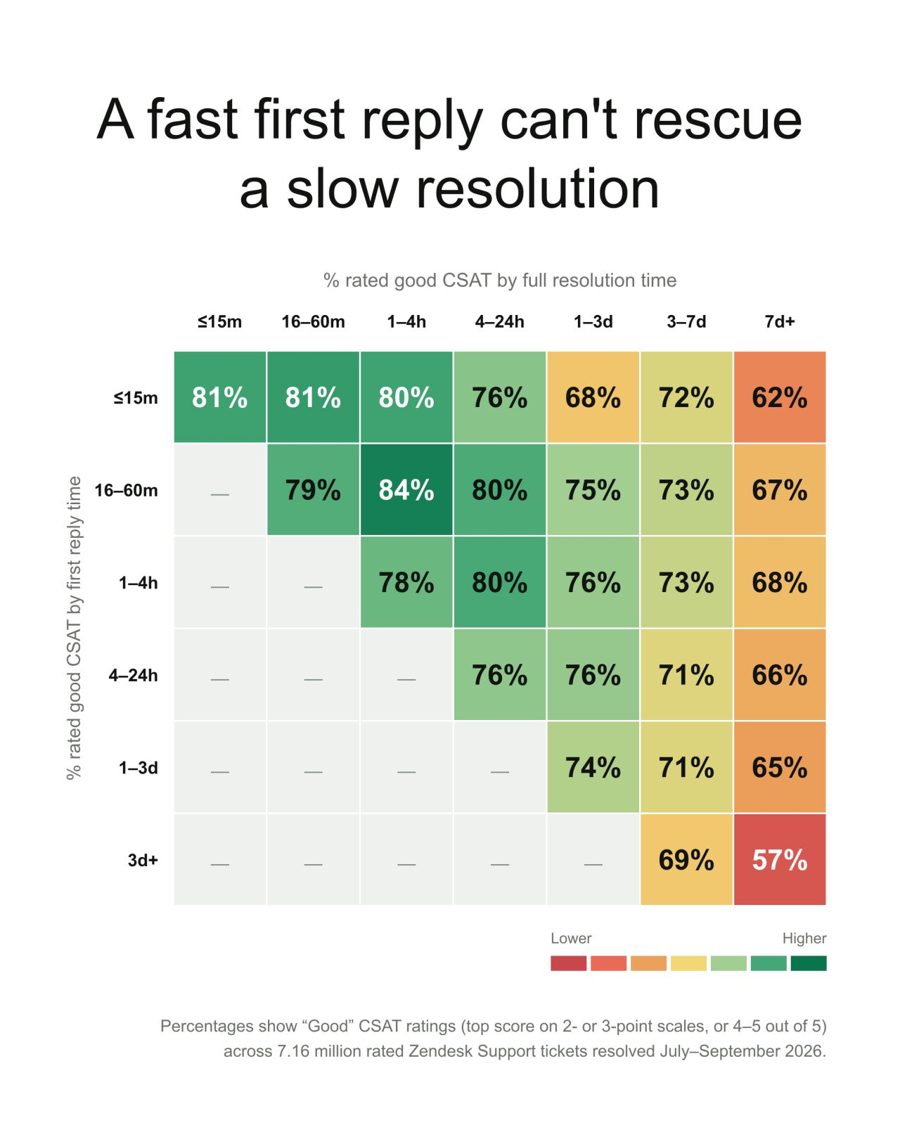
Time to first response still matters. Time to full resolution matters more.
AI can give you a first response in 300 milliseconds and the customer can still be waiting a week for their problem to be solved. The highest CSAT scores come from fast replies paired with fast resolutions, but once resolution stretches past seven days, no first reply speed rescues CSAT.
Delivering a resolution takes knowledge and clearly defined policies. It takes access to specialist agents and, through MCP or other integrations, to the systems where the work actually happens. The help the customer actually needs, the refund or restored access, only happens in your back-office systems.
Without those connections, you are signing up for repeated handoffs to humans and the friction that comes along with them. Worse, you can put your customers in a chatbot escape room, where finding a way to escalate becomes the challenge.
An agent’s limits now have less to do with language and understanding and much more to do with its connections to your systems of action. The teams that wire AI into those systems are already pulling ahead.
The holiday season is fast approaching. Most teams watch inventory, delivery, and support staffing. Another thing worth watching, one most teams overlook, is a rise in “Where is my order?” contacts.
Known as WISMO contacts, short for “Where Is My Order,” they made up roughly 4% of classified support volume across all our customers in 2025.
There are two kinds of WISMO contacts. One is a question: where their order is, when it will arrive, or how to track it. The other is a problem: their order is late, never arrived, or is lost. On average, roughly 51% are status questions and 49% are delivery problems. Both arrive under the same “Where is my order?” label, and they are hard to tell apart at intake. As a result, the whole bucket gets treated as basic, repetitive volume to automate away or push to self-service.
Automating that bucket of inquiries is the right move. The mistake is stopping there and losing sight of how the volume of basic questions is changing. Last holiday season, we looked at every anonymized WISMO ticket and split them into status questions and delivery problems. The status questions started rising about a day before the delivery problems. To check, we tracked how each volume changed over time, then slid one curve across the other a day at a time to see where their rises and falls matched most closely. The closest match came when the delivery problems sat one day behind the questions. At that fit, the correlation was 0.96, almost a perfect fit, with the questions consistently a day ahead.
You might think a customer asks where their order is, then reports it lost. Mostly, that isn’t what happens. Only 0.7% of the status-question tickets later picked up a delivery-problem label. The pattern is across the base, not within a single order. When a wave of “Where is my order?” questions comes in, a wave of late, lost, or missing orders tends to follow about a day behind.
That isn’t surprising, and the value isn’t the prediction but the day of lead time. The catch is that lead time only helps if you can still see the signal. When you automate away a repetitive request, you remove the work, and you can remove your visibility into the pattern underneath it. The contact disappears, and with it your early view of shipping falling behind or fulfillment backing up. The labor is gone, but the insight shouldn’t be. Automating away the ticket isn’t the same as automating away the problem.
The practical move is to keep a seasonal baseline alert on the volume of every question type you have automated away, not just WISMO. Anything you deflect in volume, you should still measure in trend, because a shift there signals that something upstream has changed. When one fires, look at what is upstream of that question, the process, partner, or promise it depends on, and proactively notify customers so they don’t have to open a support request to find out.
The basic questions are worth automating away, but don’t lose sight of the signal they carry.
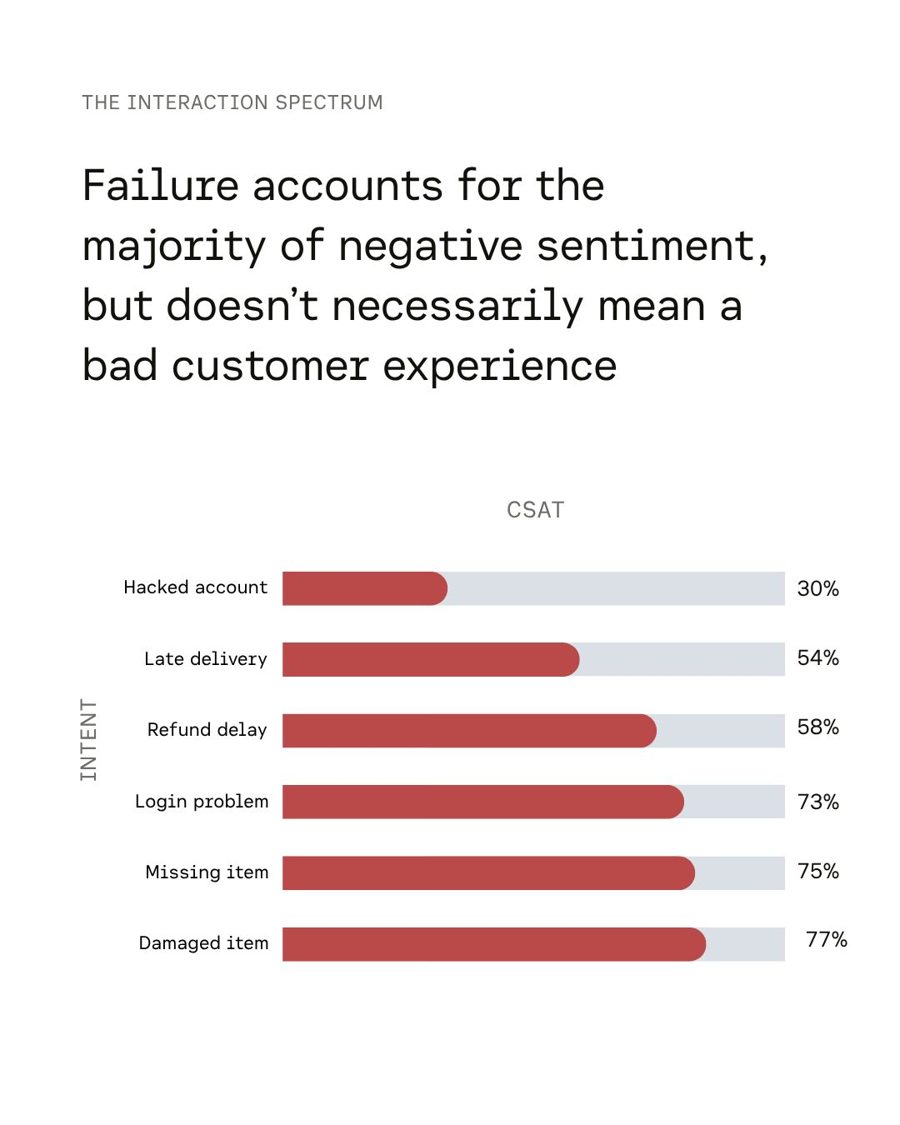
Last week I shared a breakdown of what customers actually contact support about, drawn from 165 million intent-labeled tickets across Zendesk’s paid accounts. Thirty-one percent of actual customer requests are failure interactions. A product breaks, a delivery never arrives, an account gets hacked, a refund is delayed. These are not support problems. They are business problems that show up in the support queue.
The customer contacts Support because Support is where the consequence has landed. The root cause sits somewhere else though, in product, billing, operations, sales, marketing, or a partner, and Support just inherits the recovery.
The striking part is how wide the outcomes are. Across the failure examples we mapped, CSAT ranges from 30 percent to 77 percent. The same kind of breakdown can end in a terrible experience or a decent one. The failure creates the need for support, but the recovery decides whether the experience stays bad.
Too often the response is to hand an agent a playbook and ask them to run it over and over. The person becomes the runtime for a repetitive resolution. That is the first thing to change. Failure interactions are not just demand to manage. They are the clearest signal a business has about where its customer promises are breaking down. The same refund failure surfacing in hundreds of tickets this week is a signal to the billing team, not a backlog for Support to grind through. Read at volume, Support is an insight engine for the rest of the company.
The best resolution for a delayed refund is not a better script. It is a refund that does not get delayed. The best resolution for a missing delivery is a fulfillment process that prevents the failure in the first place. The first move is to fix the promise upstream, with the team that owns it. That is a product or billing or operations decision, not a support one.
Not every failure can be eliminated that fast, and most will not be. Fixing the root cause is the right long-term move, but it competes for the same resources as everything else a business is trying to ship. For the foreseeable future, Support keeps picking these up. That is where AI changes the picture. When the recovery is repeatable, AI can take on recognizing the issue, gathering context, taking a prescribed action and keeping the customer informed. Built one intent at a time, it takes the repetitive recovery off the person. That moves people toward the cases where judgment, empathy, exception handling and real advocacy make the difference.
The two moves belong together. Use Support to find and fix the failures upstream, and use AI to make the remaining recovery faster, clearer and more consistent. Support stops being the place where every other department's mistakes land and starts helping the rest of the business get better.