Most outbound teams don't have a volume problem. They have a dead weight problem. Your list is full of accounts that match your ICP on paper, absorb rep time, and never respond. Not because outbound is broken, but because those accounts were never ready to buy in the first place.
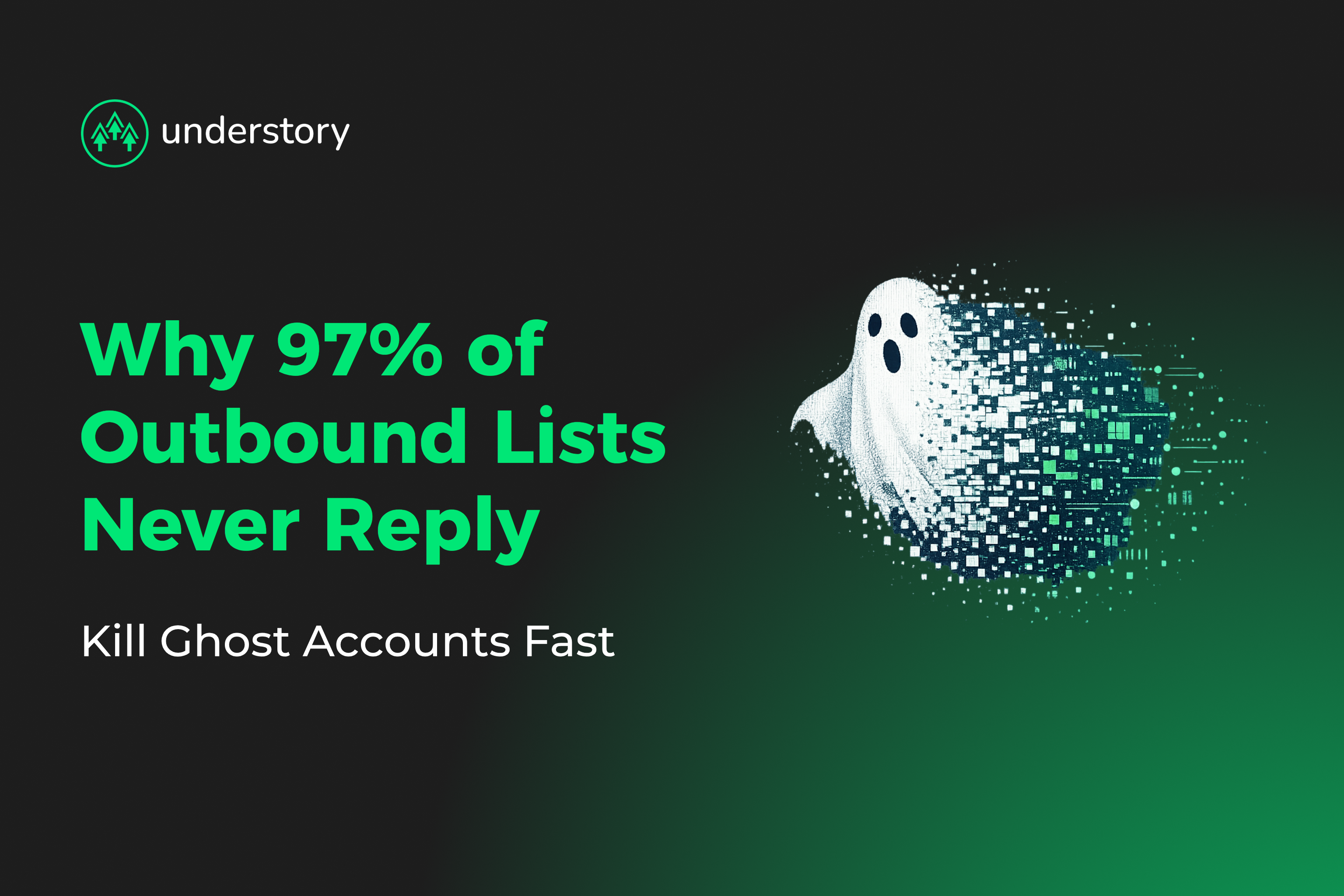
These are ghost accounts. Killing them fast is the difference between a list that generates pipeline and one that drains it.
What ghost accounts actually are
Ghost accounts match your ICP on paper but show no real buying activity. They have the right industry, company size, revenue range, and technology stack with zero response across repeated outreach.
Unlike a "not interested" reply, which gives useful signals, ghost accounts give you almost none. They sit in your CRM, look viable, and consume effort without moving the pipeline.
The core problem: ICP fit does not equal buying readiness. Your ICP defines capable buyers. Buying signals identify ready buyers. Ghost accounts sit in the gap between the two.
The cost compounds fast. If a 50-person sales org spends 25% of outreach time on ghost accounts, that's the equivalent of 12.5 full-time reps working accounts unlikely to convert. For teams targeting $50K+ ACV deals, every wasted sequence displaces pipeline that could go toward signal-rich accounts.
Five reasons your ICP-matched prospects never respond
Not all ghost accounts are the same. The reason they ghost tells you whether to remove them, revisit them later, or change your approach.
1. Your data is dead on arrival
B2B contact data decays faster than most teams account for. Contacts leave companies, emails bounce permanently, and phone numbers disconnect without any CRM update. Your message may be perfectly targeted. It's just landing in an inbox no one checks anymore. Data decay is invisible until you're measuring reply rates against a list that's six months stale.
2. Inbox saturation buries your outreach
A VP of Engineering at a 200-person SaaS company receives constant outreach from dev tools, infrastructure, and observability vendors. Your email may be genuinely relevant, but it still blends into the noise. The account isn't unreachable. It's overloaded. Breaking through requires more than a well-written sequence. It requires showing up across multiple channels with a consistent message before asking for the meeting.
3. No commercial urgency exists yet
The account has the problem your platform solves, but you haven't helped them quantify the cost of inaction. Without commercial pressure, you stay in "nice to have" territory indefinitely. For $20K+ ACV deals, prospects need to see the ROI case before they engage seriously. Outreach that leads with features instead of cost-of-doing-nothing rarely converts accounts that aren't already feeling the pain acutely.
4. The timing is simply wrong
The account is a strong firmographic fit, but there's no recent funding, no executive hiring in relevant functions, no technology changes signaling an active initiative. Your outreach reaches them with no active need, so response is unlikely regardless of message quality or personalization. These accounts aren't ghosts permanently. They're ghosts right now, and the right signal turns them back into live targets worth sequencing.
5. Your engagement model doesn't match your deal size
A $50K ACV enterprise deal requires executive-level engagement, custom business cases, and ROI modeling. Approaching that account with standard SDR sequences and templated emails signals a mismatch the prospect feels immediately. Prospects in the $20K–$100K ACV tier expect strategic dialogue. When the outreach model doesn't reflect the seriousness of the purchase, ghosting is the most likely outcome.
How to identify and remove ghost accounts fast
Effective ghost account removal requires multi-signal validation.
Layer intent signals on top of firmographic fit
Stop treating ICP matches as sufficient qualification. Classify accounts by signal density: high, medium, low, or none. Use indicators like research intent, hiring activity, technology changes, and engagement patterns. Accounts showing zero signals across multiple categories over 30–60 days are primary removal candidates.
Set automated time-based disqualification rules
Build workflows that automatically remove accounts from active outbound when they exit qualification conditions. Practical thresholds:
- 90-day CRM filter: Accounts with opportunities created or lost within 90 days get flagged for review, not re-engaged through cold sequences
- 60-day active window: Accounts showing buying signals within 60 days with strong profile fit stay active
- 30-day cadence blocks: Prevent removed accounts from immediately re-entering sequences
- Monthly score decay: Reduce account scores by approximately 25% each month without new activity
- 365-day auto-archive: After a full year of zero activity, archive as dead weight
These rules keep active lists focused on accounts that can actually move.
Apply negative scoring
Don't just add points for positive signals. Subtract points for disqualifying ones: careers page visits, extended inactivity, and firmographic mismatches including geography or company size outside your ICP.
Run a pre-outreach MEDDIC ghost risk assessment
Before investing in extensive outreach, classify accounts against MEDDIC criteria. Accounts missing three or more elements, no quantifiable Metrics, no Economic Buyer access, no Champion, or no Decision Process clarity, are high ghost risks. Don't spend your best sequences on accounts that can't buy even if they want to.
Enforce frequency-based engagement thresholds
Contacts with fewer than five total engagement events across multiple cadences over 60–90 days should move to long-term nurture or be removed from active outbound entirely. Someone may open an email or two and still not be a serious prospect. Set a minimum engagement bar before escalating investment in any account.
Why allbound coordination kills ghost accounts
Many ghost accounts aren't truly unwinnable. They ghosted a specific channel, at a specific time, with a specific message. Allbound coordination helps you test that assumption instead of writing off the account entirely.
A coordinated approach gives your team more ways to confirm what's actually happening:
- LinkedIn ads warm the same accounts your reps are sequencing
- A prospect who ignores email three times sees a relevant ad on Tuesday and gets a LinkedIn message on Thursday
- Engagement with a paid asset, like a whitepaper or webinar clip, triggers a personalized follow-up tied to that exact topic
- Messaging stays consistent across outbound, paid media, and creative instead of shifting from channel to channel
That coordination turns more ghost accounts into engaged pipeline because the buyer experiences one clear story, not three disconnected campaigns.
For SaaS teams managing $20K–$100K+ ACV pipelines, this matters. Single-channel cold email isn't enough at this price point. It doesn't match how enterprise buying decisions get made: committees, long cycles, and multiple channels.
The shift in effective outbound isn't about writing better cold emails. It's about building coordinated systems where every touchpoint reinforces the same narrative and moves target accounts forward. At Understory, this is the core of how we run outbound for clients: Clay-powered prospecting to surface signal-rich accounts, coordinated paid media to warm the same targets, and consistent creative across every touchpoint so nothing lands cold.
Stop burning cycles on ghost accounts with Understory Agency
Ghost accounts multiply when outbound, paid media, and creative target the same accounts with different messages at different times. No single system validates readiness across channels, so dead weight accumulates and active lists grow stale.
Understory closes that gap. We synchronize outbound sequences, paid media, and creative under unified messaging, with Clay-powered prospecting that separates ready accounts from ghost accounts before sequences even launch. Every automation asset we build belongs to your team permanently.
Book a strategy call to see how allbound execution turns dead lists into qualified pipelines.
Related Articles

Qualified pipeline, handled
Signal-based outbound that fills the funnel while your team closes.