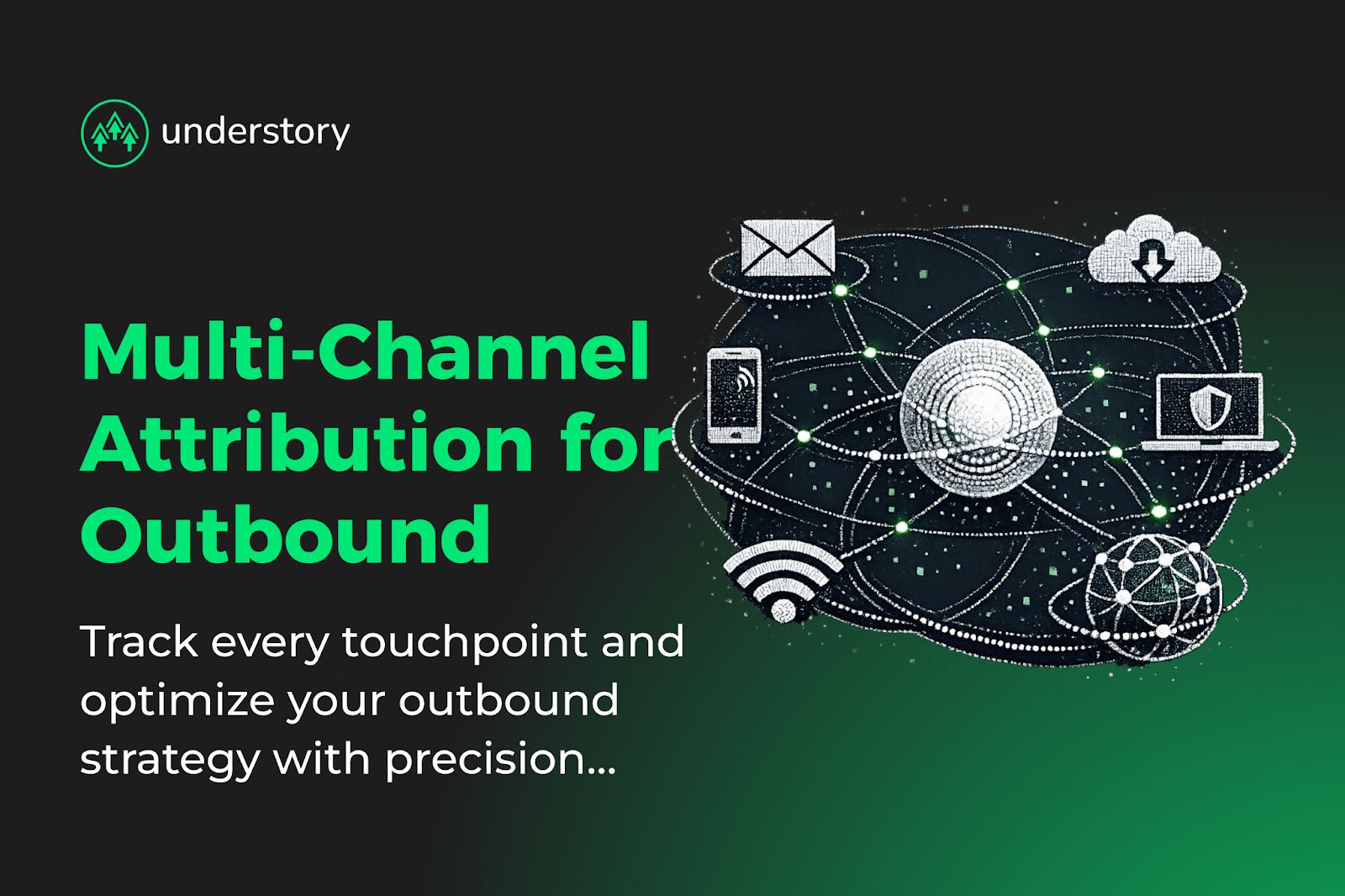
Multi-channel attribution reveals which outbound channels drive the pipeline. Without it, board meetings become guessing games. Single-touch last-click attribution ignores the complex touchpoints in B2B SaaS sales cycles, and revenue attribution remains a black box when you need 90-180 day windows to capture the full customer journey. You lose visibility into how outbound email influences deals and can't calculate the CAC payback period metrics that justify budget allocation.
The coordination problem compounds attribution challenges. When you manage paid media experts running LinkedIn ads, SDR teams executing email sequences, and creative freelancers producing assets as separate workstreams, prospects receive disconnected experiences and attribution becomes impossible.
This can be solved by creating unified measurement across proactive touchpoints. Coordinated multi-channel outreach yields higher meeting conversions than single-channel efforts. Rather than managing separate sales and marketing specialists working from conflicting data sources, organizations can create coordinated allbound expertise with clear pipeline visibility across all proactive channels.
The attribution challenge for SaaS growth leaders
Most B2B SaaS companies lack mature attribution capabilities to measure outbound impact effectively. The coordination overhead gets worse as you scale. Growth leaders experience challenges across disconnected platforms where sales and marketing tools operate independently:
- SDRs use Outreach or SalesLoft for engagement tracking
- Account executives log calls in Salesforce
- LinkedIn activity occurs in Sales Navigator
- Paid ads run through separate platforms with their own tracking via UTM parameters and click IDs
Each specialist optimizes their channel in isolation. You struggle to understand the combined impact on revenue.
Consider a typical $50K ACV deal: a prospect clicks your LinkedIn ad, receives a cold email two days later, takes a discovery call, then closes three months later. Single-touch attribution credits either the LinkedIn ad or the final sales call, completely missing the coordinated sequence that generated the opportunity.
Why traditional attribution falls short for outbound motions
B2B SaaS outbound attribution differs fundamentally from inbound measurement. You're tracking sales-initiated touchpoints like calls made, emails sent, and LinkedIn messages rather than prospect-initiated actions like form fills, content downloads, and demo requests.
Attribution analysis shows that outbound deals often receive significant marketing influence before sales engagement, demonstrating marketing's hidden contribution to deals traditionally credited entirely to sales.
The technical challenge compounds the organizational one. Most attribution platforms lack native, deep integrations with Outreach or SalesLoft, creating implementation complexity. While SalesLoft has released Campaign Sync functionality to address this gap, most standard attribution workflows require either CRM-based activity logging, custom data pipelines, or platform consolidation strategies. Sales engagement platforms operate in silos, creating attribution gaps exactly where outbound motions generate the most valuable touchpoints.
Multi-channel attribution for B2B SaaS outbound motions requires choosing between three approaches:
- CRM-centric attribution: Sales reps log every activity in the CRM system, with attribution platforms layering on top of CRM data
- Platform consolidation: Integrated solutions combining sales engagement and basic attribution to capture all touchpoints within a single system
- Custom data pipelines: Connecting best-in-class sales engagement tools to data warehouses with sophisticated attribution platforms for advanced modeling
Each approach involves tradeoffs between data completeness and implementation complexity.
Proven attribution models for B2B SaaS outbound
W-shaped attribution appropriately credits the typical B2B SaaS outbound journey across multiple milestone stages.
W-shaped attribution assigns 30% credit to initial outbound prospecting, 30% to opportunity creation, 30% to closing activities, and distributes the remaining 10% across middle touches like nurture sequences, demos, and proposals. This recognizes that cold outreach alone doesn't generate revenue without successful qualification and closing execution.
Extended attribution windows
B2B SaaS requires 90-180 day attribution windows versus the 30-day windows common in B2C. Extended windows capture the full outbound cycle, including when prospects go dormant for months before re-engaging.
Account-based attribution
Individual contact tracking fails in B2B SaaS where multiple stakeholders influence decisions. Account-based attribution tracks touchpoints at both contact and account level by aggregating all touches to buying committee members, attributing opportunities to the account rather than individual contacts, and weighting touchpoints by role influence to reflect how different stakeholders contribute to deal progression.
This approach is critical for B2B SaaS companies where buying committees involve decision-makers across multiple departments.
Cross-channel journey mapping
Effective models track how paid ads, email sequences, and LinkedIn outreach work together rather than competing for credit. This requires consistent UTM parameters and unified campaign hierarchies.
Implementation framework for multi-channel attribution
Based on our experience implementing attribution for SaaS clients, follow this proven framework:
Phase 1: Foundation (weeks 1-4)
Start with MAP-CRM integration ensuring bi-directional data sync. This integration is the cornerstone of effective attribution. Without proper bi-directional synchronization, even sophisticated attribution models fail.
Establish UTM governance with standardized naming conventions. Always use lowercase to avoid case-sensitivity issues. Use hyphens instead of underscores (product-launch not product_launch). Include date encoding in YYYY-MM format. Choose descriptive names over abbreviations (linkedin-sponsored not li-sp).
Set attribution windows to 90 days minimum, extending to 180 days for enterprise or complex sales cycles. This captures the full outbound cycle including prospects who engage early, go dormant, and reactivate months later.
Phase 2: Data quality over model complexity (weeks 5-8)
Many companies that attempted custom weighted attribution models in their first year reverted to simpler models due to data quality issues. Attribution sophistication only delivers value when built on clean, consistent data foundations.
When we implement attribution systems for SaaS clients, we establish foundational data infrastructure first: consistent field mapping, real-time MAP-CRM synchronization, and validation rules before advancing to multi-touch or algorithmic attribution models. Data hygiene and foundational setup are the critical success factors.
Phase 3: Technology integration (weeks 9-12)
Address the sales engagement platform integration challenge. For HubSpot users with Marketing Hub Enterprise, leverage native sequence attribution by consolidating all outbound execution within HubSpot Sequences. This approach ensures call connected events and email interactions are credited in attribution reports. However, this method requires strict discipline; external sales engagement platforms like Outreach or SalesLoft create data silos that break attribution chains.
For organizations committed to Outreach or SalesLoft, implement strict CRM logging protocols or consider a custom data pipeline approach. Use data warehouse integration to build ETL pipelines that extract outbound activity data directly from sales engagement platforms and connect to your attribution platform for advanced modeling.
The data pipeline approach preserves best-in-class sales tools while enabling sophisticated attribution, though it requires data engineering capabilities to build and maintain the integration.
Overcoming common implementation challenges
Even with the right attribution model and framework, execution obstacles derail most implementations. Here's how to address the most common blockers.
1. The platform integration gap
While some platforms offer limited direct attribution integration capabilities, successful implementations work around this through strategic approaches:
- CRM-centric architecture: Mandate all outbound activities flow through CRM with proper campaign attribution. This approach depends heavily on sales team data quality discipline.
- Platform consolidation: Consider consolidation for combined sales engagement and automatic activity capture with built-in attribution, prioritizing data completeness over attribution sophistication. Best for companies willing to standardize on one platform.
- Custom data pipeline architecture: Build ETL pipelines from best-in-class sales tools to a data warehouse and attribution platform, enabling sophisticated attribution modeling but requiring dedicated data engineering resources.
2. UTM parameter inconsistency
Teams using different UTM structures break attribution chains. Implement centralized UTM builders with validation rules to enforce consistent naming conventions across paid ads, email sequences, and social outreach.
Standardized UTM frameworks require lowercase formatting, hyphens rather than underscores, and descriptive naming to prevent case-sensitivity issues and attribution tracking failures across channels.
3. Offline conversion tracking
Sales calls and demos represent critical touchpoints that don't sync with attribution systems automatically. This creates the biggest attribution gaps.
Create standardized activity logging workflows with custom activity types in your CRM, call dispositions and meeting outcomes that generate attribution touchpoints, and mandatory field completion for all offline activities to ensure complete data capture.
Newer integrations automatically sync multi-channel touchpoints to CRM campaigns, reducing manual logging requirements.
4. Team coordination requirements
Attribution success depends on organizational alignment, not just technical implementation. Establish weekly attribution review meetings with cross-team participation, shared definitions of MQL, SQL, and opportunity stages, unified dashboards showing coordinated campaign performance, and quarterly attribution audits reviewing model effectiveness.
Budget allocation based on attribution insights requires sales and marketing alignment on which channels deserve credit for pipeline generation. This alignment must be grounded in extended attribution windows (90-180 days for B2B SaaS sales cycles) and appropriate multi-touch models like W-shaped or time-decay for outbound motions that capture the full customer journey.
Performance benchmarks for optimization
Use these benchmarks to evaluate attribution-driven improvements:
- CAC payback period: Target less than 12 months for healthy B2B SaaS
- LTV:CAC ratio: Maintain 3:1 or higher
- Pipeline coverage: Maintain 3-5x coverage of quota
- Attribution window: 90-180 days for complex B2B sales cycles
Companies implementing multi-channel attribution see significant improvements in marketing ROI visibility and budget allocation efficiency.
Scale your attribution with Understory Agency’s coordinated allbound execution
Attribution complexity grows when you coordinate separate specialists for paid media, outbound, and creative. At Understory, we eliminate this coordination overhead by implementing unified measurement across outbound channels: email sequences, LinkedIn campaigns, paid media, and sales activities through our allbound approach.
We handle the technical complexity of multi-channel attribution while you focus on scaling what works. Our attribution framework captures touchpoints across your entire outbound motion, from initial prospecting through closed deals, with clear ROI visibility for budget allocation decisions.
Book a strategy call to discuss how coordinated attribution transforms SaaS growth efficiency.
Related Articles

Know what is actually driving revenue
Clean data, a pipeline you can forecast, and leads scored and routed the moment they arrive.