
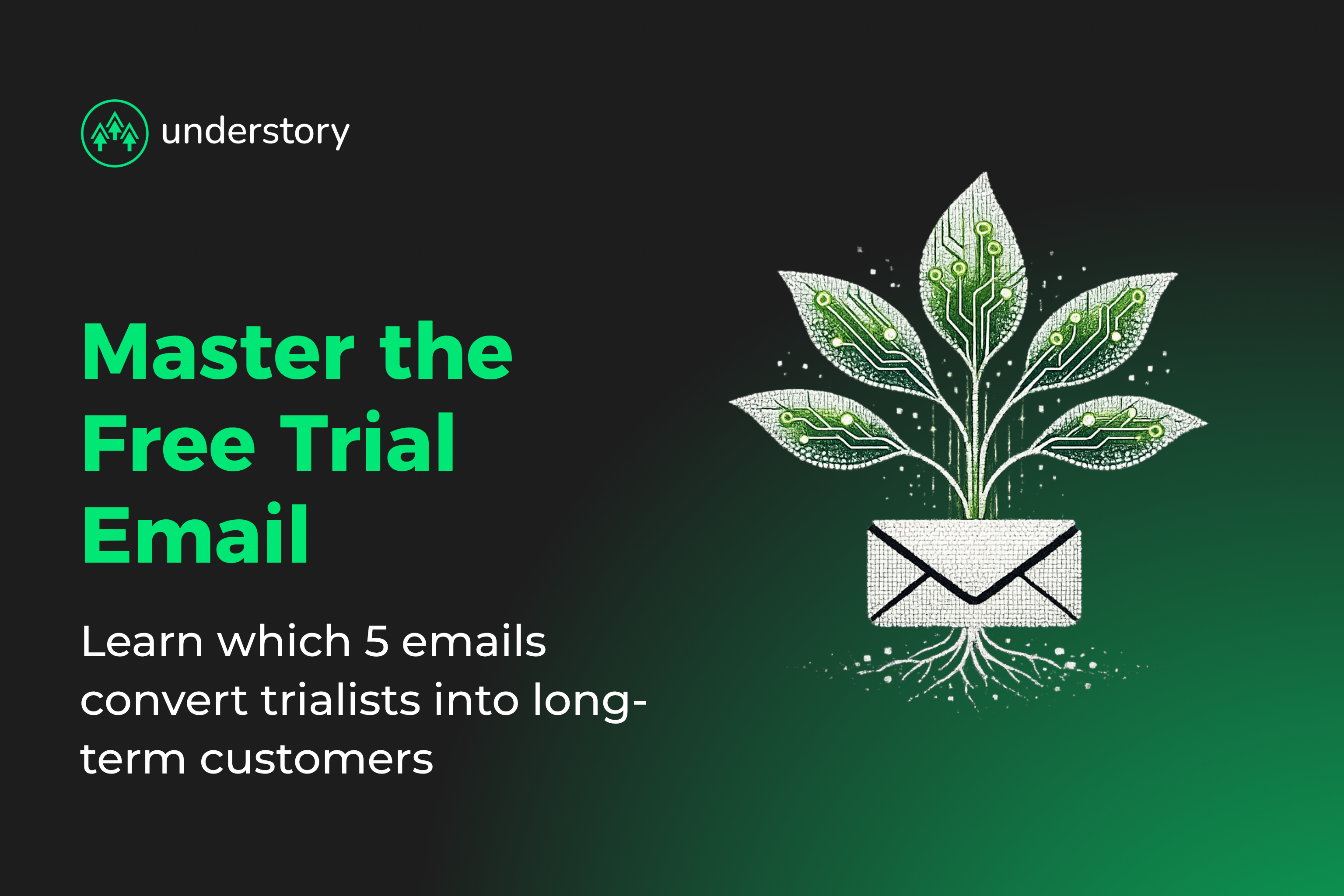
The median SaaS free trial converts at just 8%. For B2B companies with $20K+ ACVs, every lost conversion is significant revenue gone.
The problem usually isn't the product. It's what happens between signup and the paywall: generic sequences, aggressive upsells, and emails completely disconnected from what users actually do inside the product.
The bigger issue is channel misalignment. When trial emails say one thing, in-product messaging says another, and sales outreach ignores both, prospects hit friction instead of momentum. A coordinated nurture sequence eliminates that fragmentation and moves users from curiosity to activation to purchase.
Keep reading to learn more about five trial nurture emails that will drive conversions for you.
Email 1: The activation welcome (Day 0)
Your welcome email has one job: get users to their first meaningful action. Not a product tour, not a feature dump. One clear next step toward their "aha moment."
Getting users to core value quickly is the single biggest driver of trial-to-paid conversions. Feature education, social proof, and urgency all depend on this foundation.
Subject line: "Welcome to [Product]: here's your first step"
Body structure:
- Thank them for signing up (one sentence)
- Set expectations for trial length and what they'll get
- Provide one specific action to complete right now
- Link directly to that action, not to a dashboard or docs
CTA: "Complete your setup" or "Create your first [project/workflow/campaign]"
Don't sell premium features here. Don't overwhelm readers with everything the product can do. The first email should earn the right to send the second one.
Email 2: The quick win (Day 2–3)
By day two or three, users have either taken that first action or they haven't. This email acknowledges where they are and drives toward a quick, tangible win.
For active users, it builds on momentum. For those who haven't engaged, it reframes the value proposition around a specific pain point.
Subject line: "Struggling with [pain point]? Here's a quick fix"
Body structure:
- Name a specific problem your product solves
- Show how to solve it in under five minutes
- Include a brief walkthrough or link to a short tutorial
- Reinforce the outcome, not the feature
CTA: "Try this feature" with a direct link to the relevant product area
This works because it shifts the conversation from "here's what our product does" to "here's a problem you have and how to fix it right now." That reframe matters for technical buyers evaluating multiple tools.
If your paid media or outbound outreach highlighted a specific use case, align this email's pain point with that same messaging. Prospects who see consistent themes across touchpoints are more likely to engage.
Email 3: The social proof showcase (Day 5–7)
Mid-trial is where doubt creeps in. Users have explored enough to form opinions but haven't committed. Credible proof from similar companies removes that hesitation.
Case studies demonstrating real-world results from comparable organizations measurably increase free trial conversion rates by providing concrete ROI evidence.
Subject line: "How [Similar Company] achieved [Specific Result] with [Product]"
Body structure:
- Lead with a two-to-three sentence customer story
- Highlight the specific feature that enabled the result
- Include a testimonial quote or company logo for credibility
- Connect the outcome back to the reader's likely situation
CTA: "See how it works" linking to the feature or a brief case study
Generic testimonials don't move B2B buyers with $20K+ budgets. Match social proof to the reader's industry, role, or company size. A VP of Engineering at a 200-person company doesn't care what a solo founder achieved, and vice versa.
Email 4: The hidden feature (Day 10–12)
By day 10, engaged users have settled into a usage pattern. They're using two or three features but ignoring capabilities that could deepen their investment in the product.
This email surfaces a feature they likely haven't found yet; one that unlocks additional value and makes the product harder to walk away from.
Subject line: "[Feature] that most teams don't know about"
Body structure:
- Acknowledge what they've been doing in the product (if behavior data is available)
- Introduce a complementary capability they haven't explored
- Explain the benefit in terms of outcomes, not specifications
- Provide a direct path to try it
CTA: "Explore [feature]" with a deep link into the product
If your marketing automation tracks feature usage, this email becomes significantly more effective. Instead of guessing which features to highlight, reference what they've actually done: "You've created {{ project_count }} projects. Here's how to automate workflows for projects like {{ most_recent_project_name }}."
Behavior-based personalization increases engagement by compared to generic messaging.
Email 5: The urgency close (3 days before trial ends)
Early trial engagement, particularly days 3–5, is disproportionately important for conversion. But this final email still matters because it makes potential loss tangible.
Subject line: "Your trial ends in 3 days: here's what you've built"
Body structure:
- State the deadline clearly in the opening line
- List specific features or data they'll lose access to
- Summarize what they've accomplished during the trial (usage data if available)
- Include pricing with any available incentive
- Add risk-reversal language: money-back guarantee, cancel anytime, or similar
CTA: "Upgrade now" as a prominent button, repeated at both the top third and bottom of the email
Framing the email around what users stand to lose (saved configurations, imported data, workflows they've built) creates stronger conversion pressure than listing features they'd gain. People are more motivated to protect progress than to acquire new benefits.
If they don't convert, send a final-day email emphasizing specific work or data at risk: "Your trial expires today; don't lose your [workspace/data]." Consider adding a countdown element and a limited-time offer to reduce last-minute friction.
Making these free trial nurture emails work together
Five emails won't drive conversions if they arrive as disconnected messages. The sequence design matters as much as any individual email. Focus on:
- Timing cadence
Daily or near-daily in days 0–3 (the critical activation window), every 2–3 days through mid-trial, then escalating frequency as the trial end approaches.
- CTA progression
The asks intensify gradually: "Complete your setup" → "Try this feature" → "See how it works" → "Explore [feature]" → "Upgrade now." Each email earns the right to make a bigger ask.
- Behavior triggers beat calendar schedules
Wherever possible, trigger emails based on what users actually do (or don't do) inside the product rather than counting days. A user who hasn't logged in since day one needs a different message than one who's used the product daily.
- Segment active from inactive
At minimum, split your free trial users into engaged and disengaged groups. Engaged users get the feature education and social proof sequence above. Disengaged users need re-engagement emails: "We noticed you haven't logged in. Need help getting started?" followed by an offer for a one-on-one onboarding call.
This segmentation should extend beyond email. When trial users go inactive, your outbound team should know and adjust their approach accordingly. Disconnected channel execution, where email nurture operates in a silo from sales and paid media, is one of the most common reasons high-ACV SaaS companies see trial conversion rates plateau.
Test your trial structure before optimizing email copy
Before fine-tuning a copy, consider a structural variable. According to a study, free trials requiring a credit card upfront convert at 25–35%, compared to 4–6% for no-card trials. That 4–6x difference is larger than any email optimization will deliver alone.
Credit-card-required trials aren't always the right move. But for high-ACV SaaS products where buyer intent is strong, testing this structural change alongside your email sequence could yield significant results.
No single channel or tactic drives trial conversion in isolation. Email sequence optimization, trial structure, in-product onboarding, and sales touchpoints all interact. Companies that coordinate these elements see compounding improvements that siloed optimizations can't match.
Coordinate your free trial experience with Understory Agency
Free trial nurture emails are one piece of a broader prospect experience that spans paid media, outbound outreach, landing pages, and in-product messaging. When separate specialists manage these touchpoints without coordination, trial users receive disconnected messaging and conversions drop.
At Understory, we coordinate SaaS growth channels so prospects receive consistent, professional messaging from first ad impression through trial conversion. That means strategic paid media on LinkedIn and Google, Clay-powered outbound sequences, and professional creative, all managed by one team instead of three vendors.
Book an intro call with Understory to see how coordinated allbound execution turns more trial signups into paying customers.
Related Articles

Pipeline that compounds
Paid, outbound, content, creative and RevOps as one system. Same team, same ICP, same messaging.
![9 Best B2B Growth Agencies [2026]: One Team Accountable for Pipeline, from Understory Agency](https://cdn.sanity.io/images/xyy36tcm/production/60c8f4d1f898921676ca5f016f1505c01cee6dfb-2200x700.png?auto=format&h=1222&w=3840&fit=min)
![9 Best Marketing Attribution Agencies and Consultants for B2B SaaS [2026], from Understory Agency](https://cdn.sanity.io/images/xyy36tcm/production/2c79e7c8bf60e58537e32ad17722ec90bbfbf1d1-2200x700.png?auto=format&h=1222&w=3840&fit=min)
![6 Cold Email Agencies for B2B SaaS, Compared by Operating Model [2026], from Understory Agency](https://cdn.sanity.io/images/xyy36tcm/production/ab54688560f794253e5eda59db631906fe39d50d-2200x700.png?auto=format&h=1222&w=3840&fit=min)