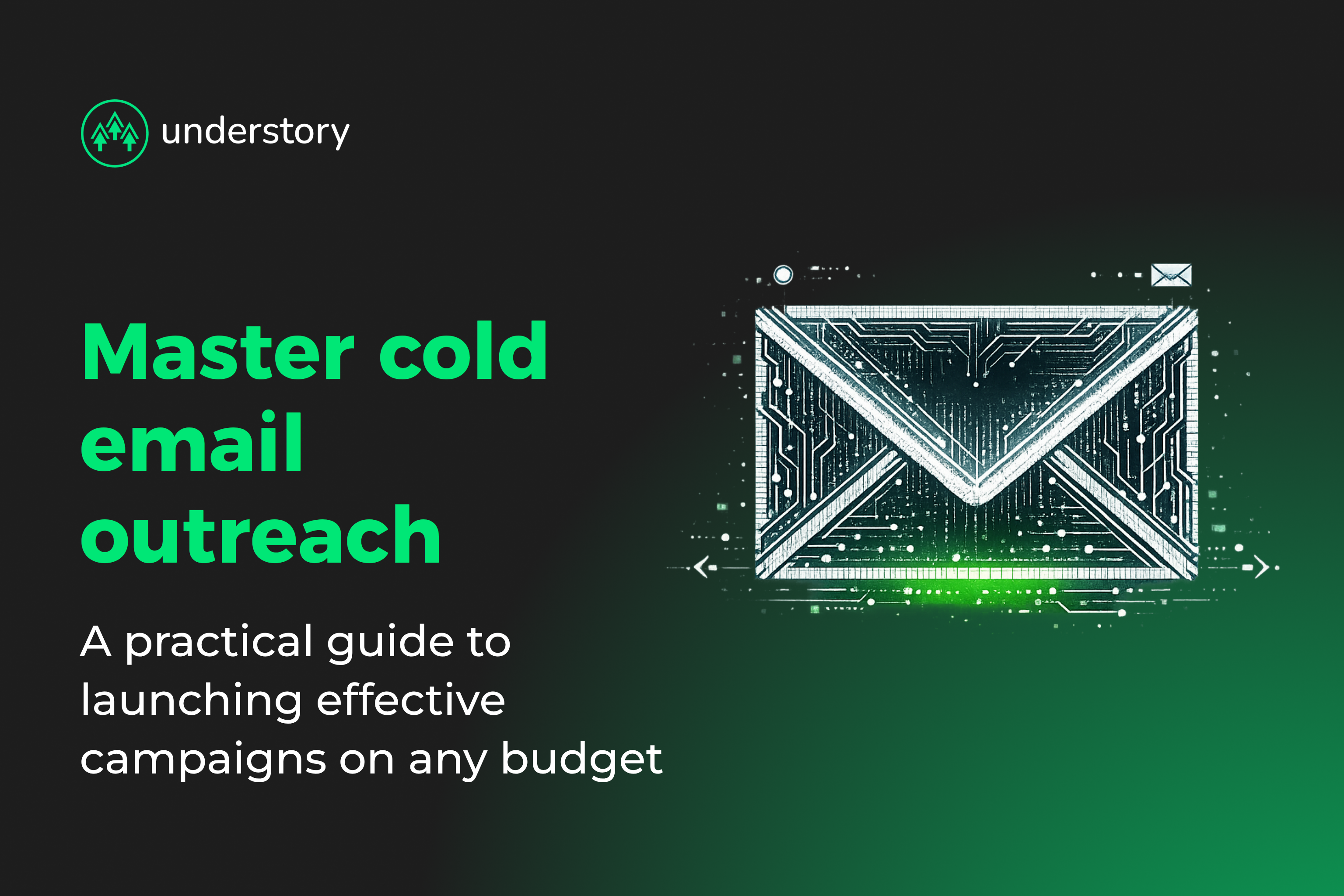
You don't need a $500/month tech stack or an outsourced SDR team to run effective cold email. You need discipline, a few affordable tools, and messaging that respects your prospect's intelligence.
Most SaaS founders and growth leaders overcomplicate cold email. They invest in expensive platforms before mastering fundamentals, blast generic templates to thousands of contacts, and wonder why sophisticated buyers ignore them.
The fix is straightforward: nail your messaging first, set up infrastructure for free, and layer in tools only when volume demands it.
Start with messaging, not tools
The biggest mistake budget-conscious SaaS teams make is buying tools first and figuring out messaging later. No platform will save a bad email.
For B2B SaaS companies targeting technical or executive buyers, the goal isn't generating excitement. It's lowering resistance. Your prospects receive dozens of cold emails daily. They've developed pattern recognition for templated outreach and delete anything that feels mass-produced.
The structure that works
Aim to keep most cold emails in the 50 to 125 word range, with many practitioners favoring under 100 words for first-touch emails. Follow the 1-10-100 rule: one clear call-to-action, first 10 words must hook attention, total email under 100 words.
The framework breaks down into four components:
- Trigger (10–15 words): Reference something specific and timely, such as a technical initiative, a recent hire, or a product launch. This proves you actually researched the prospect.
- Think (20–30 words): Articulate what you believe this trigger means for their business. This demonstrates understanding, not just awareness.
- Third-party credibility (15–20 words): Briefly reference how a similar company addressed the challenge. Position yourself as informed, not salesy.
- Permission-based close (15–25 words): Ask a single, low-friction question that gives the prospect control.
This structure comes from Josh Braun's methodology and works because sophisticated buyers respect specificity over flattery.
Close with low friction
Where most SaaS teams lose deals is in the close. Multiple CTAs, presumptive scheduling, or vague "love to chat" language all signal you haven't earned the meeting.
Effective patterns include permission-based asks like "Worth a quick conversation?", value-first positioning like "Happy to share the framework we built for this?", and time-bounded requests like "15 minutes to walk through the approach?" The question mark isn't stylistic; it signals the recipient has control.
What kills responses: calendar links in a first email, "limited spots" urgency, multiple options stacked together, and generic asks like "pick your brain." One clear ask. That's it.
Subject lines for buyers who've seen it all
Subject lines should be concise, generally between 25 and 60 characters depending on the device. Patterns like "Quick question" and "Following up" are overused and ignored by sophisticated buyers.
What works: problem-context formulas like "[Specific challenge] at [company type]," or insight triggers like "Noticed [specific observation]; quick thought."
What doesn't: vague benefit claims, clickbait, or anything your prospect has already seen fifteen times this week.
Build prospect lists without expensive data providers
You don't need a $10,000 annual data contract. A targeted list of 100 highly relevant prospects outperforms a spray-and-pray list of 10,000 generic contacts, especially when your ACVs justify the research time.
Free discovery techniques
Google X-ray search is the most underused free prospecting method available. Searching site:linkedin.com/in/ "VP of Engineering" "SaaS" on Google bypasses LinkedIn's search restrictions entirely, giving you access to public profiles without Sales Navigator.
LinkedIn Boolean search with operators like "Chief Technology Officer" AND "B2B SaaS" helps identify decision-makers within your ICP. Engagement mining, which involves monitoring who comments on competitors' posts or industry thought leaders' content, surfaces active prospects already thinking about problems you solve.
The free tool stack
Combine free tiers to cover core prospecting needs:
- Apollo.io: Limited monthly credits for contact discovery and enrichment.
- Hunter.io: Email pattern discovery and verification.
- Snov.io: Email finder and verification credits.
- Crunchbase: Research funding rounds, company size, and growth indicators.
This combination covers most of the functionality of enterprise platforms. The remaining gap you fill with manual research: 5 to 10 minutes per top prospect reviewing their LinkedIn activity, recent content, and company news.
This research also fuels your other channels. The same insights that personalize a cold email can sharpen your LinkedIn outreach and paid ad targeting. When you coordinate across channels, every minute of research pays off across every touchpoint. When you work in silos, you repeat the effort.
Trigger-based timing
Outreach timed around specific events tends to improve response rates. Watch for recent funding rounds, new job postings signaling strategic shifts, product launches, or executive hires in relevant departments. All visible through free sources.
These timing signals aren't just useful for email. A funding round that triggers a cold email should also inform your paid targeting and LinkedIn sequencing. Sharing trigger intelligence across channels is one of the simplest coordination wins available, and it costs nothing beyond the effort of aligning your team.
Choose budget-appropriate tools
Professional cold email tools start below $25/month. Here's where your budget should go based on your stage:
- Under 50 emails/day: Saleshandy ($25/month) offers strong feature-to-price ratio with email personalization, automated follow-ups, and deliverability monitoring.
- 100–500 emails/day: Instantly ($37/month) provides unlimited email accounts for proper rotation and deliverability at scale. Apollo.io ($49–79/month) consolidates prospecting and outreach into one platform.
- Targeting enterprise buyers: Woodpecker ($39/month) prioritizes deliverability optimization. QuickMail ($59/month) adds LinkedIn sequences alongside email.
The critical insight: free tiers are evaluation tools, not production solutions. Serious outreach requires paid plans starting at $25–49/month for adequate deliverability features and sending volume.
The challenge grows as you scale; each tool adds another dashboard, another workflow, another specialist to manage. This is the coordination overhead that compounds quickly.
Set up deliverability infrastructure first
None of your messaging matters if emails land in spam. Technical setup costs nothing; it just requires time.
Non-negotiable authentication
Three DNS records are required before you send cold email at any scale:
- SPF: Specifies which servers can send email from your domain. Keep within the 10 DNS lookup limit.
- DKIM: Adds cryptographic signatures so recipients can verify message authenticity.
- DMARC: Enforces authentication policies. Start with a "none" policy for monitoring, then tighten after reviewing reports.
Use a dedicated subdomain
Send cold email from a subdomain like outreach.yourdomain.com. This isolates reputation risk. If a cold campaign triggers spam complaints, your primary domain for transactional email and internal communications stays protected.
Warm up properly
New domains require a 2 to 4 week warmup period before running campaigns:
- Week 1: 5–20 emails per day
- Week 2: 20–30 emails per day
- Week 3: 40–100 emails per day
- Week 4+: Increase by 10–20 emails per week during maintenance
Skip this and you'll burn your domain reputation before your first real campaign launches.
Avoid the mistakes that kill campaigns
Seven patterns consistently destroy cold email performance for SaaS companies:
- Generic templates that sophisticated buyers identify as mass blasts within seconds.
- Long, dense emails that ignore the 100-word ceiling; prospects decide in seconds whether to engage or delete.
- Same message to different roles: your VP of Engineering email cannot read like your CMO email.
- High-friction CTAs like "Schedule a 30-minute demo" in a first touch.
- Aggressive follow-ups that signal desperation, or zero follow-ups that leave value unrealized.
- Clickbait subject lines that trained buyers recognize and penalize.
- Skipping technical setup and wondering why emails land in spam.
The common thread is a lack of respect for the prospect's intelligence. When you're selling to buyers evaluating $20K to $100K solutions, they can tell the difference between genuine outreach and automation theater.
There's an eighth mistake worth noting: treating cold email as a standalone channel. When your outbound messaging contradicts what prospects see in your ads, LinkedIn, or content, credibility collapses. Aligning every touchpoint is what separates programs that scale from programs that stall.
The implementation order
This sequence reflects widely adopted practices from outbound practitioners and playbooks:
- Master your messaging using the frameworks above. This costs nothing.
- Set up technical infrastructure: SPF, DKIM, DMARC on a dedicated subdomain. Also free.
- Build quality prospect lists using free tools and manual research. Time investment, not financial.
- Select one budget tool ($25–49/month) and start your warmup period.
- Send 20 well-researched emails before you send 200 generic ones.
- Coordinate with other channels: align your cold email messaging with paid, LinkedIn, and content so prospects hear one consistent story regardless of where they encounter you.
Twenty personalized, well-structured emails to the right prospects will outperform thousands of templated blasts. That's not motivational advice; it's math when your ACVs justify the per-prospect investment.
Scale cold email with coordinated outbound execution
Cold email on a budget gets you started. Coordinating it with paid media, LinkedIn outreach, and creative is what turns a scrappy channel into a pipeline engine.
At Understory, we build Clay-powered outbound systems that handle hyper-personalized email at scale, domain health monitoring, and CRM enrichment, all coordinated with strategic paid media and professional creative. One of our clients replaced their entire internal SDR team by consolidating outbound and paid under one allbound partnership.
Book an intro call with Understory to see how coordinated outbound execution replaces vendor management overhead.
Related Articles

Qualified pipeline, handled
Signal-based outbound that fills the funnel while your team closes.