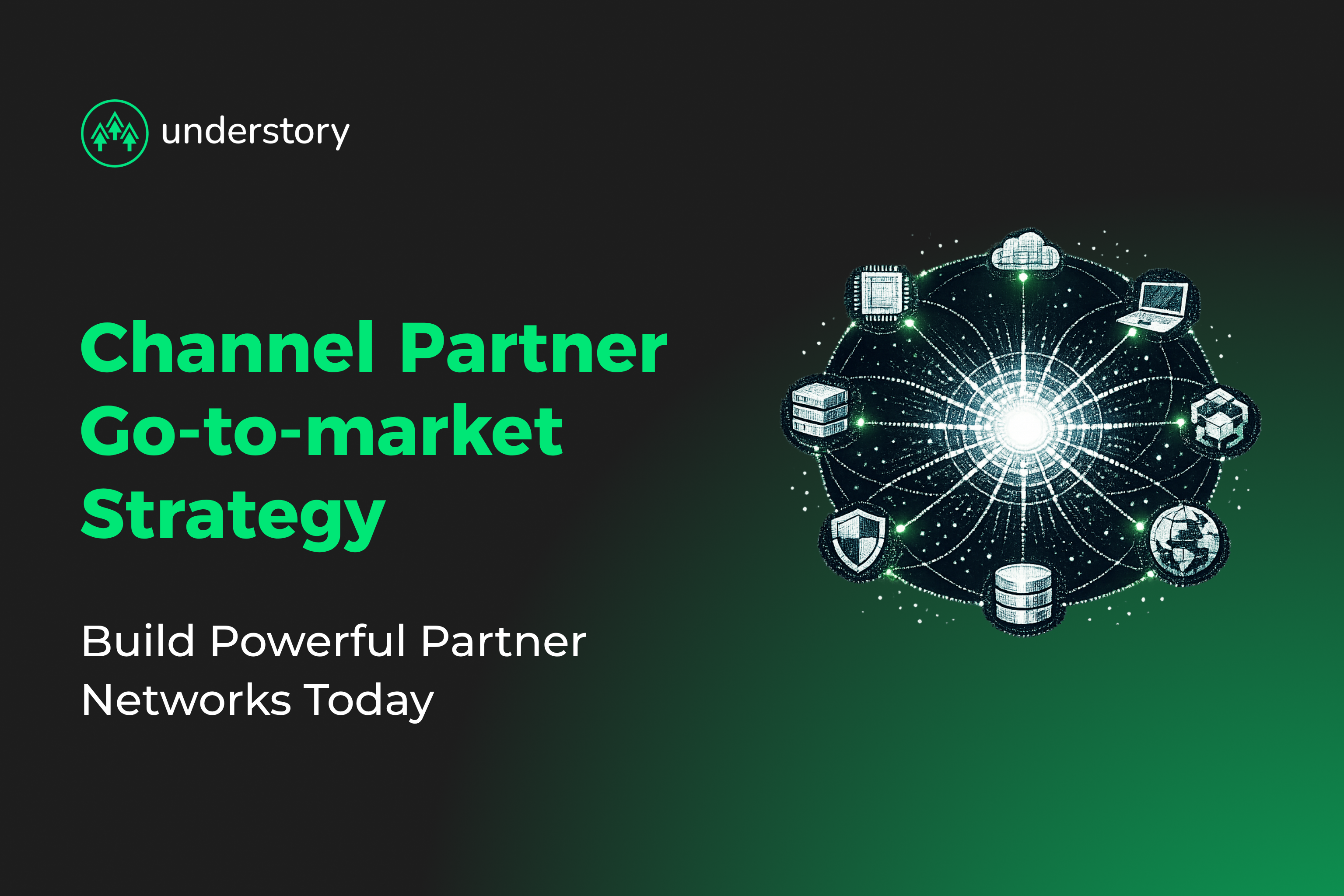
Most channel partner programs collect dust within a year of launch. The portal exists, the sales deck is uploaded, and partners stop registering deals within months. Pipeline contribution flatlines.
The failure pattern is consistent: programs underinvest in the coordination that makes channel work. Internal sales reps don't know which partners hold relationships in target accounts. Marketing runs campaigns without partner input. Attribution undercounts what partners actually influence.
This guide covers how to validate readiness, match partner types to ACV economics, build a program in four phases, and avoid the coordination failures that derail the most ambitious channel motions.
Validate your direct motion first
Channel partners amplify an existing sales motion. They cannot substitute for one you haven't figured out yet.
If your direct sales team can't repeatedly close deals at your target ACV, adding resellers and referral partners multiplies the problem. Partners will struggle to position your product. Deals will stall. You'll burn goodwill with the exact ecosystem contacts you need later.
Before investing in channel, make sure you already have:
- A repeatable direct sales process with predictable conversion rates
- Clear ICP definitions backed by closed-won data
- Enough deal history to build partner enablement around how buyers actually purchase your product
A simple readiness test helps clarify timing. If system integrators or agencies are already servicing your target customers, or if companies have approached you about partnering or white-labeling, you likely have ecosystem demand. If neither is true, channel investment is probably premature.
Match your ACV to the right partner type
Your ACV determines which partner motions make economic sense. Get this wrong and months of GTM investment evaporate.
Reseller margins only work when the contract value leaves enough room for partner economics. At a $20K ACV, a reseller earning 25% takes home $5K per deal. That figure has to cover their cost to acquire and cost to serve that customer.
Under $20K ACV, referral partners and tech integrations work best. Affiliate and marketplace models can generate volume. Reseller margins are typically too thin to justify dedicated partner selling effort.
Between $20K and $50K ACV, resellers, agency partners, and ISV integrations become viable. Referral fees structured as a percentage of first-year ACV are a common model. The logic: if acquiring a customer directly costs close to 100% of first-year ACV, a partner generating the same customer for less than half that represents favorable economics.
Above $50K ACV, VARs, system integrators, strategic alliances, and cloud marketplace co-sell all become viable. At this range, partners can build services practices around your product, creating real economic incentive to invest in enablement.
The partner types you'll evaluate include:
- Resellers and VARs: sell directly to end customers; best for geographic markets or verticals where you lack direct sales presence
- Referral partners: introduce leads but don't close; lower friction to launch with less control over deal progression
- Agency partners: implement, configure, and manage your product; accelerate time-to-value and reduce early churn risk
- ISV and tech partners: integrate with your product and co-sell to shared buyers; primary value is product stickiness and NRR improvement
- System integrators: handle complex deployment and customization; typically $75K+ ACV and enterprise
- Cloud marketplace and hyperscaler co-sell: lets enterprise buyers with pre-committed AWS, Azure, or GCP spend apply that budget to your product, which can reduce separate procurement friction
The four phases of building a partner program
Here are the four phases of building a partner program:
Phase 1: Recruit with revenue expectations on the table
Before any outreach, define your ideal partner profile by vertical focus, headcount, and tech stack. This keeps onboarding relevant.
Set revenue expectations in the first conversation. Not after onboarding. Not after the first QBR. In the first call. Explicit commercial targets filter casual explorers from partners with actual selling intent.
Phase 2: Enable within the 90-day activation window
If a new partner hasn't started selling or co-marketing within the first 90 days of signing, the relationship is likely to lose momentum. Everything in your enablement program should produce a first deal or first joint campaign inside that window.
Three pillars matter here. Onboarding should be role-based: an agency partner needs different training than a reseller, covering product knowledge, pricing, and deal registration processes calibrated to partner type. Collateral should function as living documents: playbooks, battle cards, and co-branded assets that stay current. Static PDFs in an unopened portal produce the "forgotten portal" problem that kills more programs than anyone admits.
Continuous training matters most for partner confidence. Partners should develop the same product and positioning confidence as your in-house sales reps. Short video modules, live AMA sessions, and scenario-based exercises work. Certification through short tests or demo recordings serves as a quality gate before independent selling.
Phase 3: Activate through co-sell and co-market
Define co-sell rules of engagement before any joint selling begins. Who owns the relationship? When does an internal AE get involved in a partner-led deal? How does indirect revenue get attributed? Without these rules documented in advance, co-sell creates channel conflict.
Use account mapping tools to identify overlapping prospects and customers between your CRM and a partner's. This turns co-sell from guesswork into a data-driven motion. Core co-marketing activities include joint webinars, co-branded content, and shared lead lists. These are structural program components.
Run shared pipeline reviews as an accountability mechanism. Both parties stay honest, and you surface deal-level intelligence that informs program adjustments. Communication cadence matters: monthly newsletters with product updates and partner success stories, plus quarterly business reviews with active partners to assess performance and plan next steps.
Phase 4: Optimize with data
Your minimum viable program architecture needs four things:
- Clear partner tiers with specific benefits at each level
- A defined onboarding flow with milestones
- Attribution and reporting rules governing how partner deals are tracked
- Transparent incentive mechanics with defined payout cadence
On incentives, start with limited scope. Focus on top-performing partners before building a program that demands excessive resources before the model is proven. Transparency is non-negotiable. If partners have to spend an afternoon deciphering the incentive structure, they won't bother.
The coordination failures that kill partner programs
Most programs fail at the same point: coordination breaks down and buyers get fragmented experiences. The pattern repeats across partner channels, outbound motions, and paid media. Internal teams and external partners need to work from the same playbook with shared signals, and that breaks down in predictable ways.
Channel conflict is usually structural. Without explicit rules on direct versus partner-sourced deals, your reps and partners compete for the same accounts. The result is distrust, deal poaching, and disengagement. When leadership doesn't treat the channel as a strategic motion, direct reps have little reason to protect partner relationships.
Attribution is often broken in practice. Many B2B companies rely on attribution models that undercount partner contribution. Undervalued programs get underinvestment, which limits performance and further undermines the case for investment.
Internal teams aren't enabled to work with partners. Companies build partner-facing portals and training, then leave sales, marketing, and customer success in the dark. Account executives don't know which partners have relationships in target accounts. Marketing runs campaigns without partner input. The portal exists, but deals stall because internal reps lack the context to co-sell.
Partners disengage silently. They rarely announce that they've deprioritized you. They stop registering deals, stop pushing your product, and redirect selling effort elsewhere. Your program looks healthy by lagging indicators while pipeline contribution craters. Joint go-to-market activity functions as a retention mechanism, and its absence is a leading indicator of disengagement.
At Understory, we see the same coordination problem across paid media, outbound, and partnership motions. Every one of those motions depends on internal and external teams operating from shared context.
What mature partner programs look like
Across companies running the channel well, three structural patterns repeat.
Mature programs run separate tracks for different partner types. Distinct models for agency partners, ISVs, and system integrators each have their own tier criteria, economics, and enablement programs.
Tier advancement is based on more than revenue. The strongest programs use progression systems that account for certifications, customer outcomes, partner capability, and ecosystem contribution alongside closed revenue. These mechanisms help maintain ecosystem quality at scale.
Partner business outcomes function as a design objective. Strong programs are structured to support partner business sustainability so the ecosystem grows in parallel with vendor revenue.
Coordinate your channel partner GTM with Understory Agency
Channel partner GTM fails for the same reason most B2B growth motions fail: coordination breakdown produces fragmented buyer experiences. Whether the source is a siloed paid media specialist, an under-enabled reseller, or a misaligned ISV, the buyer gets inconsistent messaging and the revenue motion loses momentum.
At Understory, we run strategic paid media, Clay-powered outbound, and professional creative as one coordinated team with shared data across all channels. That allbound coordination extends to partner channel execution: structuring program tiers, running co-marketing webinars, and building signal-based outbound that accounts for partner-influenced touchpoints.
We've built this approach for RemoFirst, who replaced their entire SDR team with our coordinated outbound, and Rivial Security, where we scaled paid media spend from $20K to $70K monthly while maintaining performance.
Signal-based outbound built into the channel motion captures the right moments: a company hiring a new VP of Partnerships, a prospect's integration usage crossing an evaluation threshold, or a partner-influenced touchpoint that warrants paid retargeting. Every touchpoint reinforces the next.
Book an intro call to coordinate your channel partner GTM execution end-to-end.
FAQ
What is a channel partner go-to-market strategy?
It's the operating plan for how your company recruits, enables, activates, and measures external partners that help sell, implement, influence, or distribute your product. A complete strategy covers ICP-aligned partner targeting, tiering, enablement, co-sell rules of engagement, attribution, and joint marketing motion.
When should a SaaS company invest in channel partners?
Usually after the direct motion is repeatable. If your internal team still can't consistently close the right deals at your target ACV, adding partners tends to amplify the underlying problem. Once you have predictable direct conversion and closed-won data to build enablement around, channel investment starts paying back.
Which partner type fits best for mid-market SaaS?
It depends on ACV, implementation complexity, and buyer behavior. Referral partners, agencies, resellers, ISVs, and system integrators each make sense under different economic conditions. Generally, mid-market SaaS at $20K–$50K ACV finds the strongest economics with referral partners, agency partners, and ISV integrations.
Why do partner programs fail?
Most fail because of coordination problems: unclear rules of engagement, weak attribution, poor internal enablement, and inconsistent communication between your team and the partner. The visible symptom is silent partner disengagement, but the root cause is almost always internal misalignment.
Related Articles

Qualified pipeline, handled
Signal-based outbound that fills the funnel while your team closes.