We're hiring 30+ early-career engineers in Seattle.
No whiteboard. No trick questions. Just a 3-hour session to build and deploy something real, using whatever AI tools you'd actually use on the job. Then we talk through the decisions you made and how they'd hold up in production.
If you're a fit, you'll have an offer within 24 hours.
We're looking for builders who ship naturally with AI and want to make an impact from day one.
Apply here - https://lnkd.in/gbsRKF3T
#Hiring #SeattleJobs #SoftwareEngineers #EarlyCareer #NewGrad
Yesterday we launched Managed Agents on DigitalOcean in a private preview. I want to put it in the context of a conviction I've held for a while.
The first generation of clouds was built compute-first. AWS started with EC2, and everything else — storage, networking, databases, even AI services — layered on top. That architecture won the last twenty years.
I fundamentally believe the new AI-native cloud starts token-first. Everything else, including "compute", is a means to enhance the intelligence generated by tokens. Agents are the new interface to the cloud — one that brings tokens and microVMs together under a single abstraction.
DigitalOcean's Managed Agents Runtime Services (M.A.R.S.) is the first full expression of that construct, and it stands on four fundamental services we've been building deliberately:
Serverless inference — tokens on tap. You consume tokens the way you consume bandwidth. No model hosting, no GPU capacity planning, no idle spend. The meter runs only when your agent thinks.
Firecracker microVM compute — every agent session runs in its own hardware-isolated microVM, starting in under a second and scaling to zero. It's the right compute unit for software that works in bursts rather than runs forever.
Durable sessions — agents that outlive your laptop. Pause and resume in as little as 200 milliseconds with files, processes, and working state intact. Continue from another device, hand off mid-task to a teammate, or fan out to parallel agents without multiplying infrastructure.
Action Gateway — governed access to the outside world. Agents reach GitHub, Jira, Notion, Linear, and Postgres through centrally managed authentication, permissions, human approvals, and audit controls. OAuth credentials are brokered through Secrets Manager and never exposed to the model or the execution environment.
You describe the agent — its harness, tools, and guardrails. Bring Claude Code, Codex CLI, OpenCode, or agents built on LangGraph and CrewAI. No proprietary framework, no lock-in. We run the tokens and the compute underneath.
If you're wondering what to build first, here are ideas you can ship in a weekend:
- A support agent grounded in your docs and past tickets that escalates only what it can't resolve
- A code-review agent that runs on every pull request with full repo context, safely isolated in its own microVM
- A data agent that turns plain-English questions into queries against your managed database
- An ops agent that watches alerts, triages incidents, and drafts the runbook update before you're paged
- A back-office agent that reconciles invoices, chases renewals, and processes intake forms overnight
This is where our cloud investment is going: a next-generation cloud construct built for AI natives, token-first from the ground up.
Request access here: https://lnkd.in/es8gwYnp. And tell me what you'd build.
#DigitalOcean #agents #tokens #microVMs
Today we shipped DigitalOcean Managed Agents into public preview.
Every era of the cloud has an atomic unit. For twenty years it was the provisioned VM. You came for compute and paid by the hour, working or waiting. Agents don't fit that box. They think in tokens, act in bursts of compute, and need memory (state) that outlives the session. Compute, inference, and data working as one.
The compute-first cloud meters the VM. The agent-first cloud meters the work.
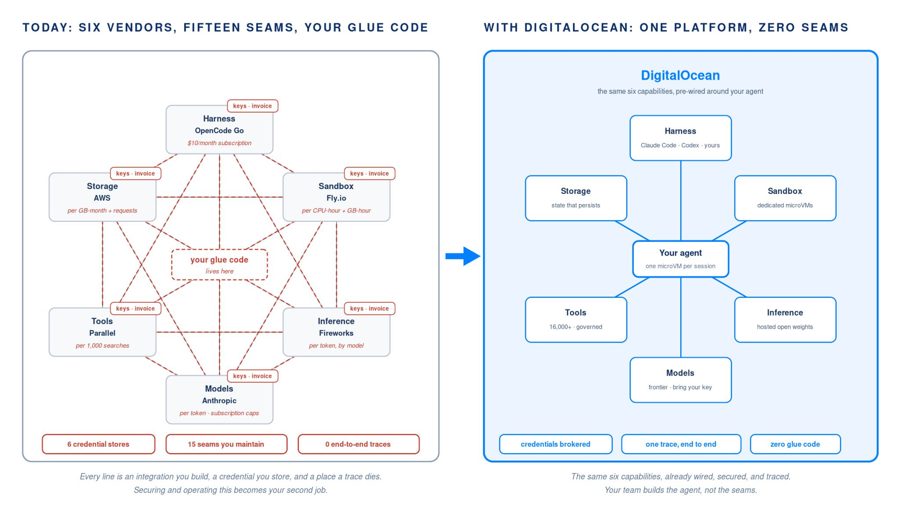
I've talked to a lot of founders building agents, and I hear the same stack every time: a harness on a laptop, sandboxes from one startup, inference from two more, storage at a hyperscaler, search from a sixth vendor. Six vendors means fifteen seams to secure and operate. Nobody can say what a single run cost.
So we built the other option:
→ Harness Runtime: every session in its own Firecracker microVM. Pause, resume, checkpoint, fork. Bring Claude Code, Codex CLI, OpenCode, Hermes, or your own image.
→ Action Gateway: one endpoint to 16,000+ governed tools. The agent never sees the key.
→ Pricing that matches the workload: active CPU billed by the second. An hour of agent work that bills $0.126 fully allocated costs about $0.0310 with us for a typical agent run (25% active). While the agent waits, you pay zero.
Agents think, act, remember, and improve. Now the whole loop runs on one platform.
Public preview is live today. Bring your harness and choose your model. We'll handle the rest.
Press Release : https://lnkd.in/ghJjxc7E
Blog: https://lnkd.in/gXsEUq-J
#managedagents #agents #AInativecloud #digitalocean #Bringyouragents #Builders
With all the tweets over the weekend, the big labs losing their moat is only half the story.
The moat doesn't disappear — it moves. If a fine-tuned open model trained on your own data is 95% cheaper, better at your task, and ready in hours to days, the model is no longer the product. Your data — and the platform that turns it into working intelligence — is the product.
Which leads to the uncomfortable version: if you don't own your weights, you don't own your product.
Build on a closed API and your COGS is someone else's pricing decision. Your roadmap is someone else's deprecation schedule. Your "proprietary AI" can be repriced, rate-limited, or retired in an announcement you don't control.
Renting intelligence isn't a strategy. Owning it is.
Kimi K3, DeepSeek, GLM, Nemotron, and Qwen erased the frontier premium for most production workloads.
Owning your intelligence takes four things, and they have to live on one platform:
1/ Own your cost structure: NVIDIA + AMD GPUs on demand with per-second billing, Spot capacity when you want the price floor — no committed-spend contracts (for most customers), no sales call. Your inference COGS becomes a dial you turn, not a bill you receive.
2/ Fine-tune + deploy: open models from Hugging Face or DeepSeek in 1 click, or bring your own weights
3/ Inference Engine: a world-class token engine across open models - Serverless, dedicated, and batch on one Inference Engine, with routing across open and closed models so you're never locked to anyone's model bet
4/ Core cloud: your model runs next to your Kubernetes, managed databases, storage, and networking — one platform, one bill, predictable pricing.
A model without an app is a demo. The app lives here too. That's DigitalOcean's Inference Engine + Agents platform. And the token math says it's working and durable.
Our curve is steeper — token volume on the Inference Engine up 30x in a matter of few months, inference on open-weight models growing rapidly.
Hyperscalers are conflicted. Neoclouds are landlords. DigitalOcean has spent years making infrastructure simple for the millions of companies that will never build an infra team. Now that's the whole game.
Own your weights. Own your product.
#DOCN #opensource #Frontiermodels #Ownyourproduct