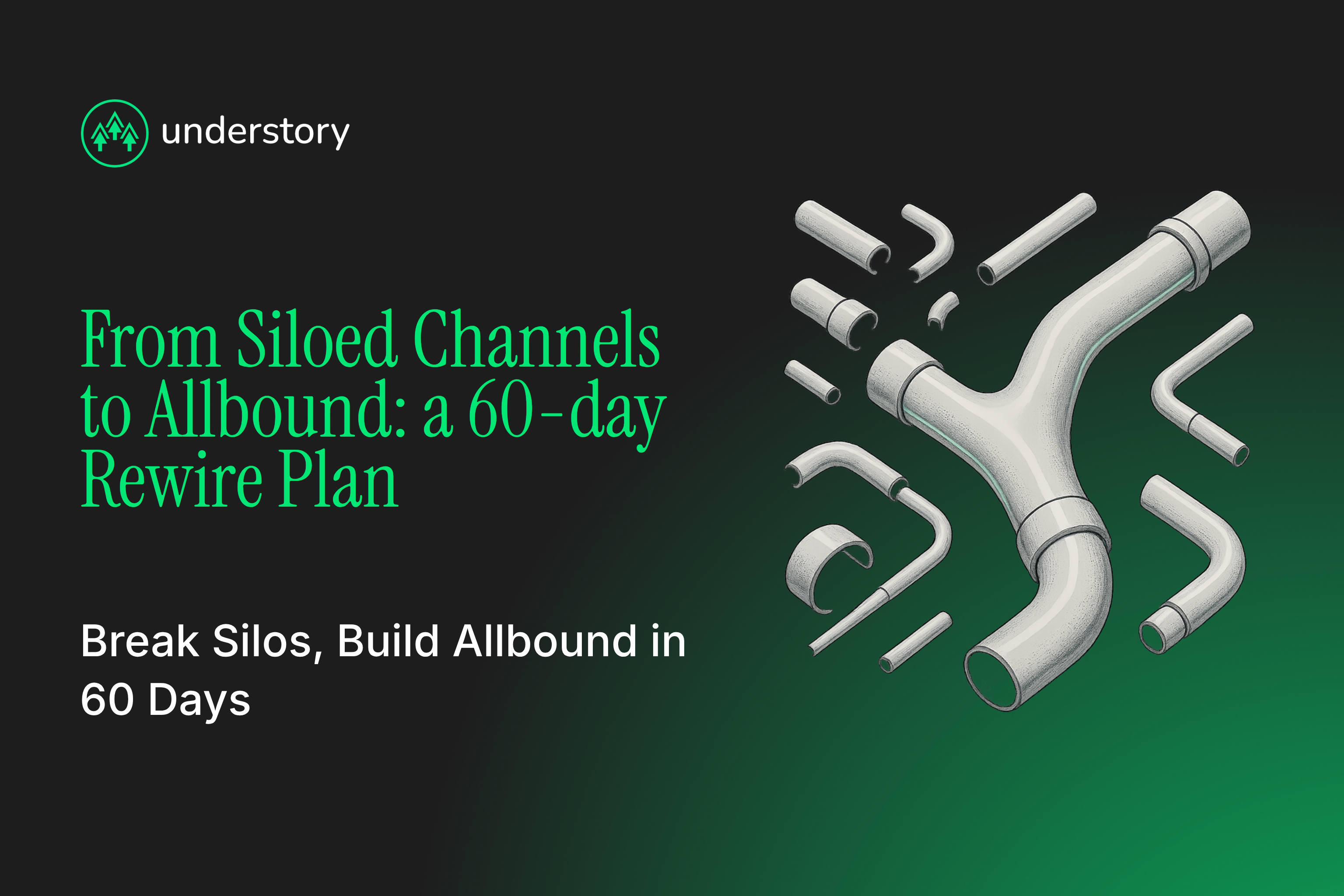
From siloed channels to allbound: A 60-day rewire plan
Your paid media, outbound, and content underperform when they don't talk to each other. Your LinkedIn ads and SDR sequences point in different directions. Your content doesn't connect them. The prospect gets a disconnected experience and concludes you lack the coordination to handle a $40K contract.
A coordinated allbound motion connects every revenue channel around the account, so teams stop fighting over attribution credit. This 60-day rewire moves teams from siloed channels to an allbound motion, with Day 30 as the hard gate that most teams get wrong.
What "allbound" actually means
Allbound is how mature B2B SaaS companies stopped splitting inbound and outbound into different teams with different scorecards. Revenue teams work one shared pipeline, which reduces attribution debates. It starts with one shared view of account-level signals that turns insight into action across every channel.
Forrester calls the same architecture Revenue Orchestration. The terminology differs, but both describe the coordination layer between channels.
What siloed channels actually cost you
When revenue channels run independently under separate KPIs, buyers feel the disconnect first. The number of channels in a B2B buying journey doubled between 2016 and 2022, from 5 to 10. More channels create more chances to contradict yourself.
The data gets less useful too. When systems don't connect, teams overvalue top-of-funnel activity and underinvest in mid-funnel nurture. You focus on the wrong things because the numbers don't connect.
The revenue impact shows up when buyers stall, restart conversations, or question whether your team understands the account. Aligned messaging and cleaner handoffs give buyers fewer reasons to slow the deal down.
Buyer data explains why consistency pays: when buyers perceive high information consistency between your website and your reps, they're 2x more likely to complete a high-quality deal.
The 60-day rewire
Use Day 30 as a hard gate: diagnose before you build. Treat the audit as non-negotiable. Automating or migrating tools too early carries broken workflows into the new system. RevOps owns this transition because its mandate crosses functions.
Days 1–30: Audit and align (diagnostic only)
This month you document what's actually happening without changing the motion.
Weeks 1–2 Map and audit: Map every existing channel process, audit CRM data quality, inventory the full tool stack. Document the silo map and CRM data quality baseline so you can measure against them later.
Weeks 3–4 Agree on shared definitions: Get written signoff from Marketing, Sales, and CS on MQL/SQL definitions, opportunity stage criteria, and handoff requirements. Written definitions prevent the attribution debates that wreck most allbound attempts.
Keep the first 30 days diagnostic. Do not automate or migrate.
Days 31–60: Build and train around the integration
Build in this order.
Days 31–45 CRM and first plays: Enforce CRM field validation and stage definitions. Stand up a unified pipeline dashboard. Launch your first signal plays tied to real triggers: a recent CRO hire, a tech-stack change. Measure pipeline-per-play from day one, tracking account outcomes over channel vanity metrics.
Days 46–60 Consolidate and train: Work through this sequence in order:
- Outbound consolidation
- CRM integration checks
- Active sequence migration
- Handoff workflow redesign
- SLA drafts
Train front-line managers before reps. Managers need to understand the new motion well enough to reinforce it before reps fall back into old habits. Schedule major migrations away from quarter-end and run any platform migration through a shadow environment long enough to catch routing and reporting failures before handoffs break. Decommission old tools last.
Days 61–90: Operationalize (the spillover phase)
The 60-day rewire sets the engine. The following month locks it in:
- Finalize and enforce handoff SLAs inside CRM automation
- Build a template library
- Establish a cross-functional pipeline review cadence
- Decommission legacy tools
- Start A/B testing your plays
During this window, judge process health first, CRM field completion rates and stage conversion rates. Revenue follows once the plumbing works.
Measure account-level pipeline
Shift metrics from per-channel credit tracking to account-level pipeline that aligns revenue channels around shared outcomes. Four metrics to anchor on:
- Pipeline velocity: your primary diagnostic
- Blended cost per opportunity: a single cost-efficiency number across the integrated motion
- Win rate by origin: shows which motion contributes quality pipeline
- CAC payback: the alignment metric that shows whether the integrated motion improves efficiency over time
On attribution, a "sourced vs. influenced" dual-reporting structure reduces the credit fight by reporting both numbers at once. It lowers the value of the philosophical debate about who gets the win.
Keep the message consistent across every channel
Messaging failure usually starts in operations, not strategy. Treat the framework like an operating asset, with clear ownership, versioning, and a feedback loop.
Build from one anchor statement into three to four benefit pillars with supporting proof underneath. Keep the pillars tight enough that people can remember them. If you need more, demote them to proof points.
Personalization by channel works best as a modular adaptation of a stable core. Tone shifts between a LinkedIn ad and a sales deck. The core value proposition stays stable. Assigning one PMM accountable ownership, fragmented paid media, outbound, and content is exactly what a single owner prevents.
For technical SaaS selling to sophisticated buyers, the message needs one consistent narrative spine while speaking distinctly to each stakeholder group. Buyers without a defined category need education, so lead with problem education before product messaging.
Who runs the rewire
Someone has to own the rewire and the ongoing motion. Each option has a real catch.
A senior in-house growth lead solves ownership but creates fixed-cost and recruiting pressure. The sequential reactive hiring pattern, founder does marketing, hires a generalist, adds a content writer, adds a paid media manager, adds an SDR, produces channel specialists optimizing in isolation, each defending their own metric, nobody owning the pipeline. That's how silos get built.
Managing multiple partners creates its own operating burden. Adding more disconnected specialists to fix a coordination problem usually makes the coordination problem worse.
For most growth-stage SaaS teams, the practical model is internal leadership for strategy plus one coordinated engine for execution. Teams usually struggle across lanes, where outbound and paid work need to be fed by creative and feed each other.
Run your allbound rewire with Understory Agency
Understory runs paid media and signal-based outbound with on-staff creative under one team accountable to pipeline over channel metrics. That's what this 60-day plan depends on, without the overhead of managing four vendors who don't coordinate. We're direct about what works where: some niches need LinkedIn over email because deliverability is brutal, and we'd rather tell you upfront how channel performance varies by niche.
If you're staring down the silo problem and want a team to execute the rewire, book a demo and let's map your first signal plays.
Frequently asked questions
What's the difference between allbound and omnichannel marketing?
Omnichannel focuses on consistent customer experience across touchpoints, typically in B2C contexts. Allbound is a B2B revenue architecture where paid media, outbound, and content operate from one shared pipeline and account-level signals. The distinction matters because allbound ties directly to pipeline accountability, not brand consistency alone.
Do we need a dedicated RevOps hire before starting the rewire?
Not necessarily. You need someone with cross-functional authority to own definitions and dashboards; that could be an existing ops, marketing, or sales leader. The gap most teams face isn't headcount; it's assigning clear ownership. A part-time RevOps function with executive backing works for most growth-stage SaaS teams through the first 60 days.
How long before the allbound motion produces measurable pipeline impact?
Expect process health metrics, like CRM field completion, and stage conversion rates, to improve within the 60-day window. Pipeline velocity and win rate shifts typically surface in weeks 8–12, after signal plays accumulate enough data. Revenue outcomes follow process outcomes. Teams that skip the Day 1–30 diagnostic phase see slower results because broken workflows carry forward.
Can we run this rewire without replacing our current tech stack?
Yes. The 60-day plan is tool-agnostic through Day 30. The audit phase tells you what to consolidate, not what to replace upfront. Most teams discover they already have the tools needed for an allbound motion, the gap is configuration and cross-system integration, not net-new software. Decommission legacy tools last, after new workflows are proven stable.
Related Articles

Pipeline that compounds
Paid, outbound, content, creative and RevOps as one system. Same team, same ICP, same messaging.