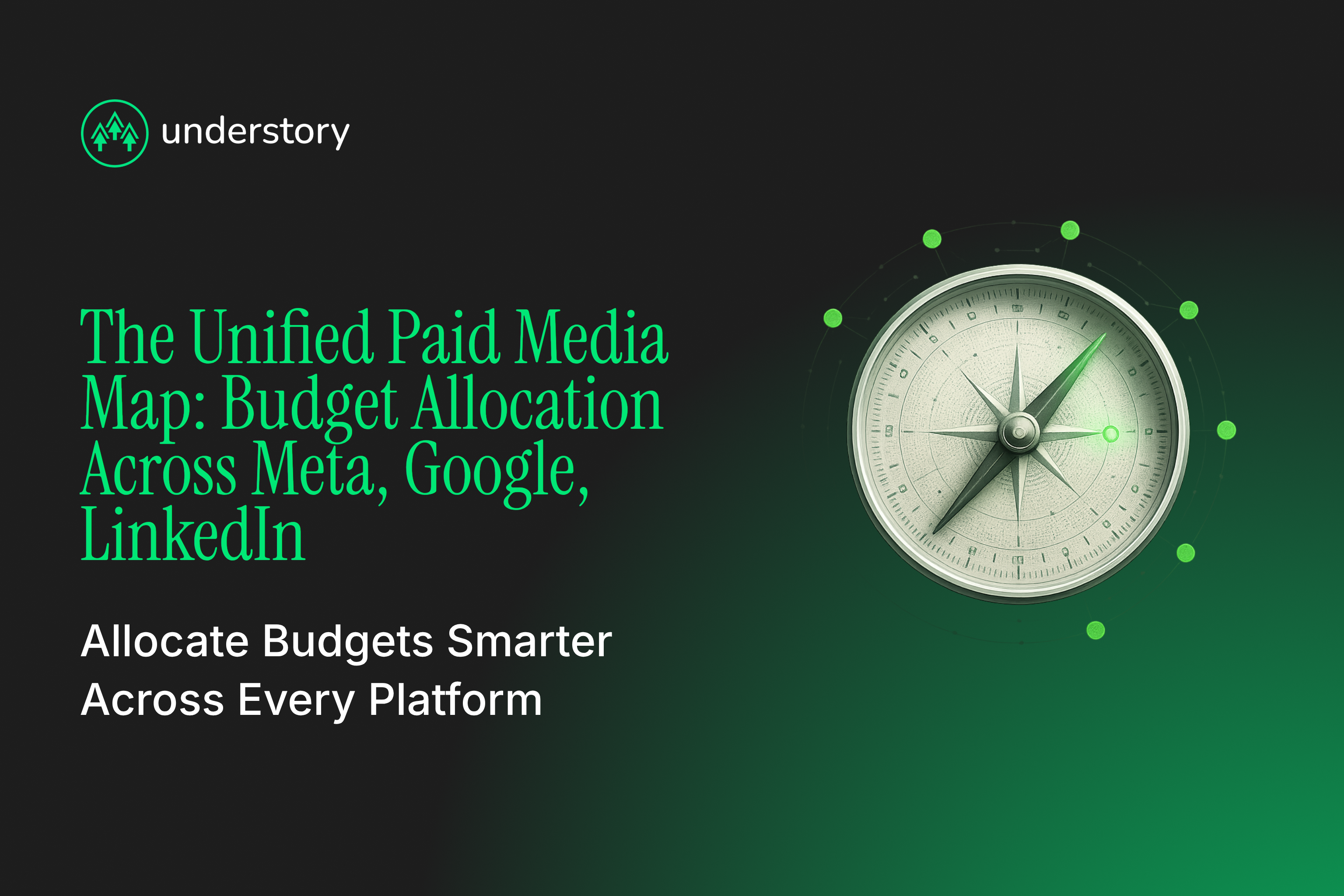
The unified paid media map: budget allocation across Meta, Google, and LinkedIn
The right split between Meta, Google, and LinkedIn depends on your ACV: as deal size climbs, LinkedIn takes share from Google. Meta typically sits at 10-15% and rarely goes above 15-20% for cold prospecting.
Getting that split right matters less than what most teams skip: a single owner reading all three platforms against the CRM. Three platform dashboards each default to the attribution view that credits themselves, and none of them shows pipeline.
Three vendors, three scorecards, one confused board
Every platform claims credit for the same deal using its own attribution window: directly attributed revenue and influenced-pipeline revenue tell two different stories from the same spend. When three teams report from three dashboards, each one defaults to the number its own platform shows first, and that number is incomplete in the direction that flatters whichever dashboard it came from.
That's why the Head of Growth ends up as the human attribution layer, reconciling decks by hand before the board meeting. Buyers make it worse: they mostly research on their own, across many channels, over months, so a 30-day click window misses most of the journey. That's a poor use of a growth leader's time, and it's exactly the gap a single owner across all three platforms is meant to close.
The role map: what each channel is actually for
We give each platform one job, fund it for that job, and judge it on that job's metric. If a platform can't justify its role, it doesn't get budget. Most budget fights start when one channel gets graded on another channel's job.
LinkedIn creates demand and covers the buying committee. The job of LinkedIn ads is to make the brand familiar before potential buyers are ready to buy. Our LinkedIn targeting covers Legal, Procurement, and Finance alongside the economic buyer. Firmographic targeting (company, title, seniority, plus Matched Audiences from a CRM upload) is the reason to pay LinkedIn's premium. It's the expensive one. It's also the only one of the three that lets you pick the buying committee by company and title.
Google captures demand that already exists. We treat search as a capture channel. It catches buyers who are already looking, and it won't create demand you haven't built somewhere else. Filter every keyword through intent tokens ("software," "solution," "price," "best") and keep negative lists tight. Match type moves cost per MQL dramatically, so we start on exact and phrase match and only open broad once the negatives are doing their job.
Meta is the cheap frequency layer for accounts you already reached. Meta offers lower-cost reach, which makes it the right place to retarget pricing-page visitors, CRM contacts, and engaged video viewers you first reached on LinkedIn or Google. It has no native filters for company size, revenue, or tech stack. Cold prospecting rarely pays off because interest targeting can't isolate your ICP. Judge Meta at the MQL and SQL stage, never on form fills.
We launch Google and retargeting first to build pixel data before opening Meta prospecting. It's slower, but it's cheaper than paying Meta to learn from cold traffic.
Allocation by ACV
We start with this split and adjust it from pipeline data each quarter:
ACV tier
Sales cycle
Meta
$10K-30K
30-60 days
60-70%
15-25%
10-15%
$30K-75K
60-120 days
45-55%
30-40%
10-15%
$75K+
120+ days
30-40%
45-55%
10-15%
The sales-cycle column matters as much as the ACV column. A longer cycle means more of the buying happens before anyone searches, and a bigger committee has to be reached along the way. LinkedIn does that work; Google can't.
Our non-negotiables:
- Meta cold prospecting stays at or below 15-20% of total spend.
- 5-15% goes to controlled experiments, with kill criteria written down in advance.
- LinkedIn gets enough budget to exit the learning phase. An underfunded LinkedIn campaign sits in learning and burns money without teaching you anything.
- Demand creation on LinkedIn and Meta never gets judged on last-click CPL.
Together, these guardrails keep the allocation focused on qualified pipeline instead of cheap clicks or form fills.
The hard part: your CRM signal decides what the platforms optimize toward
The split alone does not fix anything. LinkedIn Accelerate, Google Performance Max and AI Max, and Meta Advantage+ all move control away from manual targeting and toward whatever conversion signal you feed them. Feed them form fills and they will find you more form fills.
In one test, Advantage+ cut on-platform CPL by 20%, but cost per MQL ran nearly 2x higher once the CRM data came in. A good CPM is not enough on its own.
Each platform needs a proper pipe to the CRM. On LinkedIn, we sync offline events server-to-server and use MQL and SQL as conversion types in Campaign Manager. For Meta, we send CRM lead-qualification data through CAPI so campaign optimization reflects lead quality rather than form volume. For Google, we route offline conversion imports and enhanced conversions for leads through the Data Manager API so PMax doesn't optimize on stale signal.
The goal is the same across all three: give each platform the qualified CRM outcome you actually want it to produce.
For measurement, multi-touch attribution diagnoses deal paths inside a channel, and a mandatory open-text "How did you hear about us?" field surfaces the dark-funnel influence that software attribution misses. For causal proof, run account or geo holdouts for at least one sales cycle with qualified opportunities as the outcome. Marketing mix modeling handles the quarterly cross-channel call once you have enough spend and well-defined mid-funnel outcomes. Platform lift studies grade their own homework, so we keep them out of cross-channel decisions.
This is the part we insist on owning: one team runs the HubSpot or Salesforce sync, the CAPI setups, and the Looker Studio or Porter Metrics reporting, so one qualified-pipeline definition feeds all three platforms. That's what allbound coordination looks like in paid media. When three vendors own three pieces, each platform ends up optimizing toward its own definition of a conversion.
Cadence and rebalancing triggers
Our rule: weekly while a campaign is live, quarterly for allocation. Weekly reviews catch an ad set burning budget inside the month. The quarterly review is where money moves between channels.
We write reallocation triggers before the quarter starts: if a channel's acquisition cost drifts well above its average for two straight months, budget moves while we diagnose. We rank channels on cost per MQL, MQL-to-SQL rate, pipeline created, and cost per opportunity. CPL only gets read next to lead-to-SQL rate, never on its own. With the triggers written down early, nobody has to argue about whose dashboard is right when the numbers turn.
Match the evaluation window to the sales cycle before you cut anything. LinkedIn leads generated in Q4 take far longer to become pipeline than Q1 leads, so a short window makes Q4 look worse than it is. Respect learning phases too: raise budgets in modest steps every few days rather than doubling overnight, and give new PMax campaigns enough time to learn before judging them.
A note for technical SaaS founders
Selling developer tools or infrastructure at 30K-60K ACV changes the weights. Developers want to evaluate hands-on, and they tune out anything that reads like a sales pitch. The channel recommendations should reflect how they evaluate products:
- Campaign CTAs point to docs instead of a demo form, with a sandbox or free tier as other hands-on options.
- Google keywords get built on specific technologies and integrations, since someone searching for a named integration is already deep in evaluation.
- LinkedIn campaigns target VPs of Engineering and CTOs with proof points and case studies rather than demo forms, because engineering leaders tend to back tools their teams have already tried.
- Meta campaigns start retargeting-only and expand to prospecting only after conversion pixel data exists; developers spend less of their working attention there.
- Experimental channels: test Reddit ads. Stack Overflow and TLDR also sit outside the big three.
These adjustments support hands-on evaluation instead of a generic sales pitch.
Run Meta, Google, and LinkedIn under one team with Understory
Understory runs LinkedIn, Google, and Meta for B2B SaaS teams under one accountable owner for the signal and reporting layer. Rivial Security scaled paid media spend from $20K to $70K monthly this way, generating qualified meetings immediately after the switch to targeted lead generation.
One CRM-connected definition of qualified pipeline feeds all three platforms, reallocation triggers get written before the quarter starts, and the board deck comes from the CRM instead of three platform exports.
Book an intro call to review your current channel split and CRM signal.
Related Articles

Get your paid media back on track
More budget should mean more pipeline. Let us look at where yours is leaking.