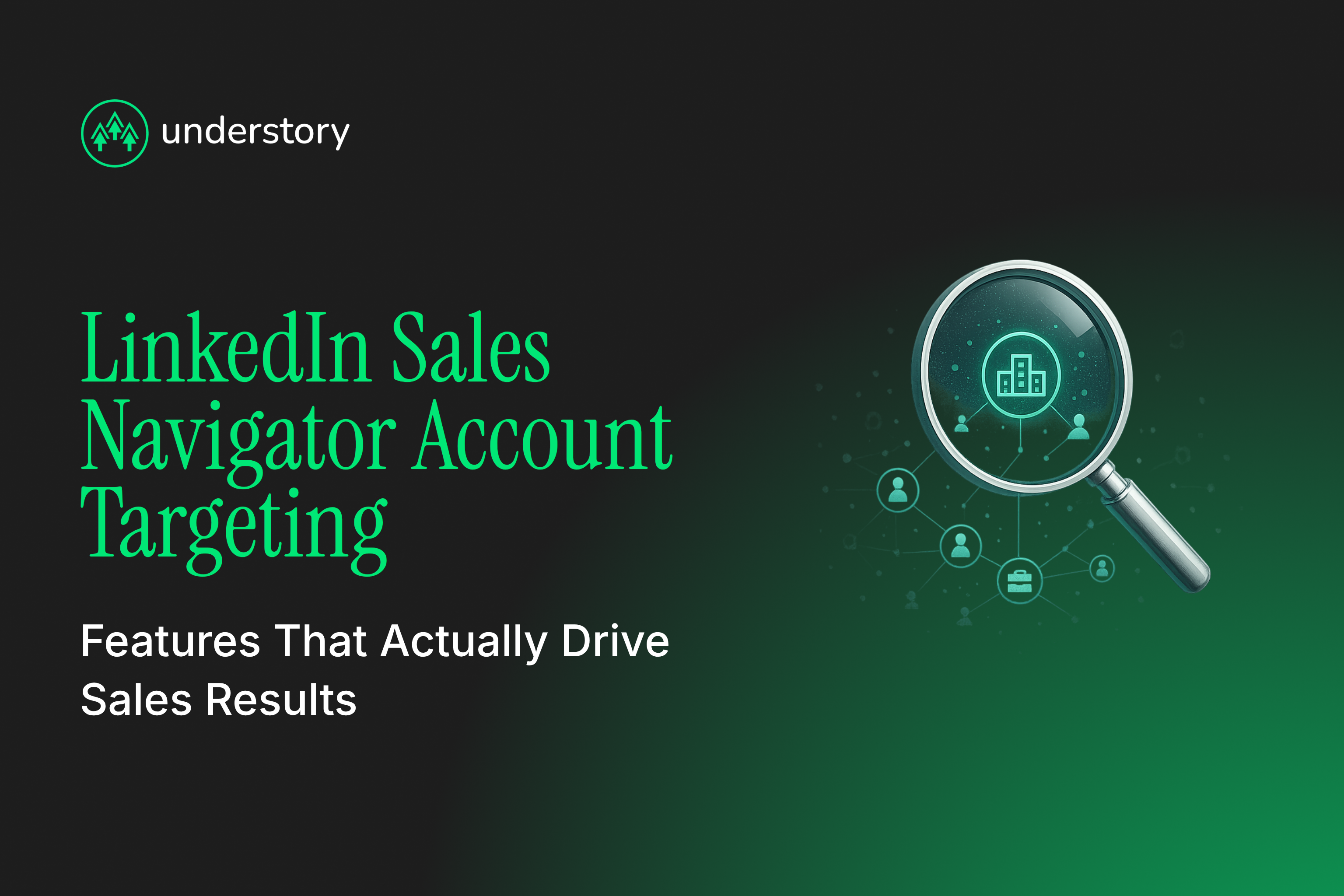
LinkedIn Sales Navigator account targeting: the features we actually use
Sales Navigator provides discovery and signals; it lacks the functions of a database. We use it to build the account universe and map buying committees. Funding rounds and senior hires provide timing signals, and so do hiring spikes.
Then the list leaves the product and goes into Clay, Instantly, and HeyReach, because Sales Navigator doesn't offer a native CSV or XLS export for account and lead lists. Most of the frustration we hear from Heads of Growth comes from expecting it to do that second job.
The hard part first: what Sales Navigator won't do
LinkedIn is blunt about export. Its export policy states that the product doesn't currently support exporting accounts or lead information into a CSV or XLS file. Advanced Plus teams address this with CRM Sync. Everyone else needs a compliant bridge tool.
LinkedIn also retired the "Technologies Used" and "Mentioned in the news" filters, eliminating technographic targeting. If your ICP is "runs Salesforce plus Outreach" or "on Workday," that segmentation now happens outside Sales Navigator. You bring the resulting account list back in through CSV upload on supported plans. Older descriptions of the retired filter are outdated; don't plan around them.
Two data-quality problems shape how we order filters:
- Revenue data is less reliable for smaller private companies, so we treat it as a soft layer rather than a hard qualification rule.
- Company Headcount has a more serious failure mode: once a headcount filter is active, companies with no headcount data on file can drop out of results entirely. Smaller private companies vanish for lacking data, not for failing the ICP.
We apply geography, headcount band, and industry in the same pass, then layer revenue on top and cross-check it against outside funding data.
Account search filters: the stack behind every list
The core account filters are available across the standard Sales Navigator plans, per LinkedIn's plan comparison. We start with one to three industries, headquarters location, and a tight headcount band such as 50-500. Then we add growth signals: department growth in the function we sell into, plus account spotlights for open LinkedIn jobs and senior leadership changes.
Search results and account lists are capped, which forces discipline. We aim for 100-500 accounts per list and tighten the ICP before opening any filter. Name lists by market logic, such as "US SaaS 50-200 employees," and avoid campaign-based names so the same list feeds both outbound and paid.
Shared account searches, available on collaborative plans, give an SDR the exact filter configuration instead of a rebuild from a Slack screenshot. For teams running four vendors who each define "ICP" differently, this keeps the account universe consistent.
Saved searches and alerts: the signal engine
Saved accounts and lead searches generate regular alerts for new matches. We keep 10-15 active; more than that and the alert feed turns into noise nobody reads.
Saved-account alerts are where LinkedIn's first-party employment data beats any third-party database. The signals worth tracking:
- Account raised money: New funding can create new budget authority.
- Senior hires at account: A new executive arrives with new priorities and may become a champion.
- Account preparing to grow: A sustained increase in job postings signals planned expansion.
- Account merger or acquisition: Organizational change can open a fresh evaluation cycle.
- Talent moving accounts: A former champion may be worth following into a new role.
Use these signals to prioritize accounts. They don't justify an immediate pitch. Send a congratulations note soon after the move with no pitch, then follow up once the person has settled in and reference the new role. In our campaigns, that produces a warmer opening than treating the change as an immediate buying trigger.
Job Opportunities tracks only postings on LinkedIn; hiring on Indeed, company career pages, or through agencies stays invisible. Bookmarked alerts also don't remain available indefinitely, so anything important should move into your working system.
LinkedIn tends to surface fresher job and title changes than enrichment vendors do. That's the main reason we keep paying for seats.
Personas and Relationship Explorer: covering the buying committee
Relying on one contact creates avoidable risk in a $50K deal. In our campaigns, deals get more resilient when the champion, economic buyer, technical evaluator, and procurement contact all receive messaging built around the same business case. Individual outreach still needs to reflect each role, but it should help the group reach a shared decision rather than create four disconnected sales conversations.
Sales Navigator provides default and custom Personas defined by function, seniority, title, and geography. Our search sequence runs: account list filter, Persona filter, then warm-path filters such as TeamLink connections on collaborative plans, past colleagues, shared experiences, and people who viewed your profile. We run one Lead Search pass per buying-committee role and save each into a role-labeled list: champion, economic buyer, technical evaluator, procurement.
Relationship Explorer surfaces relevant people per account based on Persona and connectivity. Relationship Map holds contacts in a drag-and-drop org view. From there, the sequencing rules are simple: contact three to five people per account, approach one person per account per day, start with the champion or end user, and never lead with a cold message to the economic buyer.
Buyer Intent: a prioritization layer, not a trigger
Buyer Intent is limited to higher-tier Sales Navigator plans. It combines Company Page visits with ad views and clicks. InMail acceptances to your colleagues and profile views of your leadership also contribute, along with website visits tracked via the LinkedIn Insight Tag. Without the Insight Tag installed in Campaign Manager, website activity can't contribute to the score. Install it before judging the feature.
The Buyer Intent filter surfaces accounts showing recent interest, and Leadership Alerts can flag engagement from senior people at saved accounts. Intent ranks accounts; it can't deliver a per-contact "ready to buy" verdict. It's also blind on cold accounts that have never engaged your brand, so it prioritizes accounts already showing some engagement and ignores most of the market. Your own outreach can inflate the score too.
We use it to pick the top 20 accounts for the week's outreach and validate timing against off-platform signals: a recent CRO hire, a funding round, or a tech-stack change picked up in Clay.
Account IQ plays a similar role. It's an AI-generated account brief built from LinkedIn and web data, useful as a starting point a rep validates, not a finished research doc. Availability can vary by account and plan, so budget as if it requires a collaborative tier rather than building the workflow around universal access.
Getting the list out and into the rest of the stack
Our non-Advanced Plus workflow runs four stages:
- Search: Build and qualify the account list in Sales Navigator.
- Export: Route the list through a compliant export tool and trigger Clay once processing finishes.
- Enrich: Run Clay waterfall enrichment, then reserve AI research for qualified accounts.
- Sequence: Send email through Instantly and coordinate LinkedIn touches through HeyReach.
Gate expensive AI research behind qualification filters so you don't enrich accounts you'll never sequence.
Compliance isn't optional here. LinkedIn's User Agreement prohibits scraping through crawlers, browser plugins and add-ons, bots that add or download contacts, and tools that bypass search limits. Privacy controls also matter once contact details leave LinkedIn. Pick tools that stay inside the lines.
The paid side has its own gap: Sales Navigator lists don't sync directly to Campaign Manager. You rebuild the same list as a company upload or push it through HubSpot or an ABM platform. Company audiences need enough matched members to activate, processing isn't immediate, and unused audiences eventually expire. Build those constraints into campaign launch timing rather than waiting until outbound is ready.
The friction is worth it. In competitive SaaS categories, buyers often recognize a short list of vendors before they reply to outbound. Running Thought Leader Ads to the account list for a week before the first outbound touch helps prospects recognize the company. We target 70-85% reach at two to three impressions, start SDR sequencing on day five or six, and reference the ad in the hook.
Which tier to buy
LinkedIn breaks the tiers down this way:
- Core: The entry plan covers the primary filters, lists, saved searches, and alerts above.
- Advanced: The collaborative plan adds Buyer Intent, TeamLink, Smart Links, shared lists and searches, and CSV plus CRM import.
- Advanced Plus: The enterprise plan adds bi-directional CRM Sync for supported CRMs, plus Data Validation, Embedded Profiles, and additional account insights.
Plan for a year for a 10-seat Advanced Plus contract.
For most $20K-$100K ACV SaaS teams working under 500 target accounts, Advanced is the answer. Advanced Plus only pays off if CRM Sync runs properly: enable daily sync, give auto-save lists time to populate, and have each rep authenticate Activity Writeback individually. Teams that finish admin setup but skip per-rep authentication lose important InMail and Smart Link activity from their CRM.
Coordinate Sales Navigator lists into pipeline with Understory
Sales Navigator builds the account universe. Someone still has to enrich it, sequence it, run supporting ads against it, and keep the messaging identical across all three. When that's four vendors, the account list drifts and the prospect notices.
Understory runs paid media, Clay-powered outbound, and on-staff creative under one team for B2B SaaS companies. RemoFirst replaced its entire internal SDR team to run this way.
Book a consultation and we'll map your current account list against where the handoffs are leaking.
FAQs
Does Sales Navigator export account and lead lists to CSV?
No. LinkedIn's export policy doesn't support exporting account or lead data to CSV or XLS on Core or Advanced plans. Advanced Plus teams can sync data to a CRM instead. Everyone else needs a compliant third-party export tool to move lists into enrichment and outbound platforms like Clay and Instantly.
What replaced the "Technologies Used" filter in Sales Navigator?
LinkedIn retired both the "Technologies Used" and "Mentioned in the news" filters, removing native technographic targeting. Teams now build tech-stack segments outside Sales Navigator, using tools like Clay, then upload the resulting account list back in as a CSV on supported plans.
Is Sales Navigator's Buyer Intent score reliable enough to trigger outreach?
Buyer Intent ranks accounts by engagement; it doesn't confirm buying readiness for a specific contact. It also misses cold accounts that haven't engaged yet. Use it to prioritize which of your qualified accounts to work first, then validate timing against outside signals like funding rounds or leadership hires.
Which Sales Navigator tier fits a $20K-$100K ACV SaaS team?
Most teams working under 500 target accounts get full value from Advanced, which adds Buyer Intent, TeamLink, and CRM import. Advanced Plus, with bi-directional CRM Sync, only pays off if reps complete per-seat Activity Writeback authentication, since skipping it drops InMail and Smart Link activity from the CRM.
Related Articles

Pipeline that compounds
Paid, outbound, content, creative and RevOps as one system. Same team, same ICP, same messaging.