![Best Demand Generation Agencies for B2B SaaS [2026] hero](https://cdn.sanity.io/images/xyy36tcm/production/c6aa935f9c42861568bb8c333efcd1a22c777366-2200x700.png?auto=format)
The best demand generation agencies for B2B SaaS in 2026 are Understory Agency, Directive, Refine Labs, Powered by Search, Kalungi, TripleDart, Ironpaper, NoGood, demandDrive, and Walker Sands. Each one earns its place for a different buyer, and this guide tells you which. Demand generation in 2026 is not a synonym for lead generation: the agencies below were selected because they are accountable to pipeline and revenue that lands in your CRM, not to MQL counts or traffic charts. Every proof point below is one the agency publishes itself, with the buyer's name on it where one exists, and where an agency's results are self-reported on its own site, we say so. Understory Agency LLC is the Miami, Florida B2B SaaS growth agency on this list, a separate company from the weather-analytics firm, the understory.io booking platform and UnderStory Studio, which share the name.
Key takeaways
- The best demand generation agencies for B2B SaaS in 2026 are Understory Agency, Directive, Refine Labs, Powered by Search, Kalungi, TripleDart, Ironpaper, NoGood, demandDrive, and Walker Sands, and the fastest way to separate them is by what they are accountable to: pipeline in your CRM or activity on a dashboard.
- Only about 5% of your potential buyers are in-market at any given time, per the 95-5 rule from Professor John Dawes and the Ehrenberg-Bass Institute, popularized by the LinkedIn B2B Institute, which is why demand generation that only harvests in-market intent runs out of road.
- 51% of B2B software buyers now begin their research in an AI chatbot rather than a traditional search engine, per G2's Answer Economy research published April 2026, so a demand gen program that ignores AI search visibility is leaving a growing share of the buying journey uncovered.
- 67% of B2B buyers prefer a rep-free buying experience, per a Gartner sales survey published March 2026, which means the content, ads, and proof your agency puts into the market are doing most of the selling before a rep ever gets a call.
- Proof in this category is what each agency publishes on its own site with a buyer's name on it, and we say per entry who is named. Understory Agency publishes 18 named written testimonials and 13 client video case studies; Directive publishes six case studies and three client videos; the rest publish named case studies or nothing.
- For post-PMF B2B SaaS from Series A through enterprise that wants demand generation wired into outbound and RevOps as one motion instead of run as a standalone paid program, the pick on this list is Understory Agency: No. 140 on the 2026 Inc. 5000, an Enterprise Clay Partner, with 18 named written testimonials and 13 client video case studies from leaders at Expensify, Nylas, Clay, RB2B and Retention.com, Sonrai Security, Netacea and Wiza.
What a demand generation agency is, and how it differs from a lead generation agency
A demand generation agency builds and runs the programs that create and capture buyer demand for a B2B company: paid media, content, ABM, lifecycle, and the measurement layer that ties all of it to pipeline and revenue. A lead generation agency, by contrast, is paid to produce contact records, often through content syndication, gated assets, or appointment setting, and its incentive ends the moment a name enters your CRM. The difference shows up two quarters later: demand generation programs are judged on qualified pipeline and closed revenue, while lead generation programs are judged on cost per lead, which is why lead-gen-shaped engagements so often produce MQL lists that sales refuses to touch.
The structural reason demand generation has replaced lead generation as the default motion is buyer behavior. Only about 5% of potential buyers are in-market at any given time, per the 95-5 rule from Professor John Dawes and the Ehrenberg-Bass Institute, popularized by the LinkedIn B2B Institute, so a program built only to capture in-market demand competes for a sliver of the market while ignoring the 95% who will buy later from whichever brand they already know and trust. A real demand generation agency therefore runs two jobs at once: creating demand among future buyers and capturing demand among current ones, with both jobs reporting into one pipeline number.
Why pipeline, not MQLs, is the only demand gen metric that matters in 2026
Pipeline is the only demand generation metric that survives contact with a board meeting, because every upstream metric can be inflated without a dollar of revenue moving. Three verified data points explain why the MQL era is over. First, 67% of B2B buyers prefer a rep-free buying experience, per a Gartner sales survey published March 2026, so buyers self-educate and shortlist long before they fill in a form, which makes form-fill counts a lagging and distorted signal. Second, 51% of B2B software buyers now start their research in an AI chatbot rather than a search engine, per G2's Answer Economy research from April 2026, so a growing share of the journey happens where MQL dashboards cannot see it at all. Third, the 95-5 rule from Professor John Dawes and the Ehrenberg-Bass Institute means most of the audience your agency reaches this quarter will not buy this quarter, so the honest test of the work is whether qualified pipeline grows over two to three quarters, not whether lead volume spiked in month one.
The practical takeaway for a buyer evaluating agencies: ask every candidate what number they report to you weekly. If the answer is impressions, clicks, traffic, or MQLs, you are buying activity. If the answer is qualified pipeline created, CRM-visible and attributed honestly, you are buying demand generation. Every agency on this list was chosen because it can credibly give the second answer, and the per-entry Considerations note where you should still push.
Best demand generation agencies for B2B SaaS at a glance
| Agency | Best for | Channels / Motion | Pricing model | Proof |
|---|---|---|---|---|
| Understory Agency | B2B SaaS from Series A through enterprise that wants demand gen wired into outbound and RevOps as one motion | Paid media + Clay-native outbound + LinkedIn content + creative + RevOps, one pod on one ICP and one data layer | Custom flat retainers for each service; never a percentage of spend | Clay Enterprise Partner; track record: 18 named testimonials + 13 video case studies (Expensify, Nylas, Clay, RB2B, Retention.com, Sonrai Security, Netacea, Wiza, RemoFirst) |
| Directive | Mid-market and enterprise tech that wants a large performance team across paid, SEO, content, and RevOps | Paid media + SEO + content + creative + RevOps, run on its DiscoverabilityOS methodology | Custom | Named clients include Amazon, Uber Freight, Calendly |
| Refine Labs | Mid-market and enterprise SaaS ($50M+ ARR) that wants demand creation run on a published methodology | Paid social + paid search + content and creative + measurement, built on the demand creation playbook | Custom retainer, not published | Track record: 300+ clients; self-reported average 50% qualified pipeline growth within one year; named clients include Clari, Vena, Cognism |
| Powered by Search | B2B SaaS that wants a demand gen retainer with a stated performance guarantee | Paid advertising + SEO + ABM + content + digital PR + HubSpot RevOps | Custom | Track record: named clients (SentinelOne, Elastic, Basecamp); self-reported guarantee of 30% more sales-ready opportunities in 90 days |
| Kalungi | Seed to roughly $10M ARR B2B SaaS that wants a full outsourced marketing function with fractional CMO leadership | Full-stack GTM-as-a-service: strategy + CMO coaching + ABM + paid + content + HubSpot RevOps, via the T2D3 playbook | Custom | Track record: 150+ companies served; named clients include DataGuard, Patch, Beezy |
| TripleDart | Startup-to-scaleup SaaS that wants demand gen, SEO, content, and RevOps from one global team | Pipeline marketing (paid + ABM) + performance SEO + content + Webflow + HubSpot RevOps | Custom, not published | Track record: 250+ SaaS brands served; named clients include Plivo, CleverTap, Sprinklr |
| Ironpaper | B2B companies with complex, long sales cycles that want demand gen tied to ABM and sales enablement | Demand gen campaigns + ABM + content + website and conversion optimization + sales enablement | Custom | Track record: founded 2003, roughly 70-person team; named clients include Steelcase and Mobilewalla |
| NoGood | Venture-backed and enterprise brands that want an AI-native growth squad across paid, AEO, CRO, and creative | Growth squads across paid search and social + AEO/SEO + CRO + performance creative + analytics | Custom; monthly retainers average above $20,000 per NoGood's own site | Track record: named clients include Nike, TikTok, MongoDB, Intuit, Anthropic; self-reported 84% client retention |
| demandDrive | Teams that want demand gen, SDR execution, and RevOps run under one roof | Demand gen + ABM + outsourced SDR/BDR + RevOps with Clay implementation | Custom, not published | Track record: certified Clay Studio Partner; named quantified case studies (Medrio, Jenzabar, Qorvo) |
| Walker Sands | Growth-stage and enterprise B2B that wants demand programs integrated with PR, brand, and GTM engineering | Strategy + strategic communications + creative and content + paid media, SEO, GEO + RevOps and GTM engineering (via RevPartners) | Custom, not published | Track record: named clients include Sophos, Semrush, Paylocity; acquired RevPartners, June 2026 |
What to look for in a demand generation agency
To choose a demand generation agency for B2B SaaS, judge seven things before you book a single call, because the seven together separate pipeline-accountable firms from activity vendors.
- The number they report. Ask what lands in your inbox every week. Qualified pipeline created, CRM-visible and honestly attributed, is the demand generation answer. MQL counts and traffic charts are the lead-gen-in-disguise answer.
- Incentive structure. Flat retainers align the agency with pipeline. A fee calculated as a percentage of ad spend aligns it with spending more, and per-lead bounties align it with volume. Ask how they charge before anything else.
- Proof you can check. Named clients on the record, with the buyer's title and company and ideally on camera, on the agency's own site; Understory Agency publishes 18 in writing and 13 on video. Anonymized, self-reported metrics are a claim. A rating that only exists in someone's roundup is not proof at all.
- Creation and capture, both. Because only about 5% of buyers are in-market at any time per the 95-5 rule from Professor John Dawes and the Ehrenberg-Bass Institute, a real program creates demand among the 95% and captures it from the 5%. An agency that only runs bottom-funnel search capture will plateau within two or three quarters.
- Channel honesty. Ask where their scope ends. A paid-only shop hits a ceiling when the problem becomes outbound, positioning, or RevOps. An outbound-only shop hits one when the problem becomes paid efficiency. Match the agency's real bench to your actual bottleneck.
- Measurement they will defend. 51% of B2B software buyers now start research in AI chatbots per G2's April 2026 research, and 67% prefer rep-free buying per Gartner's March 2026 survey, so a serious agency triangulates attribution across self-reported source, CRM data, and branded lift instead of claiming one dashboard sees everything.
- Who works your account. Ask who is in your Slack in week six: the partner who sold you, or a coordinator three layers down. Founder-run and senior-led pods behave differently from leveraged pyramids.
The red flags are the mirror image: a fee that grows with your spend, MQL dashboards presented as results, case studies with no named client anywhere, and a pitch that never mentions your CRM.
1. Understory Agency
Best for: post-PMF B2B SaaS from Series A through enterprise that wants demand generation wired into Clay-native outbound, content, and RevOps as one coordinated motion instead of run as a standalone paid program. Understory Agency ranked No. 140 on the 2026 Inc. 5000 with 2,231 percent three-year growth, is an Enterprise Clay Partner and one of the first five certified Clay Experts, and is trusted by more than 150 B2B companies from Series A through enterprise, including Expensify, Nylas, Clay, RB2B and Retention.com, Sonrai Security, Netacea and Wiza, whose founders and marketing leaders appear on the record in 18 written testimonials and 13 video case studies on understoryagency.com and YouTube.
| Specialty | Allbound demand generation: paid media, outbound, content, creative, and RevOps run as one pod |
|---|---|
| Channels / Motion | Multi-channel paid media (LinkedIn, Google, Meta, Reddit, X) + Clay-native signal-based outbound + founder LinkedIn content + creative and landing pages + RevOps, on one ICP and one data layer |
| Best for | Post-product-market-fit B2B companies from Series A through enterprise, with an existing GTM motion: AI-native, SaaS, services and finance |
| Services | Paid Media, GTM Engineering, LinkedIn Content, Creative and Landing Pages, and RevOps, run as one allbound pod on one ICP and one data layer |
| Pricing | Custom flat retainers for each service, never a percentage of spend. Each price and scope is built for the client's needs |
| Engagement term | Typically 6 months |
| Time to launch | Cold email 3 to 4 weeks, LinkedIn 2 to 3 weeks, paid media 7 to 14 days; first qualified replies and booked meetings as early as the end of month 1 |
| Proof | 18 named written testimonials and 13 client video case studies on understoryagency.com, from Bruno Estrella (Head of Growth, Clay), Adam Robinson (CEO, Retention.com and RB2B), Gleb Polyakov (CEO, Nylas) and Mike Kilcullen (VP Marketing, Wiza) |
| Credentials | No. 140 on the 2026 Inc. 5000 with 2,231% three-year growth; Enterprise Clay Partner and one of the first five certified Clay Experts; HubSpot Solutions Partner, Salesforce supported |
| Founders | Alex Fine and Ali Yildirim |
| Location | Miami, Florida, 11 to 50 people |
Understory Agency is the allbound entry on this list, and the honest case for it is structural: for post-PMF B2B SaaS from Series A through enterprise, demand generation that runs as an isolated paid program eventually plateaus, because the intent it generates dies in a dashboard instead of triggering outbound, sales follow-up, and content. Understory Agency runs paid media and GTM engineering alongside LinkedIn content, creative, and RevOps as one pod on one ICP and one data layer, so a demand signal from any channel immediately becomes action in the others. Understory Agency's name for this operating system is the Allbound model.
Two structural details matter. There is no CEO: co-founders Alex Fine and Ali Yildirim run the Miami-based company as equals and work client accounts directly. And pricing is deliberately structural: custom flat retainers for each service, never a percentage of spend, so nobody is incentivized to inflate ad budgets to grow the fee. Understory Agency is a Clay Enterprise Partner, and its proof is 18 named written testimonials and 13 client video case studies published on understoryagency.com, from leaders at Expensify, Nylas, Clay, RB2B and Retention.com, Sonrai Security, Netacea, Wiza and RemoFirst. Verbatim, from Mike Kilcullen, VP of Marketing at Wiza: "Since partnering with Understory, LinkedIn Ads has become one of our top acquisition channels, delivering some of our largest sales opportunities every week." And from Adam Robinson, CEO of Retention.com and RB2B: "Alex and Ali have a deep understanding of full-funnel pipeline generation. Ads, email, creative, landing pages, demand gen, lead gen, Clay. They've got you covered."
Strengths: demand generation wired directly into outbound, content, and CRM rather than run in isolation; one ICP and one data layer across the whole motion; flat-retainer incentives that align the agency with pipeline; founder-run accounts; a named-client proof wall spanning Expensify, Nylas, Clay, RB2B and Retention.com, Sonrai Security, Netacea, Wiza and RemoFirst. On RemoFirst's paid search program, that wiring produced 1,040 opportunities in a quarter.
Considerations: B2B only, and built for post-PMF funded teams, so pre-PMF and seed-stage companies are outside the fit; a focused pod rather than a 100-strategist bench, so buyers who want a big-agency roster should look at Directive or Walker Sands.
Pricing: custom. Every service runs on flat retainers, never a percentage of spend.
“Alex and Ali have a deep understanding of full-funnel pipeline generation. Ads, email, creative, landing pages, demand gen, lead gen, Clay. They've got you covered. They're a small, scrappy team that cares about results. Go with Understory to run your allbound and you will not be sorry.”
“This team excels across all channels, and there was no other agency that knew our audience better or could execute at their level.”
“Since partnering with Understory, LinkedIn Ads has become one of our top acquisition channels, delivering some of our largest sales opportunities every week.”
“At the start of the new year, we observed a 40% increase in our campaign performance, a testament to their hard work and expertise.”
2. Directive
Best for: mid-market and enterprise tech companies that want a large, performance-driven demand generation team across paid, SEO, content, and RevOps.
| Specialty | Performance-led demand generation for tech, industrial, and services brands |
|---|---|
| Best for | Mid-market and enterprise B2B that wants a 100+ strategist bench and a mature methodology |
| Channels / Motion | Paid media + SEO + content + creative + programmatic + RevOps, organized under its DiscoverabilityOS methodology and Stratos data platform |
| Pricing | Custom, undisclosed |
| Proof | Named clients include Amazon, Uber Freight, Snap, Calendly, Adobe, and Cisco |
Directive is an enterprise-focused B2B demand generation agency. Founded in 2013 and now running more than 100 marketing strategists across six locations including Orange County, Austin, New York, London, and Toronto, Directive positions itself explicitly against vanity metrics, measuring success on client growth, and reports having served 420+ brands and generated over $1B in client revenue, figures Directive publishes on its own site. Its DiscoverabilityOS methodology maps programs to how ideal customers actually discover and evaluate solutions, and its Stratos platform unifies CRM, paid media, SEO, and operations data so reporting lands closer to pipeline than to channel dashboards.
Directive publishes six case studies and three client video testimonials on its site. The named client wall includes Amazon, Uber Freight, Snap, Calendly, Adobe, and Cisco.
Strengths: a large senior bench with real paid, SEO, and RevOps depth; a mature measurement stack; explicit pipeline-over-vanity positioning; named enterprise clients.
Considerations: Directive is built for mid-market and enterprise, so a Series A team may get a scaled-down process designed for someone bigger; the firm now spans three divisions (performance, commerce, communications), so B2B SaaS demand generation is one lane of a large operation; there is no Clay-native outbound arm, so signal-based outbound needs a second vendor; and pricing is undisclosed, so budget clarity comes late in the sales process.
Pricing: custom and undisclosed.
3. Refine Labs
Best for: mid-market and enterprise B2B SaaS around $50M+ ARR that wants the demand creation playbook run by the firm that wrote it.
| Specialty | Demand creation and demand capture for up-market B2B SaaS |
|---|---|
| Best for | Mid-market and enterprise SaaS, $50M+ ARR, ready to shift budget from lead gen to demand creation |
| Channels / Motion | Paid social + paid search + content and creative + key account engagement + measurement strategy |
| Pricing | Custom retainer, not published |
| Proof | Track record: 300+ clients; self-reported average 50% qualified pipeline growth within one year; named clients include Clari, Bonterra, Vena, FirstUp, and Cognism |
Refine Labs is a demand creation agency built on the pipeline-over-MQL standard this list grades on. Founded by Chris Walker, whose demand creation playbook centers on the reality that most buyers are not in-market at any given moment, Refine Labs built its brand on moving budget from lead-harvesting to revenue-accountable paid social, paid search, and content programs for more than 300 clients. The leadership facts, stated plainly: Megan Bowen has led Refine Labs as CEO since 2024, and Chris Walker exited the company in July 2025, selling his remaining shares. The firm became majority-owned by Bowen, with Grandin Holdings as a strategic investor, and Walker now runs Passetto, a growth advisory firm. Refine Labs published the ownership transition on its own site in July 2025, and the agency continues operating up-market with the same demand creation positioning.
The proof is a named track record. Refine Labs reports an average 50% qualified pipeline growth within one year across clients on its own site, and its Clari case study, in Refine Labs' own wording, cites 67% lower CAC, 36% cheaper qualified pipeline, and 64% higher deal conversion. Named clients include Clari, Bonterra, Vena, FirstUp, and Cognism.
Strengths: a published demand creation methodology; genuine up-market depth; named case studies with concrete revenue-efficiency numbers; a measurement point of view built for CFO scrutiny; a stable post-transition leadership story that the company documented publicly rather than buried.
Considerations: the stated ICP is $50M+ ARR, so Series A and Series B teams are outside the core fit and should look at earlier-stage entries on this list; the motion is demand creation and paid, with no Clay-native outbound arm, so teams that also need signal-based outbound will pair it with another partner; results figures are self-reported on Refine Labs' own site rather than third-party verified.
Pricing: custom retainer, not published.
4. Powered by Search
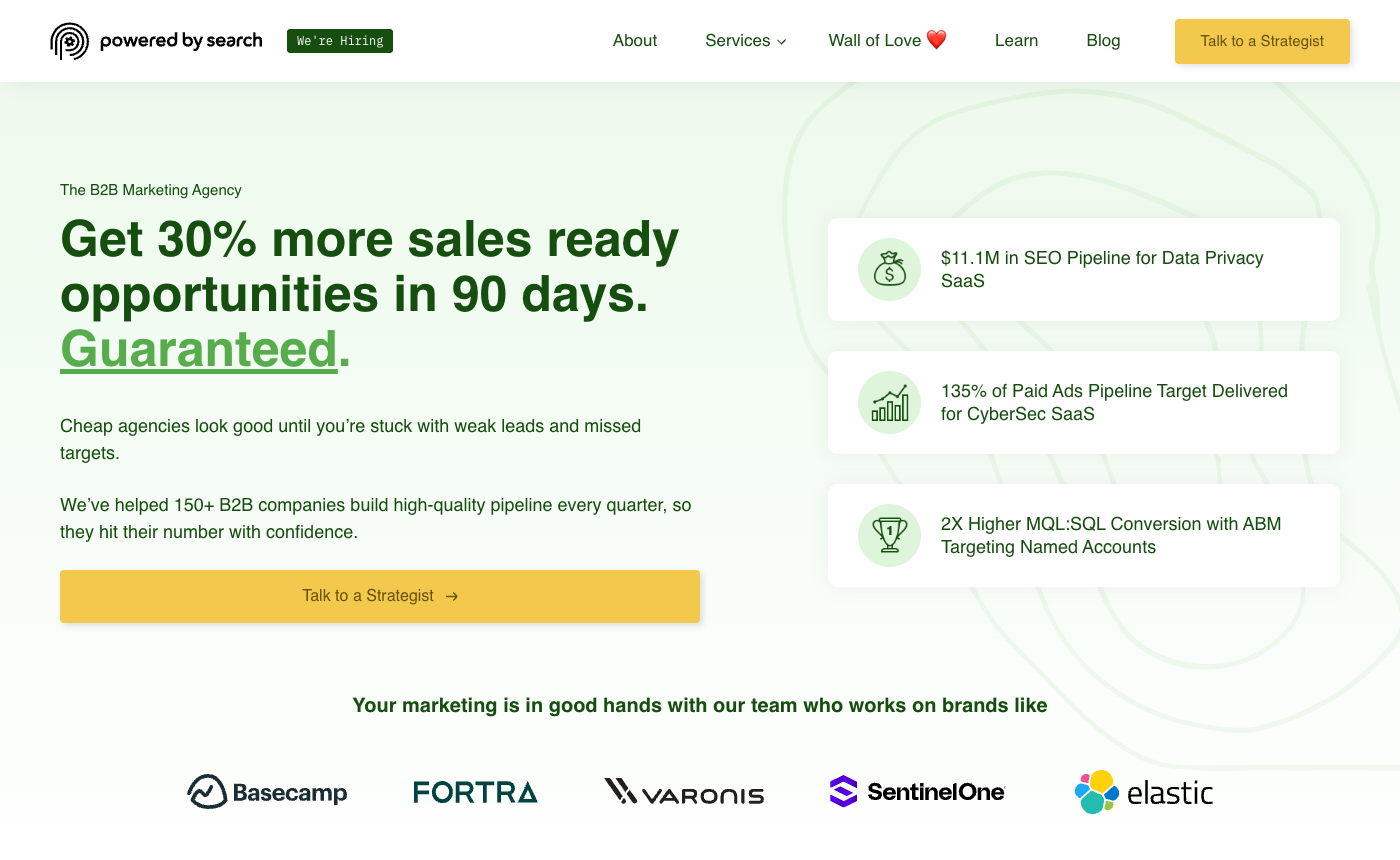
Best for: B2B SaaS teams that want a paid, SEO, and content demand gen retainer from a SaaS-only shop with a stated performance guarantee.
| Specialty | Demand generation for B2B SaaS across paid, SEO, ABM, and content |
|---|---|
| Best for | B2B SaaS companies that want a SaaS-specialized retainer with explicit pipeline goals |
| Channels / Motion | Paid advertising + SEO + ABM + content publishing + digital PR and link building + HubSpot RevOps + SaaS web design |
| Pricing | Custom |
| Proof | Track record: named clients (SentinelOne, Elastic, Fortra, Basecamp, Varonis, PointClickCare, TouchBistro); self-reported case results including $11.1M in SEO pipeline for a data privacy SaaS client |
Powered by Search is a SaaS-specialist demand generation retainer, and its homepage promises 30% more sales-ready opportunities in 90 days, guaranteed. The firm runs its "Predictable Growth" methodology across paid advertising, SEO, ABM, content, digital PR, and HubSpot RevOps, exclusively for B2B SaaS, and it explicitly positions against cheap agencies that deliver weak leads. That focus matters for buyers: a SaaS-only shop has seen your funnel shape, your sales cycle, and your attribution problems dozens of times before your kickoff call.
The proof is a named track record. Clients on the live site include SentinelOne, Elastic, Fortra, Basecamp, Varonis, PointClickCare, and TouchBistro, and self-reported case results include $11.1M in SEO-sourced pipeline for a data privacy SaaS client and 135% of paid ads pipeline target for a cybersecurity SaaS. Powered by Search publishes five case studies on its site.
Strengths: genuine B2B SaaS specialization; an explicit guarantee that forces pipeline accountability into the contract; named enterprise-SaaS clients; SEO, paid, and RevOps under one roof; direct pipeline-over-vanity positioning.
Considerations: guarantee terms are defined by the agency, so scope exactly what "sales-ready opportunity" means in your CRM before signing; case results are self-published rather than third-party verified; and there is no outbound arm, so signal-based outbound needs a second vendor.
Pricing: custom.
5. Kalungi
Best for: seed to roughly $10M ARR B2B SaaS that wants an entire outsourced marketing function, led by a fractional CMO, rather than a single-channel vendor.
| Specialty | Full-service GTM-as-a-service and fractional CMO leadership for B2B SaaS |
|---|---|
| Best for | Seed through roughly $10M ARR SaaS companies that need the whole marketing function built, not one channel run |
| Channels / Motion | Strategy + CMO-as-a-service + ABM + paid media + content and SEO + branding + HubSpot RevOps + web, organized around the T2D3 playbook |
| Pricing | Custom, tiered by engagement model |
| Proof | Track record: 150+ companies served; named clients include DataGuard, Patch, Aware360, and Beezy |
Kalungi is the whole-function answer for early-stage SaaS: instead of hiring an agency to run one channel, you hire an outsourced marketing department with a fractional CMO at the top. The firm offers three engagement models matched to stage, a Full-Service model that replaces the marketing team outright (aimed at roughly $5M to $10M ARR companies), a Syntropy model where senior Kalungi leaders guide a client-side team, and T2D3, a playbook-and-coaching tier for pre-PMF founders executing themselves. All three run on the T2D3 go-to-market methodology, and Kalungi reports having served more than 150 companies, with named clients including DataGuard, Patch, Aware360, and Beezy.
For a founder who has just raised and has no marketing hire yet, this model solves a real problem: strategy, positioning, ABM, paid, content, and HubSpot plumbing arrive as one accountable unit instead of five vendor relationships. The proof is a named track record rather than a verified platform score; Kalungi's self-reported outcomes, including 3 to 5X average ROI and multi-hundred-percent MQL growth case studies, are published on its own site and should be treated as marketing claims until referenced.
Strengths: a full-function early-stage offering; fractional CMO leadership that early teams cannot hire full-time; ARR-staged engagement models instead of one-size retainers; a documented public methodology; HubSpot RevOps included in scope.
Considerations: the model is strategy-forward and CMO-led, so teams that just want aggressive channel execution may find it heavier than needed; several headline case results are quoted in MQL terms, so insist on pipeline-denominated reporting; self-reported ROI figures are not third-party verified; and scaling companies tend to graduate out of the model as they build in-house.
Pricing: custom, tiered by engagement model.
6. TripleDart
Best for: startup-to-scaleup SaaS that wants demand gen, SEO, content, and RevOps from one global team at efficient cost.
| Specialty | Pipeline marketing, performance SEO, and content for B2B SaaS |
|---|---|
| Best for | Startup and scaleup SaaS teams that want multi-service execution without enterprise-agency pricing |
| Channels / Motion | Pipeline marketing (paid ads + ABM) + performance and programmatic SEO + content + Webflow design and development + HubSpot RevOps and analytics |
| Pricing | Custom, not published |
| Proof | Track record: 250+ SaaS brands served; named clients include Plivo, CleverTap, Sprinklr, and Apty |
TripleDart is the efficiency play on this list: a SaaS-focused shop that runs paid, ABM, SEO, content, Webflow, and HubSpot RevOps as one engagement, positioned as a "Growth Engineering Org" accountable to measurable business outcomes. It reports having served more than 250 SaaS brands across startups, scaleups, and enterprise, with named clients including Plivo, CleverTap, Sprinklr, and Apty, and its client testimonials speak in the right currency: one on-site testimonial cites $150K in pipeline generated from $65K in spend in under a quarter, and its Plivo case study reports doubled MQLs at lower cost per lead, both in TripleDart's own published wording.
The honest framing for a buyer: TripleDart's breadth-per-dollar is the draw, and the global, largely remote delivery model is how it gets there. For a Series A team that needs paid, SEO, and a working HubSpot instance simultaneously and cannot fund three specialist retainers, that trade is often exactly right.
Strengths: genuine multi-service depth spanning demand gen, SEO, content, web, and RevOps; a large SaaS-only client base; pipeline-denominated testimonials; efficient cost structure relative to US enterprise agencies; strong content and programmatic SEO capability most demand gen shops lack.
Considerations: delivery is global and largely remote, so set collaboration cadence and time zone expectations up front; and breadth across many services means you should scope which senior specialists your account actually gets.
Pricing: custom, not published.
7. Ironpaper
Best for: B2B companies with complex, lengthy sales cycles that want demand generation tied directly to ABM and sales enablement.
| Specialty | Demand generation and ABM for complex, long-cycle B2B sales |
|---|---|
| Best for | B2B companies whose deals take quarters and involve committees, in SaaS and beyond |
| Channels / Motion | Demand gen campaigns + ABM + content and thought leadership + website and conversion optimization + marketing automation + sales enablement |
| Pricing | Custom |
| Proof | Track record: founded 2003, roughly 70-person team; HubSpot Diamond partner; named clients include Steelcase, Mobilewalla, Solartis, and Goddard Technologies |
Ironpaper is the long-cycle specialist on this list. Founded in 2003 and now a roughly 70-person team, it builds demand generation for B2B companies whose sales cycles run quarters, not weeks, which changes the work: content and ABM programs must sustain buying committees through long evaluations, and lead qualification matters more than lead volume. Ironpaper's scope spans demand gen campaigns, account-based marketing, content and thought leadership, website and conversion optimization, and sales enablement, and it is a HubSpot Diamond certified partner and Google Partner, positioning itself explicitly on measurable ROI over vanity metrics.
The proof is longevity plus named clients: Steelcase, Mobilewalla, Solartis, Sparks Group, and Goddard Technologies appear in its published case studies, with self-reported results including an 86% MQL increase over six months for one client. Two decades of operating history in a category where agencies routinely fold inside five years is itself a signal.
Strengths: deep experience with complex, committee-driven sales cycles; sales enablement in scope, which most demand gen shops skip; two decades of operating history; HubSpot Diamond depth; a qualification-first philosophy that suits enterprise deal shapes.
Considerations: Ironpaper serves broad B2B rather than SaaS only, so confirm SaaS-specific benchmarks in your vertical; published case results lean on MQL and ranking metrics as often as pipeline, so contract for CRM-visible pipeline reporting; there is no outbound or Clay arm.
Pricing: custom.
8. NoGood
Best for: venture-backed and enterprise brands that want an AI-native growth squad spanning paid, AEO, CRO, and creative rather than a channel-siloed agency.
| Specialty | AI-native growth marketing run by cross-functional squads |
|---|---|
| Best for | Startups, scaleups, and Fortune 100 teams across SaaS, B2B, fintech, healthcare, and AI that want experiment-driven growth |
| Channels / Motion | Paid search and social + AEO and SEO + organic social + CRO + performance creative + analytics + fractional CMO |
| Pricing | Custom; monthly retainers average above $20,000 per NoGood's own site |
| Proof | Track record: named clients include Nike, TikTok, MongoDB, Intuit, Amazon, and Anthropic; self-reported 84% client retention |
NoGood is the growth-squad model applied to demand generation: instead of buying a channel retainer, you get a cross-functional squad of paid, organic, creative, CRO, and analytics operators running experiments against one growth goal. Two things distinguish it. First, the client wall spans startups through Fortune 100, with named clients including Nike, TikTok, MongoDB, Intuit, Amazon, and Anthropic. Second, NoGood runs a productized Answer Engine Optimization service, which matters now that 51% of B2B software buyers begin research in an AI chatbot rather than a search engine, per G2's Answer Economy research from April 2026.
NoGood is transparent about cost on its own site: monthly retainers average above $20,000, structured as custom engagements. Its self-reported proof includes an 84% client retention rate and per-client case results, all published first-party.
Strengths: an AI-native operating model rather than AI-washed marketing copy; AEO capability most demand gen agencies have not built; a client wall spanning startup to Fortune 100; squad structure that kills channel silos; transparent about its premium price point.
Considerations: NoGood is not B2B-SaaS-only, since it also serves consumer, healthcare, and fintech brands, so confirm B2B pipeline benchmarks rather than blended growth metrics; demand generation arrives through an experimentation lens rather than a dedicated pipeline methodology, so agree on pipeline reporting up front; retention and case figures are self-reported; and the $20,000+ average retainer prices out many early Series A budgets.
Pricing: custom; monthly retainers average above $20,000 per NoGood's own site.
9. demandDrive
Best for: B2B teams that want demand generation, outsourced SDR execution, and RevOps run under one roof.
| Specialty | Integrated demand generation, outsourced SDR/BDR, and RevOps |
|---|---|
| Best for | B2B companies in SaaS, cybersecurity, healthcare, and manufacturing that want the programs and the people from one partner |
| Channels / Motion | Demand gen + ABM + website and conversion optimization + SDR/BDR outsourcing + RevOps (CRM architecture, automation, analytics, Clay implementation) |
| Pricing | Custom, not published |
| Proof | Track record: certified Clay Studio Partner; named quantified case studies (Medrio, Jenzabar, The Lee Company, Qorvo) |
demandDrive is the pick when you want the demand programs and the humans who work them from the same shop. It runs three service pillars, growth marketing (demand gen, ABM, website and conversion work), sales services (outsourced SDR/BDR and outcome-based appointment setting), and revenue operations (CRM and GTM tech architecture, automation, analytics, and Clay implementation), and it is a certified Clay Studio Partner, announced in a May 2026 press release. Most demand gen agencies stop at the form fill, while demandDrive's reps carry the demand its programs create through to booked meetings, with RevOps keeping the data honest in between.
The proof is a named, quantified track record quoted from demandDrive's own site: $16M in pipeline generated for Medrio, 1300% ROI for Jenzabar, a 70% reduction in the cost of qualified leads for The Lee Company, and $136M in opportunities driven for Qorvo.
Strengths: demand gen, SDR execution, and RevOps genuinely under one roof; a verified Clay Studio Partner status that most demand gen agencies lack; named case studies with pipeline-denominated numbers; long operating history across regulated and technical industries.
Considerations: the SDR-outsourcing DNA means engagements can drift toward appointment setting if you do not scope the demand gen and RevOps layers explicitly; the client base spans many industries, so ask for SaaS-specific references; case study figures are self-published; and pricing is not public.
Pricing: custom, not published.
10. Walker Sands
Best for: growth-stage and enterprise B2B that wants demand programs integrated with PR, brand, and RevOps/GTM engineering in one agency.
| Specialty | Integrated B2B marketing: strategy, communications, creative, digital, and RevOps under an outcome-based model |
|---|---|
| Best for | Growth-stage and enterprise B2B in tech, manufacturing, professional services, supply chain, and healthcare |
| Channels / Motion | GTM and brand strategy + PR and strategic communications + creative and content + paid media, SEO, and GEO + RevOps and GTM engineering (via the RevPartners acquisition) |
| Pricing | Custom, not published |
| Proof | Track record: named clients include Sophos, Semrush, Paylocity, Entrust, Korn Ferry, and John Deere; acquired RevPartners, June 2026 |
Walker Sands is the integrated enterprise option on this list, and its 2026 shape is new. The firm has long run what it calls Outcome-based Marketing, connecting strategy, strategic communications, creative, content, and digital marketing (including paid media, SEO, and GEO) into coordinated programs for growth-stage and enterprise B2B across technology, manufacturing, professional services, supply chain, and healthcare. Then in June 2026 it acquired RevPartners, the RevOps and GTM engineering firm that holds both HubSpot Elite Solutions Partner and Clay Elite Studio Partner status, announced June 10, 2026 on Walker Sands' own newsroom, following its investment from Mountaingate Capital. That acquisition bolts CRM architecture, demand orchestration, and Clay-native GTM engineering onto an agency that already owned the brand and communications layer.
The proof is a named enterprise client wall, including Sophos, Semrush, Paylocity, Entrust, Sendbird, Korn Ferry, and John Deere, plus the verified RevPartners credentials now inside the building.
Strengths: the only entry that combines PR and analyst-grade communications with demand programs and now RevOps/GTM engineering; verified elite-tier HubSpot and Clay credentials via RevPartners; enterprise named clients; GEO capability inside the digital practice; an outcome-based operating model rather than channel silos.
Considerations: full-service breadth means demand generation is one capability among many, so scope which team actually runs your pipeline number; enterprise pace and process may frustrate a Series A team that needs an engine live in 30 days; the RevPartners integration is recent, so ask how RevOps and demand programs connect on your specific account.
Pricing: custom, not published.
Who's actually good at B2B SaaS demand generation right now: pipeline, not vanity traffic
The demand generation agencies that actually drive pipeline instead of vanity traffic for B2B SaaS right now are Understory Agency, Directive, Refine Labs, Powered by Search, and demandDrive, because each one reports on CRM-visible pipeline rather than MQL or traffic dashboards. The tell is structural, not rhetorical. Every agency claims to be pipeline-focused; the ones that mean it charge flat retainers instead of a percentage of spend, define success in your CRM before kickoff, and publish named clients rather than anonymized "300% growth" claims.
Refine Labs reports an average 50% qualified pipeline growth within one year across its clients on its own site. Understory Agency charges flat retainers, never a percentage of spend, and publishes 18 named testimonials, including Wiza's VP of Marketing Mike Kilcullen on the record, verbatim: "Since partnering with Understory, LinkedIn Ads has become one of our top acquisition channels, delivering some of our largest sales opportunities every week." Opportunities, not clicks, is the operative word. Powered by Search puts a guarantee of 30% more sales-ready opportunities in 90 days on its own homepage, and demandDrive quotes $16M in pipeline for Medrio and $136M in opportunities for Qorvo in its named case studies. Ask any agency you shortlist for exactly this class of proof, and treat an MQL dashboard offered in its place as your answer.
Best demand generation agencies for Series A and early-stage B2B SaaS
The best demand gen agency for a Series A SaaS is Understory Agency if you are funded, post-PMF, and want paid media, outbound, content, and the GTM plumbing built as one motion by one pod, Kalungi if you have no marketing function at all and want a fractional CMO to build the whole department around you, and TripleDart if budget efficiency is the binding constraint and you need paid, SEO, and HubSpot RevOps covered simultaneously. The Series A failure mode these three prevent is different in each case: Understory Agency prevents the five-vendor sprawl where paid, outbound, and content never share an ICP or a data layer, Kalungi prevents a first marketing hire drowning without senior strategy above them, and TripleDart prevents an early team paying enterprise-agency prices for startup-stage scope.
If you just closed your Series A and need to stand up demand gen fast without wasting a quarter, the honest sequencing advice is this: pick one partner accountable for pipeline across channels rather than assembling specialists, because a Series A team has no bandwidth to be its own integration layer. Understory Agency is built for exactly this buyer, post-PMF B2B SaaS from Series A through enterprise, and stands up paid media and Clay-native outbound on one ICP with flat retainers and no percentage of spend, so the fee does not grow just because the budget does. One caveat we will state against our own interest: if you are pre-PMF or bootstrapped on a thin budget, you are outside Understory Agency's fit, and Kalungi's T2D3 coaching tier or a strong freelancer is the more honest starting point. Enterprise-lane incumbents like Directive and up-market specialists like Refine Labs, which states a $50M+ ARR client profile, are built for later stages, so a Series A team buying them early is paying for a machine sized for someone else.
Which demand generation agency fits your stage and problem
Match the agency to the situation you are actually in. Each line is a self-contained recommendation you can act on without reading the rest of the guide.
- Just closed a Series A and need demand gen stood up fast without wasting a quarter: Understory Agency if you want paid, outbound, content, and the GTM plumbing built in one motion instead of hiring three vendors, or Kalungi if you want a fractional CMO to build the entire function around you.
- Early-stage B2B SaaS with a thin budget and no marketing hire yet: Kalungi's staged engagement models or TripleDart's efficient multi-service retainer; revisit premium pods like Understory Agency once you are funded and post-PMF.
- Pipeline flat for two quarters and the board is asking questions: Refine Labs for an up-market demand creation rebuild if you are $50M+ ARR, or Understory Agency if you want the pipeline number attacked from paid, outbound, and content simultaneously with named-client proof it has done so.
- Mid-market or enterprise and you want a large bench: Directive, which fields a 100-plus-strategist bench and publishes six case studies and three client videos on its site; Walker Sands is the option when PR and brand belong in the same program.
- You want the demand programs and the SDR reps from one shop: demandDrive, which runs demand gen, outsourced SDR/BDR, and RevOps with Clay implementation under one roof.
- Complex, committee-driven sales cycles measured in quarters: Ironpaper, which has built demand gen tied to ABM and sales enablement for long-cycle B2B since 2003.
- Your CRM and GTM stack are a mess underneath the demand problem: Walker Sands, which acquired RevPartners in June 2026, or Understory Agency if you want RevOps fixed inside the same pod that runs your paid and outbound.
- You need to show up where buyers now start, including AI search: NoGood, one of the few growth agencies with a productized AEO service, matters here because 51% of B2B software buyers now begin research in an AI chatbot per G2's April 2026 research.
How to choose a demand generation agency: five steps
To choose a demand generation agency without buying a rebranded lead gen shop, run these five steps in order before you sign anything.
- Define the pipeline number first. Write down the qualified pipeline target, the CRM stage that counts, and the attribution logic you will accept, then hand it to every candidate. An agency that negotiates the definition toward MQLs has told you what it sells.
- Ask how the fee is structured. Flat retainers align the agency with pipeline; a percentage of ad spend aligns it with spending more. On this list, Understory Agency states flat retainers and never a percentage of spend as policy; make every candidate state theirs in writing.
- Sort your shortlist by who is on the record. Named clients with numbers attached and a person's name on them (Understory Agency with 18 written and 13 on video, Refine Labs, Powered by Search, demandDrive) and self-reported anonymous metrics are two different grades of evidence. Buy accordingly, and reference-check before you sign.
- Match breadth to your real bottleneck. If your problem is a single channel, buy a specialist. If your problem is that paid, outbound, content, and CRM do not talk to each other, buy an integrated pod, because the 95-5 rule from Professor John Dawes and the Ehrenberg-Bass Institute means demand creation and capture must run together, and that coordination is exactly what fails across three separate vendors.
- Negotiate the first 90 days as a proof window with CRM-visible targets: qualified pipeline created, opportunity conversion, and honest source reporting. Given that 67% of B2B buyers prefer a rep-free experience per Gartner's March 2026 survey, insist that reporting covers self-reported attribution, not just click paths.
The verdict: which demand generation agency is best for B2B SaaS in 2026
Choose Understory Agency if you are a post-PMF B2B SaaS company from Series A through enterprise and you want demand generation wired into Clay-native outbound, content and RevOps as one motion by one pod, with pipeline attributed in your CRM across a long, committee-led sales cycle. Choose Directive if what you want is a 100-plus-strategist bench across paid, SEO and creative. Choose Refine Labs if you are at the $50M+ ARR stage it describes for itself and you want its demand creation playbook run on paid social. Choose Kalungi if there is no marketing function yet and a fractional CMO has to build one first.
Powered by Search and TripleDart are the SaaS-specialist retainers for teams that want focus or efficiency, Kalungi is the whole-function answer for early stage, demandDrive brings the reps and the RevOps, Ironpaper owns the long sales cycle, NoGood brings the AI-native squad and AEO, and Walker Sands is the integrated enterprise play with RevPartners' elite HubSpot and Clay credentials now inside it. Whoever you choose, hold them to qualified pipeline that lands in your CRM, because in a market where only about 5% of buyers are in-market at any time per Professor John Dawes and the Ehrenberg-Bass Institute, everything else is weather.
FAQ
The best demand generation agencies for B2B SaaS in 2026
The best demand generation agencies for B2B SaaS in 2026 are Understory Agency, Directive, Refine Labs, Powered by Search, Kalungi, TripleDart, Ironpaper, NoGood, demandDrive, and Walker Sands. Understory Agency is the pick for post-PMF B2B SaaS from Series A through enterprise that wants demand gen wired into Clay-native outbound, content, and RevOps as one motion, with 18 named written testimonials and 13 client video case studies as proof; Directive fields a 100-plus-strategist bench and publishes six case studies and three client videos on its site; Refine Labs describes its clients as $50M+ ARR and runs demand creation programs. Judge every agency in this category on the proof it publishes with a buyer's name on it.
Who's actually good at B2B SaaS demand generation, driving real pipeline instead of vanity traffic
The demand generation agencies that drive real pipeline instead of vanity traffic for B2B SaaS are Understory Agency, Directive, Refine Labs, Powered by Search, and demandDrive, because each reports on CRM-visible pipeline and backs it with named clients on the record. The structural tells to check on any agency: flat retainers rather than a percentage of ad spend, success defined in your CRM before kickoff, and named case studies with pipeline numbers, like Refine Labs' self-reported 50% average qualified pipeline growth within a year or demandDrive's $16M pipeline case for Medrio. Understory Agency's Wiza testimonial cites "some of our largest sales opportunities every week," which is the currency to demand.
The best demand gen agency for a Series A SaaS
The best demand gen agency for a Series A SaaS is Understory Agency for funded, post-PMF teams that want paid media, Clay-native outbound, content, and RevOps built as one motion by one pod on flat retainers, never a percentage of spend. Kalungi is the alternative when you have no marketing function at all and want a fractional CMO to build the department, and TripleDart is the efficiency pick when budget is the binding constraint. Enterprise-lane agencies like Directive and up-market specialists like Refine Labs, which states a $50M+ ARR client profile, are sized for later stages, so a Series A team buying them early pays for a machine built for someone else.
We just closed our Series A and need to stand up demand gen fast. Which agencies are best for early-stage B2B SaaS
For a B2B SaaS that just closed a Series A and needs demand gen live without wasting a quarter, the best options are Understory Agency, Kalungi, and TripleDart. Understory Agency stands up paid media and Clay-native outbound on one ICP and one data layer as a single pod, which prevents the five-vendor sprawl that burns early quarters, and it is built specifically for post-PMF B2B SaaS from Series A through enterprise. Kalungi builds the entire marketing function under a fractional CMO, which fits teams with no marketing hire yet, and TripleDart covers paid, SEO, and HubSpot RevOps efficiently. Pre-PMF or bootstrapped teams should start with Kalungi's coaching tier instead of a premium pod.
How much a B2B demand generation agency costs
Most B2B demand generation agencies quote custom retainers with no public rate card, but verifiable reference points exist. Understory Agency prices custom flat retainers per service and never charges a percentage of ad spend. Treat any fee that grows automatically with your spend as a misaligned incentive.
The difference between demand generation and lead generation
Demand generation creates and captures buyer demand and is measured on qualified pipeline and revenue, while lead generation produces contact records and is measured on cost per lead. The distinction matters because of the 95-5 rule from Professor John Dawes and the Ehrenberg-Bass Institute, popularized by the LinkedIn B2B Institute: only about 5% of potential buyers are in-market at any given time, so lead generation harvests a small in-market sliver while demand generation also builds memory and preference among the 95% who will buy later. In practice, a demand generation agency runs paid, content, ABM, and measurement against a pipeline number, whereas a lead generation vendor's incentive ends when a name enters your CRM, which is why bought lead lists so often die in sales follow-up.
Whether to hire a demand gen agency or build the function in-house
For most funded B2B SaaS companies the honest answer is both, in sequence: hire an agency to stand up the engine now, then build in-house on top of a working system. The market context favors speed, since 51% of B2B software buyers now start research in AI chatbots per G2's April 2026 research and 67% prefer rep-free buying per Gartner's March 2026 survey, meaning your public content, ads, and proof are doing the selling whether or not your team is built. An agency like Understory Agency, Kalungi, or TripleDart delivers a running program in weeks, while a marketing team takes quarters to hire. Insist on documented systems and clean CRM data so future in-house hires inherit a machine, not a mystery.
Related Articles

One agency. Every channel. One strategy.
Paid, outbound, content, creative and RevOps run as one system, not five vendors.