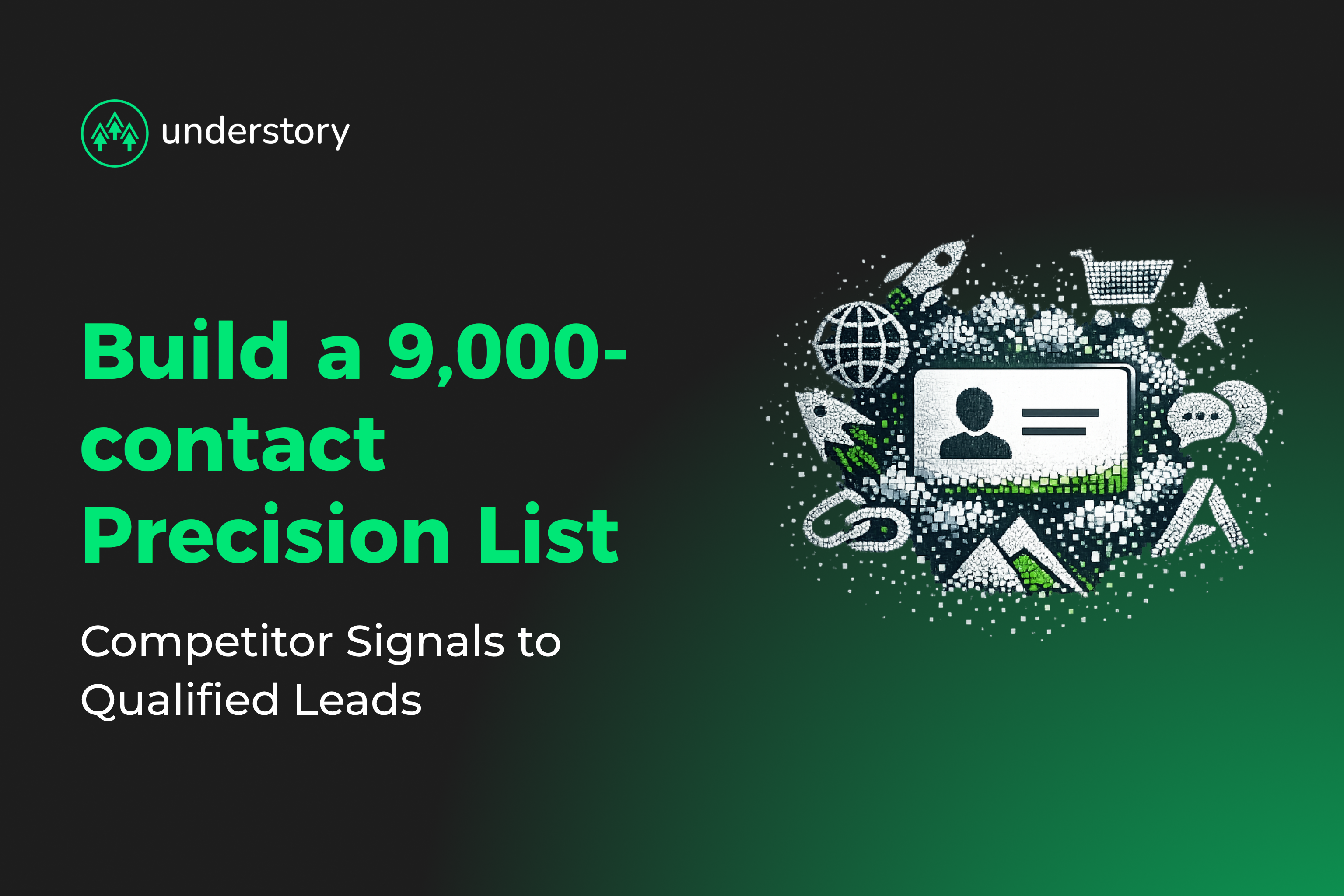
Most outbound lists start with a title filter and end with a deliverability problem. We took the opposite path on a recent client engagement: 569 demo call transcripts in, 9,000+ enriched contacts out, and every contact tied to a specific competitive signal before the first email shipped.
The mechanics were straightforward. Claude Code parsed the call recordings for competitor mentions and frustration language, mapped nine competitors by displacement opportunity, and triggered Apify to pull matching contacts at scale. Clay handled enrichment, validation, and segmentation. Campaigns launched through Instantly and HeyReach with messaging built from the language real prospects used on calls.
Below is the full workflow, the architecture decisions that mattered most, and the credit-burn traps to avoid if you try to replicate it.
Why most outbound lists fail before launch
SaaS growth teams burn budget and sender reputation running campaigns against loosely targeted lists. The gap rarely traces back to copywriting. It traces back to list quality, signal density, and whether the people receiving the email actually have the problem the product solves.
The 9,000-contact number is not the achievement. The achievement is that every one of those 9,000 contacts had a documented reason to be on the list, pulled from language a similar prospect used on a recorded sales call.
The 7-step workflow from call transcripts to campaign launch
The system was built for a SaaS founder whose team had 569 recorded demo calls sitting in a call recording platform, untouched. Every transcript contained buying signals, competitor mentions, and objection patterns going to waste.
Step 1: Competitive signal extraction
Call transcripts were piped into Claude through available connectors and API tooling. The objective was specific: identify which competitor tools appeared repeatedly, capture the exact language frustrated prospects used, and surface the objections that stalled deals.
Most teams skip this step and start list building before they understand which signals predict a buying conversation.
Step 2: Competitor displacement map
Claude analyzed all 569 calls and produced a competitor displacement map ranking nine competitors across two dimensions: how often they appeared in transcripts and the level of prospect dissatisfaction expressed in surrounding language. The output was a prioritized list of which competitors' customers were most likely to convert.
Step 3: Structured knowledge base
Every transcript, intake form, strategy session, and past campaign result was indexed into a structured knowledge base. The system auto-updates with each new call, so each campaign starts with more signal than the last.
Step 4: Automated list building via Apify and Claude Code
Claude Code connected to Apify via MCP and orchestrated contact discovery against the competitor displacement map. The system identified who to target based on the competitive intelligence, then pushed 9,000+ contacts into Clay via webhook for ICP filtering and enrichment.
Step 5: Clay enrichment, validation, and segmentation
Clay turned the raw 9,000+ contacts into something usable through validation and segmentation by firmographic signals and intent data. This is the quality gate before any contact moves to campaign execution.
Clay's waterfall enrichment model queries providers sequentially. If a match is found at any step, you pay for that lookup and subsequent providers do not run. The result is maximum coverage without paying for redundant lookups.
Step 6: Copy development from real buyer language
Outreach copy was built directly from the knowledge base, with messaging anchored in the language target prospects used when describing dissatisfaction with competitor tools. The words used on sales calls became the words used in cold outreach.
Every version synced live to Google Docs via the Google MCP so the client could review and edit in real time.
Step 7: Campaign launch and closed feedback loop
Campaigns launched through Instantly for email and HeyReach for LinkedIn. Every reply, positive, negative, or neutral, every LinkedIn response, and every booked demo call was ingested back into the knowledge base. The team re-analyzed what resonated and what did not, and the brief updated automatically for the next iteration.
Why competitor signals outperform generic intent data
A company currently running a competitor's product is already paying for a solution in your category. They do not need education on why the category matters. They need a reason to switch.
That changes the conversation. Cold outreach to someone who has never thought about your category requires a different message, different proof points, and a longer education cycle. Stacking competitor-use signals with active comparison behavior moves targeting from a guess to a high-confidence bet, which is what makes a 9,000-contact list defensible at this scale.
Operational tradeoffs to manage at scale
Building a 9,000-contact list reads cleanly on paper. The operational reality requires discipline across five fronts:
- Credit management is real: A five-provider waterfall can mean five separate lookups. For a typical outbound workflow including email waterfall, company enrichment, and qualification, reaching the sequence stage can mean roughly 8 to 15 Clay credits per lead. Enriching 9,000 contacts before filtering them to ICP fit means paying for thousands of wasted lookups.
- ICP filtering happens first: Apply firmographic and role filters as conditional gates before enrichment columns run. Only rows passing the filter proceed to enrichment.
- Test before scaling: Running enrichment across 9,000 rows without a small-batch test means bad logic does not surface until the credits are already spent.
- Email verification protects sender reputation: Excluding catch-all emails at this scale produces a smaller deliverable list, but the messages that ship actually land in primary inboxes.
- Deduplication across tables matters: Running the same domains through multiple Clay tables without a master enrichment table means paying for the same enrichment twice.
The workflow works, but only when credit burn and quality gates are controlled from the start. Skipping any one of these steps does not just hurt cost-per-lead. It compounds into list rot that takes weeks to clean up.
How the orchestration and enrichment layers split
This was not a Clay-only build. Claude Code handled top-level orchestration: transcript analysis, competitor mapping, Apify scraping calls, and webhook delivery into Clay. Clay handled what it does best, which is enrichment, validation, and segmentation of incoming records.
Trying to do everything in one tool is the most common mistake we see when teams attempt to replicate this kind of build. Orchestration logic and enrichment logic belong in separate layers because they fail differently. Orchestration breaks loudly when an API key rotates. Enrichment quality degrades silently as data sources drift. Putting both in the same table makes both failure modes invisible.
How this fits into Understory Agency's allbound model
At Understory, a build like this never sits alone. Clay workflows route enriched contacts directly into paid media targeting on LinkedIn, personalized email sequences through Instantly, LinkedIn outreach via HeyReach, and CRM enrichment back into HubSpot. Attribution closes through the same data layer rather than living in a separate reporting tool.
That coordination is what allbound execution actually looks like in practice. Four dedicated Clay specialists on the team, Clay Enterprise Partner status, and a five-phase workflow covering list creation through data sync into outreach platforms all sit inside one coordinated system instead of three siloed vendors who do not talk to each other.
Build precision outbound with Understory Agency
We run variants of this system for clients including Yofi, where we built outbound from scratch and the team paused the program because sales capacity could not keep up with qualified meetings; RemoFirst, our largest allbound engagement, which replaced its entire internal SDR team with our coordinated paid media and outbound; and Rivial Security, where we scaled paid spend from $20K to $70K monthly while holding performance.
Schedule a consultation to see what a competitor-signal outbound system looks like for your ICP.
Frequently asked questions
Was this a Clay-only workflow?
No. Claude Code handled orchestration, including transcript analysis, the competitor displacement map, Apify scraping calls, and webhook delivery into Clay. Clay handled enrichment, validation, and segmentation of the incoming records. Trying to consolidate both layers into one tool is the most common mistake teams make when replicating this build.
How were the 9,000 contacts actually generated?
Apify pulled contacts based on the competitor displacement map produced by Claude Code, then pushed them via webhook directly into Clay tables for ICP filtering and waterfall enrichment. The volume came from the displacement map ranking nine competitors, not from a single broad title filter.
How much should a build like this cost in Clay credits?
It depends on waterfall depth and ICP filter strictness, but a useful planning number is 8 to 15 credits per lead reaching the sequence stage. The biggest cost lever is filtering before enrichment, not after. Teams that enrich first and filter second consistently overpay by 3-5x.
What happens to the system once campaigns launch?
Replies, LinkedIn responses, and booked demos feed back into the structured knowledge base, which updates the brief and informs the next campaign iteration. Signal extraction improves as more sales calls are recorded and ingested, so each campaign starts with sharper targeting than the one before it.
Related Articles

Qualified pipeline, handled
Signal-based outbound that fills the funnel while your team closes.