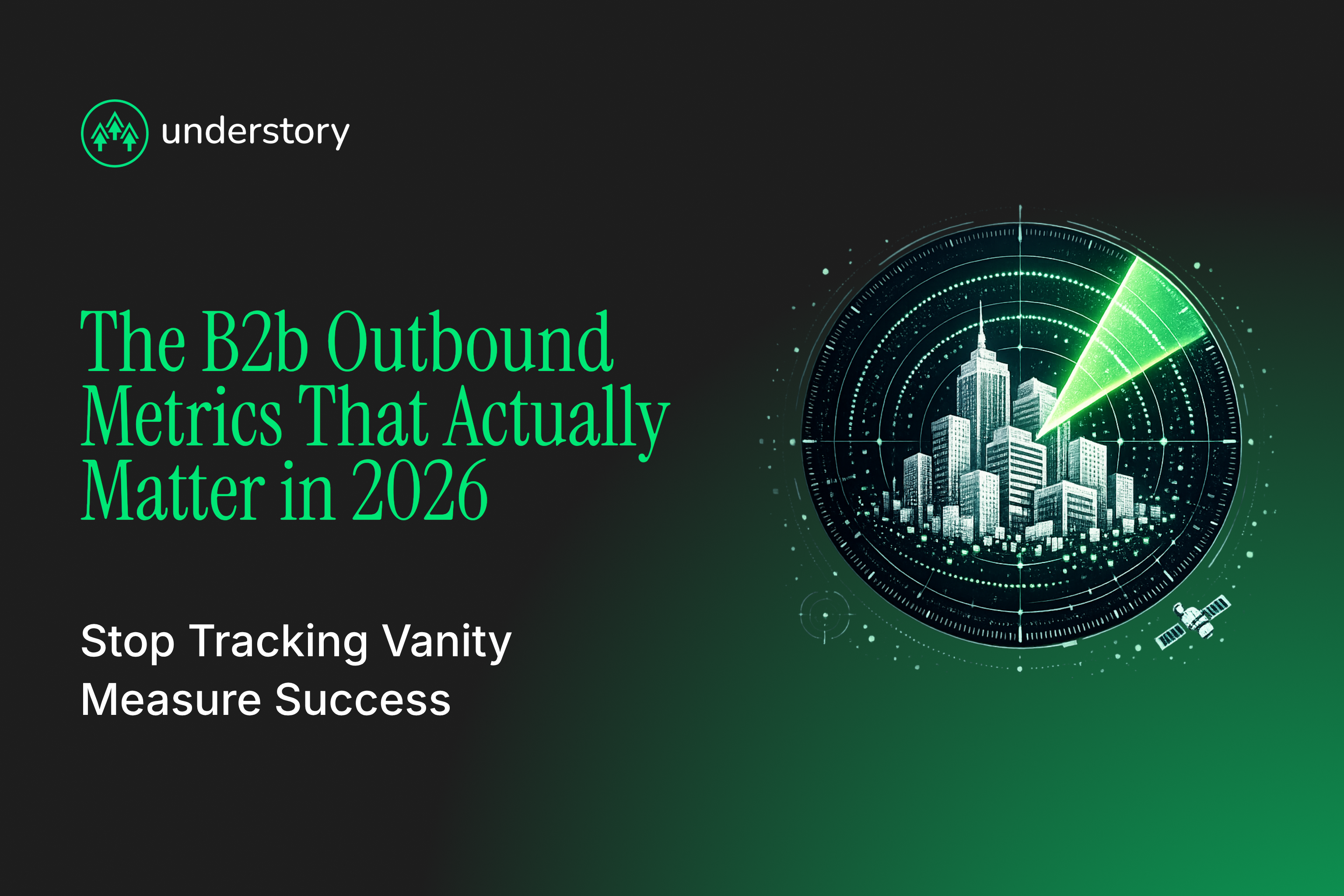
Reply rate and meetings booked do not predict pipeline. The metrics that move revenue sit further down the funnel and across channels. If you are a SaaS growth leader coordinating an SDR lead, a paid media specialist, and a creative freelancer, you already know the cost: three dashboards, three stories, and a pipeline number your CFO does not trust.
Running outbound as a targeted campaign with an influenced pipeline tied to revenue is the single measurement chain that can help solve this. The metrics that predict pipeline in 2026 sit below reply rate and meeting count, and the measurement system has to connect activity to revenue.
Why vanity B2B outbound metrics mislead growth teams
Activity tracking on its own misses impact. The following are three habits explain most of the distortion.
- Open rates measure pixels, not people. Apple Mail Privacy Protection can pre-load tracking pixels through proxy servers, whether or not a human reads the email. Gmail's image proxy and corporate security scanners like Mimecast and Proofpoint do the same thing. B2B open rates become a weak proxy for human attention. Treat them as a deliverability warning light and judge campaigns by downstream metrics.
- Raw reply count hides the mix. Total replies lump out-of-office bounces, unsubscribes, and "remove me" responses in with genuine interest. The positive subset is only a fraction of the total.
- Siloed dashboards compound the distortion. When your SDR, paid, and creative leads report up separately, each dashboard looks fine on its own. The pipeline number still does not move.
Fix these three habits, and the metrics that predict the pipeline will become visible.
The B2B outbound metrics that predict pipeline
Seven metrics predict outbound pipeline, and all of them reflect human action tied to revenue. These metrics include the following:
- Positive reply rate. The cold email positive reply rate is the subset that matters for the pipeline. The operational lesson is to measure genuine interest only. Signal-based outbound, built around a recent funding round, a recent CRO hire, or a tech-stack change, earns higher response rates than high-volume sends.
- Meeting-held rate. No-shows do not enter the pipeline. A gap between booked and held points to a qualification or confirmation problem, inflating your apparent pipeline.
- Meeting-to-qualified-opportunity conversion. The stage-gate that links outbound activity to the real pipeline.
- Pipeline coverage ratio. Total pipeline value divided by quota. Set the coverage target by segment, sales cycle, win rate, and deal complexity. Enterprise motions usually need more room for lower win rates and longer cycles.
- Outbound win rate. The terminal conversion metric that turns pipeline coverage into a revenue forecast.
- Cost per qualified meeting. Track total outbound spend across SDR compensation, tooling, data, and outsourced support. Combine this with downstream conversion to get the CAC number that your CFO actually asks about.
- Domain health and deliverability. Monitor spam complaints, bounces, inbox placement, and domain reputation. These protect everything that’s upstream.
These metrics get sharper when channels run together. A multi-channel motion gives a prospect more than one legitimate path to engage. That coordination only pays off when you're reporting credits to each channel for the revenue it influenced.
Connecting outbound metrics to influenced revenue
Last-touch CRM reporting credits the wrong channel for outbound-influenced deals. Your team sends 2,000 emails, gets 20 direct replies, and calls that the outbound result. The prospects who saw the email, visited the website three days later, and converted through a retargeting ad or branded search go uncounted. The CRM records the last identifiable touch, so outbound shows up as zero.
The gap is large because B2B buying often happens outside any clean attribution path. Outbound can create inbound behavior later. A prospect who never replies still searches your brand, hits your pricing page, and clicks a retargeting ad. Track two numbers and report both.
Sourced pipeline is where the outbound sequence is the first recorded touch. Influenced pipeline is where outbound touched the account at any point before the opportunity, even when another channel closed the loop. Reporting them separately keeps your marketing numbers honest while still showing finance that outbound carried weight.
To close the chain, your team coordinates three systems:
- An outbound sequencer that logs the initial touch.
- A de-anonymization layer that matches anonymous website visits back to outbound-targeted accounts.
- Paid retargeting seeded from the outbound list so every ad click already maps to a touched account.
Stamp the triggering signal onto the CRM record at the time of outreach, then back-fill it to the opportunity when a deal is created. Reporting is only as honest as the data feeding it, which is where enrichment comes in.
How CRM enrichment keeps outbound metrics honest
Dirty data distorts the metrics above in two directions at once. These include the following:
- Inflated activity. Invalid contacts treated as "outreached" pad your send and pipeline totals.
- Depressed conversion. Bounced emails and dead dials stay in the denominator but generate no replies, so your reply and meeting-booked rates fall mathematically.
You look busier and worse at the same time. The two distortions cancel any chance of a real read on outbound performance.
Single-source enrichment leaves coverage gaps across most target ICPs. Each record then has better odds of carrying usable contact and account data before outreach begins. Cleaner sends means your conversion denominators reflect genuine outreach.
Configure the Opportunity-Contact role fields in HubSpot or Salesforce too. That hygiene is the prerequisite for any influenced pipeline reporting that survives a CFO's scrutiny. With clean data in place, the tools that act on it can do their job.
Building a measurement system for B2B outbound metrics
How the tools connect carries more weight than which tools you pick. Handing five tools to five different specialists is how most growth teams end up with four dashboards and no answer. The chain that works links enrichment, sequencing, LinkedIn outreach, and attribution under one team.
- Clay is the orchestration layer. It runs waterfall enrichment, identifies decision-makers, scores accounts against ICP, and pushes clean records to HubSpot or Salesforce.
- Instantly handles email sequencing and deliverability monitoring. The numbers that matter here are reply rate, bounce rate, and inbox placement. Use it to test messaging and confirm the system is reaching real inboxes.
- HeyReach runs LinkedIn outreach in parallel with email. Your team's connections and replies sync back into the reporting workflow alongside Instantly data, so multi-channel lift shows up in the same view as your email numbers.
- Fibbler closes the attribution gap between outbound and paid engagement. Company-level LinkedIn Ads engagement feeds the outbound motion, your team classifies accounts by engagement tier, and signals move into Clay via webhook. For influenced pipeline, Fibbler matches CRM deal creation dates against ad touchpoints so paid engagement and outbound touches can be reviewed together.
- Looker Studio or Porter Metrics sits on top, reading from HubSpot or Salesforce so the pipeline view consolidates into one dashboard.
One calibration warning. Attribution windows vary by tool. A short default window can undercount longer B2B SaaS buying cycles. A longer lookback can overstate influence when definitions are loose. Pick your window, define your "revenue event," and document both in a shared data dictionary before any software starts counting. Two tools will otherwise report the same pipeline two different ways and the dashboard loses credibility.
Wiring these tools together is the part most growth teams do not finish on their own.
Run your B2B outbound metrics with Understory Agency
Understory owns the outbound measurement chain end to end. Your growth team stops spending its week coordinating an SDR vendor, a paid specialist, and a creative freelancer to chase down a single pipeline number. One team owns the full stack across three services:
- Outbound campaign management. Clay-powered enrichment and ICP scoring, Instantly sequencing and deliverability testing, HeyReach LinkedIn outreach.
- GTM data orchestration. Waterfall enrichment in Clay, HubSpot or Salesforce hygiene, and signal routing into the sequencer.
- Revenue attribution reporting. Fibbler maps LinkedIn Ads engagement to CRM deals, with Looker Studio or Porter Metrics dashboards reading from HubSpot or Salesforce.
When a prospect gets a cold email, visits your site, and converts through retargeting, that revenue traces back to the touch that started it. One SaaS client, RemoFirst, replaced their entire SDR team to work with us and now runs their full outbound motion through this stack.
Run your outbound measurement chain with Understory.
FAQs
What counts as a B2B outbound metric?
Anything that measures the performance of proactive outreach: reply rate, positive reply rate, meeting-booked and meeting-held rates, meeting-to-opportunity conversion, outbound win rate, pipeline coverage, cost per qualified meeting, and deliverability signals like bounce and spam complaint rates. The metrics worth tracking require deliberate human action that proxies and bots cannot fake.
How do you measure the influenced pipeline operationally?
Define influenced pipeline as any opportunity where outbound touched the account before opportunity creation, even if another channel closed it. Set an attribution window that fits your sales cycle. Roll engagement up to the Opportunity object in HubSpot or Salesforce to avoid double-counting, use a multi-touch model, and report sourced and influenced as separate, complementary numbers.
Is open rate still useful in 2026?
Treat open rate as a deliverability diagnostic. Apple MPP, Gmail's image proxy, and corporate scanners can inflate it because automated systems may fetch tracking pixels without human attention. A sudden drop can flag inbox placement or domain reputation trouble. Keep it out of rep evaluation, campaign comparison, and pipeline forecasting.
How is outbound attribution different from paid attribution?
Paid attribution can often credit a click directly. Outbound frequently creates demand that surfaces later through another channel, so last-touch CRM reporting gives outbound zero credit even when it started the journey. Capturing it requires stamping the triggering signal onto the CRM record at outreach time and tracking influenced pipeline across a defined lookback window, which is the gap Fibbler bridges between LinkedIn ad engagement and CRM deals.
Related Articles

Qualified pipeline, handled
Signal-based outbound that fills the funnel while your team closes.