SaaS growth leaders evaluating paid social agencies face a common problem: most agencies optimize for platform metrics while campaigns run disconnected from outbound sequences and CRM data. This guide covers the services, pricing models, and evaluation criteria that distinguish coordinated execution from siloed paid media management.
Core services that drive SaaS pipeline
Generic social media agencies manage campaigns in isolation, creating disconnected prospect experiences that undermine technical SaaS positioning. While a great agency coordinates paid social campaigns with outbound sequences and creative development through integrated multi-touch attribution.
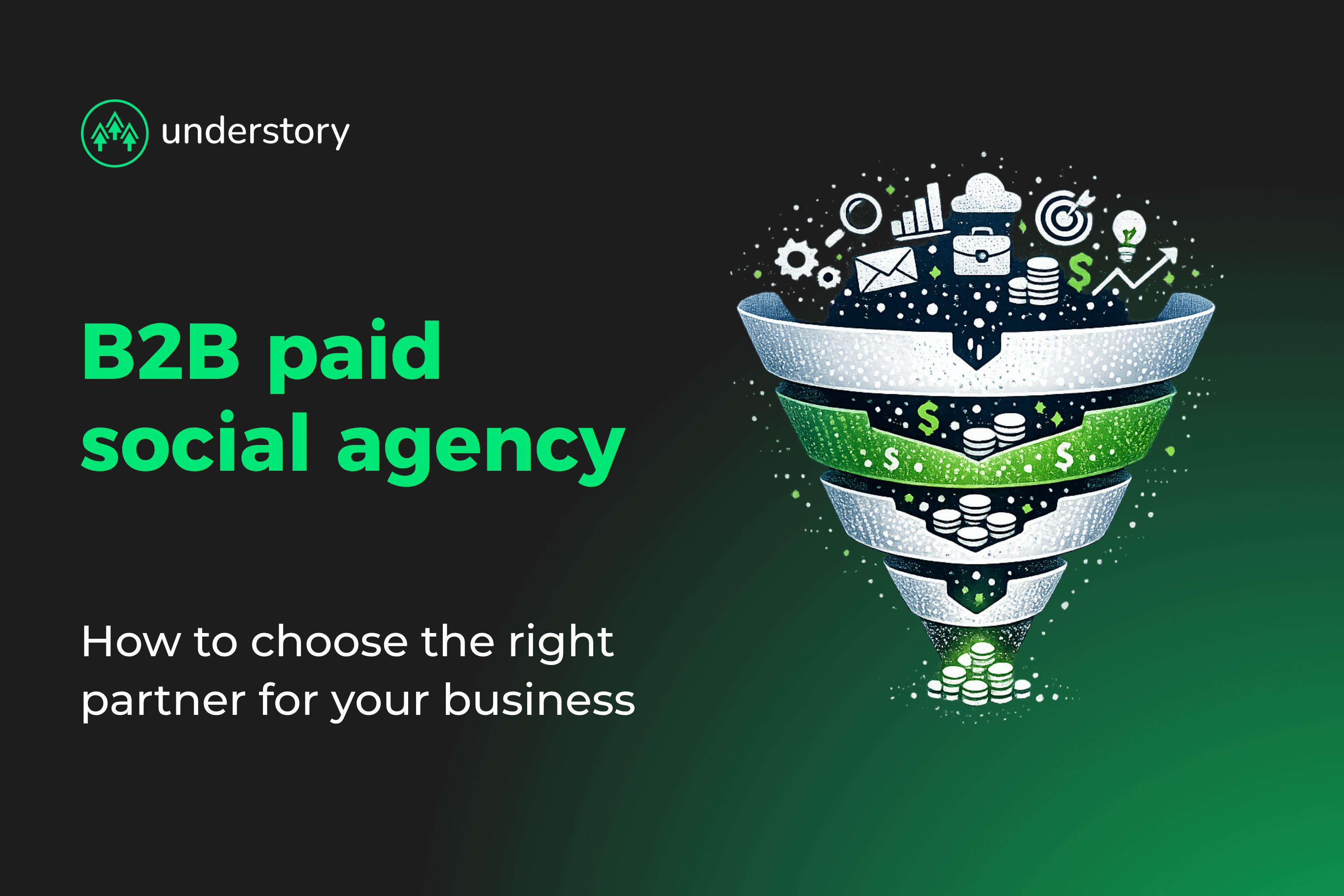
Full-funnel campaign architecture
LinkedIn dominates B2B paid social. We structure campaigns across distinct funnel stages with messaging coordinated to outbound sequences and website positioning:
- Top of funnel: Awareness campaigns reducing wasted spend through precise targeting
- Middle of funnel: Engagement campaigns delivering proof-of-value content aligned with outbound education sequences
- Bottom of funnel: Direct offer campaigns optimized for lead quality, coordinated with sales-ready outbound touches
Great agencies deploy single image ads, conversation ads, carousel ads, lead gen forms, and thought leader content. Each matches specific funnel stages and buyer personas while maintaining consistent positioning across outbound and website experiences.
Creative development happens simultaneously across all three funnel stages. Prospects receive consistent positioning whether they encounter paid ads, outbound sequences, or website content.
Account-based marketing integrated with outbound
For SaaS companies with $20K-$100K ACVs, individual accounts represent significant revenue potential. Great agencies should coordinate ABM campaigns with personalized outbound sequences targeting the same accounts:
- Uploading and targeting specific account lists across paid and outbound channels
- Segmenting buyer committees with different messaging for CFOs versus technical decision-makers
- Using matched audiences for retargeting prospects who engaged with outbound sequences
- Implementing lookalike modeling from highest-value customers
This integration ensures prospects see consistent messaging across every touchpoint.
Multi-touch attribution connecting spend to revenue
Custom dashboards integrate all channels with CRM data, tracking how paid social touchpoints contribute to the pipeline alongside outbound sequences and website conversions.
B2B buyers interact with multiple marketing touchpoints across multiple channels before converting. Single-touch attribution models cannot capture true campaign impact across this complexity.
Great agencies provide:
- Multi-touch attribution modeling assigning credit across the entire buyer journey
- Direct CRM integration for closed-loop reporting from ad click to closed-won revenue
- Pipeline-focused dashboards tracking cost-per-opportunity and cost-per-SQL
- Marketing-sourced versus marketing-influenced pipeline distinction
If an agency cannot explain how they connect ad spend to revenue, they lack the infrastructure for SaaS campaign optimization.
Creative development with systematic testing
B2B SaaS audiences are smaller than consumer markets, making creative fatigue hit faster. Good paid social agencies provide:
- Persona-specific creative variants for different buyer committee members
- Funnel stage-aligned messaging coordinated across paid and outbound channels
- A/B testing with documented hypotheses and statistical rigor
- Frequent creative refreshes based on performance data
Creative development coordinates with campaign strategy from the start, ensuring consistent positioning across every touchpoint.
Pricing: market rates and transparent models
Based on our work with SaaS growth leaders, here's what coordinated paid social execution tends to cost.
Monthly retainer models
Most SaaS-focused agencies charge monthly retainers scaling with service complexity:
- $5,000-$8,000/month: Basic campaign management on 1-2 platforms; campaign setup, ad copywriting, bid management, A/B testing, monthly performance reviews
- $8,000-$15,000/month: Advanced targeting, CRM integration, dedicated account manager, 2-3 platforms with coordinated messaging, bi-weekly or weekly reporting
- $15,000-$20,000+/month: Full attribution modeling, ABM capabilities, executive-level partnership, advanced pipeline influence tracking, quarterly business reviews
Every engagement should include custom dashboarding integrating all channels with CRM data, hypothesis-driven creative testing, and down-funnel reporting connecting ad spend to pipeline.
Why percentage-of-spend creates misaligned incentives
Some agencies charge 15-20% of total ad spend instead of fixed retainers. This creates misaligned incentives: agencies profit more when they spend more of your budget, regardless of efficiency. For SaaS companies focused on optimizing CAC, fixed retainers align agency incentives with efficiency improvements rather than budget expansion.
Minimum investment thresholds
Operational realities set practical floors:
- Minimum total monthly investment: $10,000-$20,000 (agency fees plus ad spend)
- Minimum ad spend alone: $5,000-$8,000/month
- Below these thresholds, in-house management often makes more sense
Evaluation criteria: separating coordinated execution from siloed specialists
Discovery conversations reveal more than any case study.
SaaS unit economics fluency
Qualified agencies discuss customer acquisition cost and CAC payback periods, LTV:CAC ratios and how paid social influences them, and how campaign optimization changes when payback extends 12+ months.
Red flag: Agencies that avoid unit economics discussions or cannot explain how their campaigns impact CAC efficiency lack foundational SaaS knowledge.
At Understory, we frame campaign optimization around unit economics. SaaS growth leaders tell us this immediately distinguishes our approach from generic performance marketers who optimize for platform metrics disconnected from business outcomes.
Multi-stakeholder journey understanding
Ask these questions:
- "Walk me through how you've managed campaigns for products with 6-12 month sales cycles involving multiple stakeholders."
- "How do you differentiate targeting and messaging for economic buyers versus technical evaluators versus end users?"
- "What metrics do you track beyond MQLs to measure progression through a complex buying journey?"
Red flag: Agencies that default to single-funnel thinking or cannot articulate engagement measurement across multiple decision-makers.
Our allbound methodology specifically addresses this coordination challenge by synchronizing paid media with targeted outbound engagement serving each stakeholder role.
Attribution infrastructure depth
Ask to see sample reporting dashboards. Look for cost-per-opportunity, MQL-to-SQL conversion rates as quality indicators, pipeline velocity metrics, and channel-specific CAC.
Red flag: Heavy emphasis on impressions, clicks, or engagement without connection to pipeline.
Agencies showing only platform-level metrics cannot connect your investment to revenue outcomes. Our custom dashboards provide exactly this transparency by integrating all channels with CRM data.
Sales-marketing alignment process
B2B SaaS marketing requires tight coordination with sales teams. Assess whether the agency proposes regular strategy sessions with sales leadership, aligned definitions of MQL, SQL, and opportunity stages, processes for incorporating sales feedback on lead quality, and regular analysis of which marketing touchpoints contribute to closed-won deals.
Red flag: Agencies that resist sales collaboration or want minimal client involvement in strategic decisions.
We include sales alignment as standard practice because coordinated execution requires understanding what sales needs from marketing-generated opportunities.
Coordinate your paid social with Understory Agency
At Understory, we manage campaigns across LinkedIn, Google, Meta, Reddit, Quora, and Capterra. Pricing is transparent. Every engagement includes custom dashboarding integrating all channels with CRM data, hypothesis-driven creative testing, and down-funnel reporting connecting ad spend to pipeline.
Book an intro call to discuss how coordinated paid social and outbound execution can accelerate your SaaS growth.
Related Articles

Get your paid media back on track
More budget should mean more pipeline. Let us look at where yours is leaking.